Is Hammurabi’s code just “an eye for an eye”?
No. Most of its 282 laws cover marriage, trade, medicine and building, and even “an eye for an eye” became a fine if the victim was of lower rank.
282laws
“An eye for an eye, a tooth for a tooth.” Hear those words and many people think of the Code of Hammurabi. Along with that comes a vague image of a harsh law of revenge: if someone hurts you, hurt them back just as much.
Yet the code is not mostly about revenge. The bulk of it is made up of surprisingly down-to-earth, detailed rules for everyday life.
A black stone over 2 meters tall
Hammurabi was the sixth king of the First Dynasty of Babylon in ancient Mesopotamia, roughly present-day Iraq, and is thought to have reigned from about 1792 to 1750 BC. The code was compiled toward the end of his reign, in the 1750s BC.
The best-known copy is a basalt stele 2.25 meters (7 feet 4 inches) tall. At the top, Hammurabi is carved standing before Shamash, the sun god and god of justice, and below the scene the text is packed in cuneiform script.
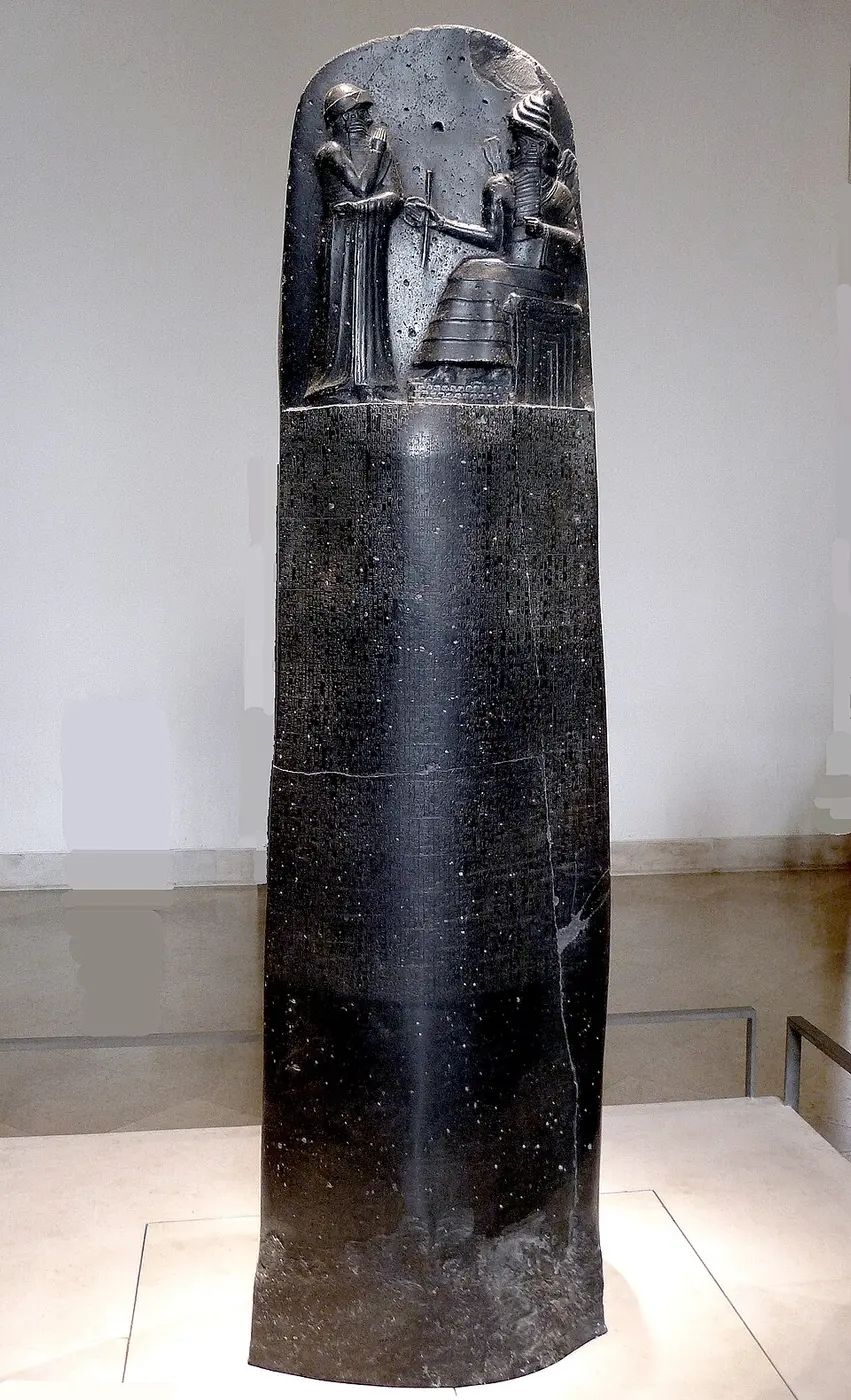

The stele was not found in Babylon. A French archaeological mission dug it up in 1901–1902 at the ancient city of Susa, in present-day Iran. Some 600 years after it was made, the army of neighboring Elam had carried it off from Babylonia as war booty. Today it is on display in the Louvre.
Not the same eye for everyone
Modern scholars have numbered the laws on the stele, arriving at 282. The famous “eye for an eye” is law 196:
If an awīlu should blind the eye of another awīlu, they shall blind his eye.
An awīlu was a free man of the upper class. Read on, and it becomes clear that the penalty depended on the victim’s rank. Blinding the eye of a commoner cost 60 shekels of silver. Blinding a slave’s eye cost half the slave’s value. Teeth worked the same way: knock out the tooth of an equal and lose your own, but knock out a commoner’s tooth and pay in silver. The same injury could bring very different punishments depending on who the victim was.
At the same time, “an eye for an eye” is often explained as a limit: you may not take more than you lost. Rather than a call for revenge, it set a ceiling on how severe a punishment could be.
Doctors, builders and tavern keepers
Look through the 282 laws and you will find plenty that have nothing to do with revenge.
Take doctors. A surgeon who cured an upper-class patient with an operation earned 10 shekels of silver, but one whose operation killed the patient would have his hand cut off. As for builders, if a house collapsed and killed its owner, the builder was put to death; if it killed the owner’s son, the builder’s son was put to death. Other laws dealt with the price of drinks in taverns, loans and interest, renting land, marriage and divorce, adoption, inheritance, and the wages of craftsmen and farmhands. Almost every corner of daily life is covered.


The stele ends in Hammurabi’s own words. He set it up, he says, so that the strong might not oppress the weak, and to protect orphans and widows. Anyone with a case at law should come before the stele, read its words and learn where they stand.
Not the oldest law code
The Code of Hammurabi is sometimes called the world’s oldest law code, but older ones have been found. One is the Code of Ur-Nammu, drawn up some 300 years earlier under King Ur-Nammu, founder of the Third Dynasty of Ur. Interestingly, it punished many injuries with fines: injuring someone’s eye, for example, cost half a mina, or 30 shekels, of silver.
Scholars also disagree about how far Hammurabi’s code was actually applied in court. No surviving court record from the period explicitly cites it.