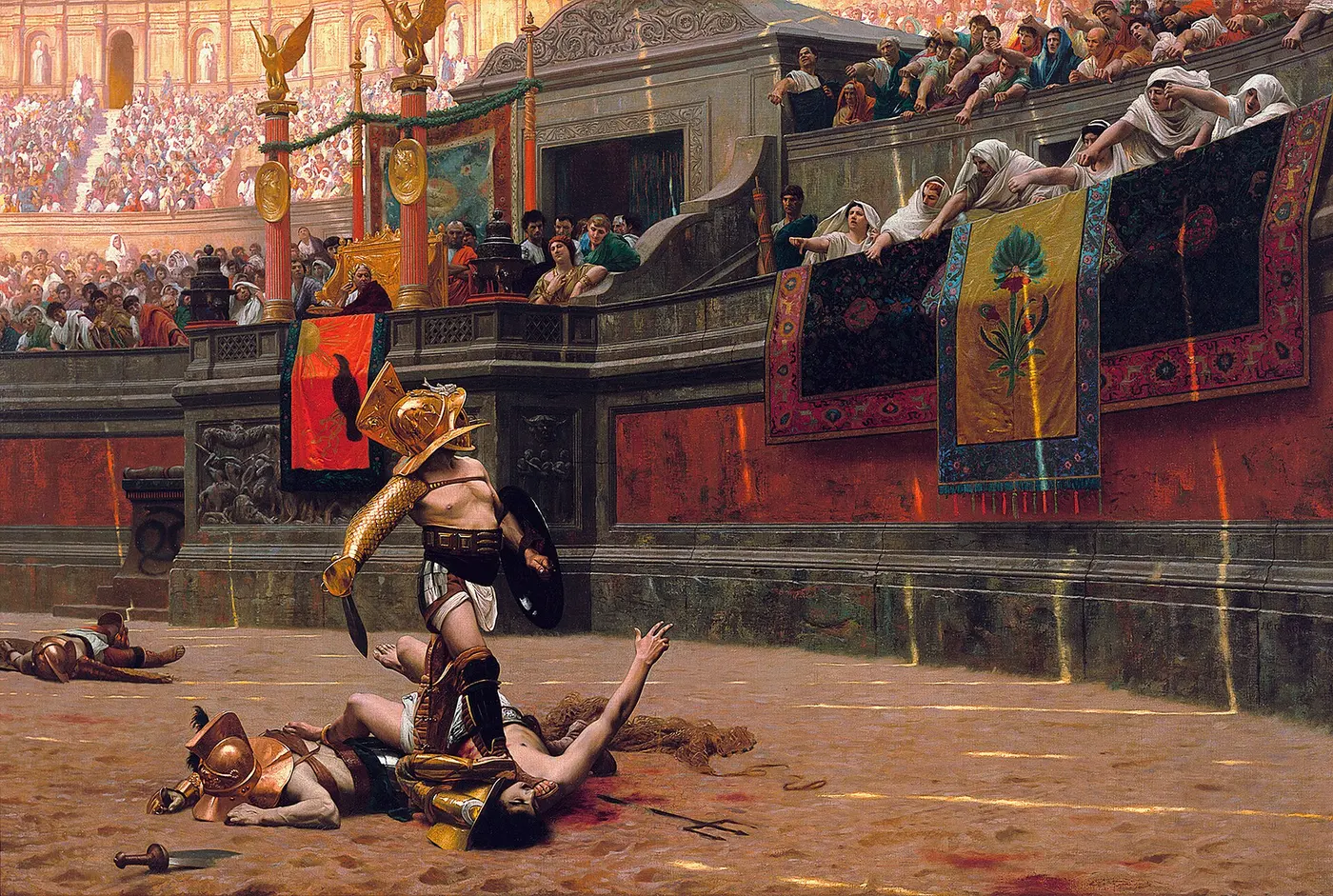
Did gladiators really fight to the death?
Not always. There were referees and a way to surrender, and in the 1st century AD only about one fight in five ended with the loser’s death.
20%
A gladiator lies sprawled on the sand. In the stands, thumbs turn downward, and the victor moves in for the kill. That is the image of Roman gladiators we know from films and novels, and it leaves the impression that every bout was a fight to the death staged for a bloodthirsty crowd.
Look at the surviving records, and at the gladiators’ own skeletons, and a rather different picture emerges.
Referees and surrender
Gladiator fights were not free-for-alls. According to Alfonso Manas, a researcher at the University of California, Berkeley, who has studied gladiators extensively, bouts were overseen by a referee called the summa rudis, who enforced the rules and could stop a fight when one man was about to be killed. A gladiator in trouble could surrender by dropping his shield and raising his index finger.
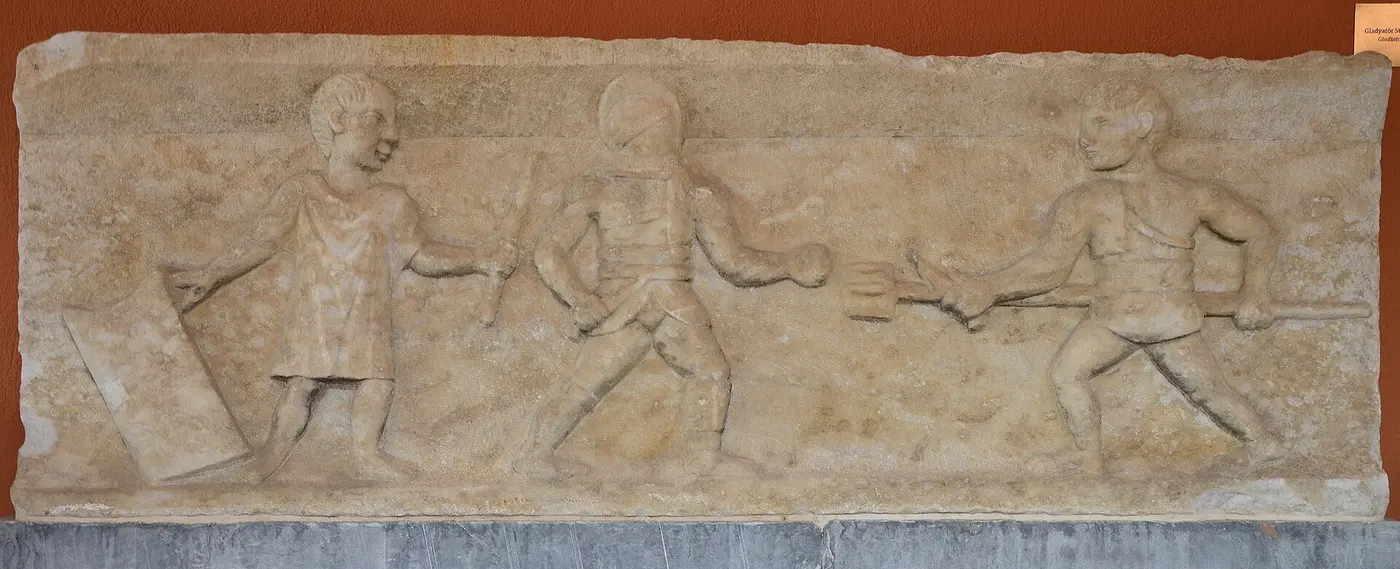
Whether a beaten gladiator lived was up to the person who put on the games. Being spared and allowed to leave the arena was called missio. Fights could also end in a draw with both men still on their feet. A medallion from the late 2nd or early 3rd century AD, now in the archaeological museum in Nîmes in southern France, shows two gladiators along with the words stantes missi, “released standing.”

One fight in five
That is not to say nobody died. Manas says studies of fight results painted on the walls of Pompeii show that in the 1st century AD, one fight in five ended with the death of the loser. Estimates vary among researchers, but either way, in most fights the loser walked out of the arena alive. By the 3rd century, a growing taste for cruelty seems to have pushed the rate up to one fight in two.
One reason gladiators’ lives were not thrown away lightly was money. Virginia Campbell, a lecturer in classical studies at The Open University in Britain, explains that people staging games sometimes rented gladiators from their owners. If a gladiator came back badly injured, or did not come back at all, the rental could be converted into a sale, at a price as much as 50 times the original fee. A well-trained gladiator was a valuable asset.
What the bones reveal
Some of the best evidence about real gladiators comes from a cemetery of the 2nd and 3rd centuries AD discovered in 1993 at Ephesus, an ancient city in western Turkey. Researchers from the Medical University of Vienna and other institutions examined the remains closely.
Their 2006 report found at least 68 people buried there. Apart from one woman and one middle-aged man, all were men aged 20 to 30. Eleven skulls carried a total of 16 head wounds that had healed well, which suggests that some gladiators were patched up after serious injuries and recovered. Ten individuals had one wound each that seemed to have been inflicted around the time of death, and no one had several fatal wounds. The researchers said this fits written accounts of strict rules in the arena.
In 2014, the same team analyzed the chemistry of the bones. The gladiators’ staple foods were grains such as wheat and barley, with no major difference from the diet of other local people. Their bones did, however, contain markedly higher levels of strontium. The researchers cautiously suggested a reason: a drink made of plant ash, which the Roman writer Pliny the Elder said gladiators took.
The mystery of the thumb
What about the famous thumbs-down? The Roman poet Juvenal and others describe crowds demanding a defeated gladiator’s death pollice verso, “with a turned thumb.” But they never say which way the thumb was turned, so nobody knows exactly what the gesture looked like.
The classicist Anthony Corbeill argues that a thumb pressed down on top of a closed fist meant mercy, while a thumb thrust out meant death. The idea that thumbs-down meant “kill him” is said to have been popularized by a painting made in 1872 by the French artist Jean-Léon Gérôme.