Did Hachiko really wait for his master at Shibuya Station?
Yes. After his owner, Professor Hidesaburo Ueno, died, Hachi kept going to Shibuya Station for years. But the story that he saw Ueno off at the station every day is doubtful.
The bronze statue of Hachiko outside Shibuya Station in Tokyo is one of the city’s best-known meeting spots. The story of the Akita dog who kept waiting at the station for his dead master has been made into films not only in Japan but also in the United States and China.
Not every part of the familiar story, however, holds up against the records. Which parts are true, and which were added later?
Barely a year together
Hachi was born in November 1923 in Odate, in Akita Prefecture in northern Japan. According to the University of Tokyo, he was sent to Tokyo by rail as a parcel when he was about 50 days old, and in January 1924 he joined the household of Hidesaburo Ueno, a professor in the agriculture faculty of Tokyo Imperial University. Ueno founded the field of agricultural engineering in Japan, the study of laying out farmland, irrigation and drainage, and he adored dogs.
On May 21, 1925, Ueno died suddenly at the university. Hachi had been with him for only about a year and four months. Ueno’s partner, Yae, could not inherit the house and could no longer keep a large dog. After being passed between several homes, Hachi was taken in by a gardener who had been indebted to Ueno. From then on, he went to Shibuya Station morning and evening.
Did he really see Ueno off every day?
In the familiar story, Hachi walked Ueno to Shibuya Station every morning and went back to meet him every evening. That is how a 1934 ethics textbook for second graders told it.
Takashi Tamura, an associate professor at the University of Tokyo, has questioned this. At the time, the agriculture faculty stood near today’s Komaba campus, and Ueno’s house lay between the campus and Shibuya Station, about a 10-minute walk from work. He had no reason to head for a station in the opposite direction. Ueno seems to have walked to work, with Hachi seeing him off and meeting him at the campus gate. According to a history compiled by Shibuya Station in 1958, Ueno took the train only for trips such as visits to an agricultural experiment station.
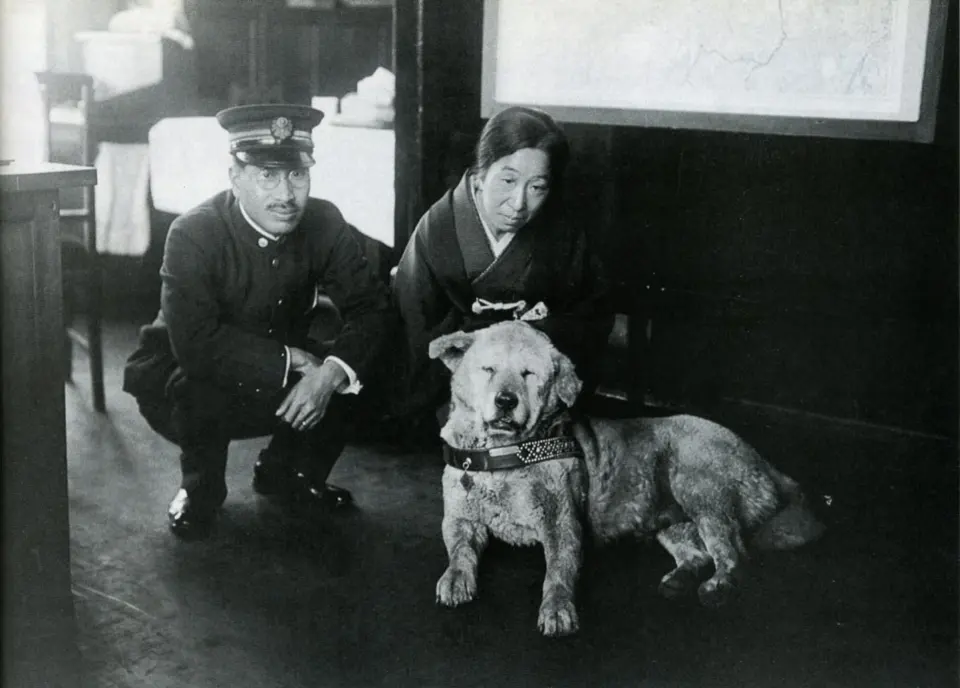

Ueno may well have taken Hachi to Shibuya Station at times. But Tamura suspects that the daily station routine was worked out backward from the sight of Hachi waiting there after his master’s death.
Famous overnight
The man who made Hachi famous was Hirokichi Saito, a researcher who campaigned to preserve Japan’s native dog breeds, including the Akita. When he learned of the old dog who kept coming to Shibuya Station, he wrote to the Asahi newspaper.
On October 4, 1932, the Tokyo Asahi Shimbun ran a story titled “The Tale of a Beloved Old Dog,” reporting that Hachi was still waiting at the station for a master who would never return. Hachi became a national celebrity. On April 21, 1934, a bronze statue by the sculptor Teru Ando was unveiled in front of the station, with Hachi himself in attendance.
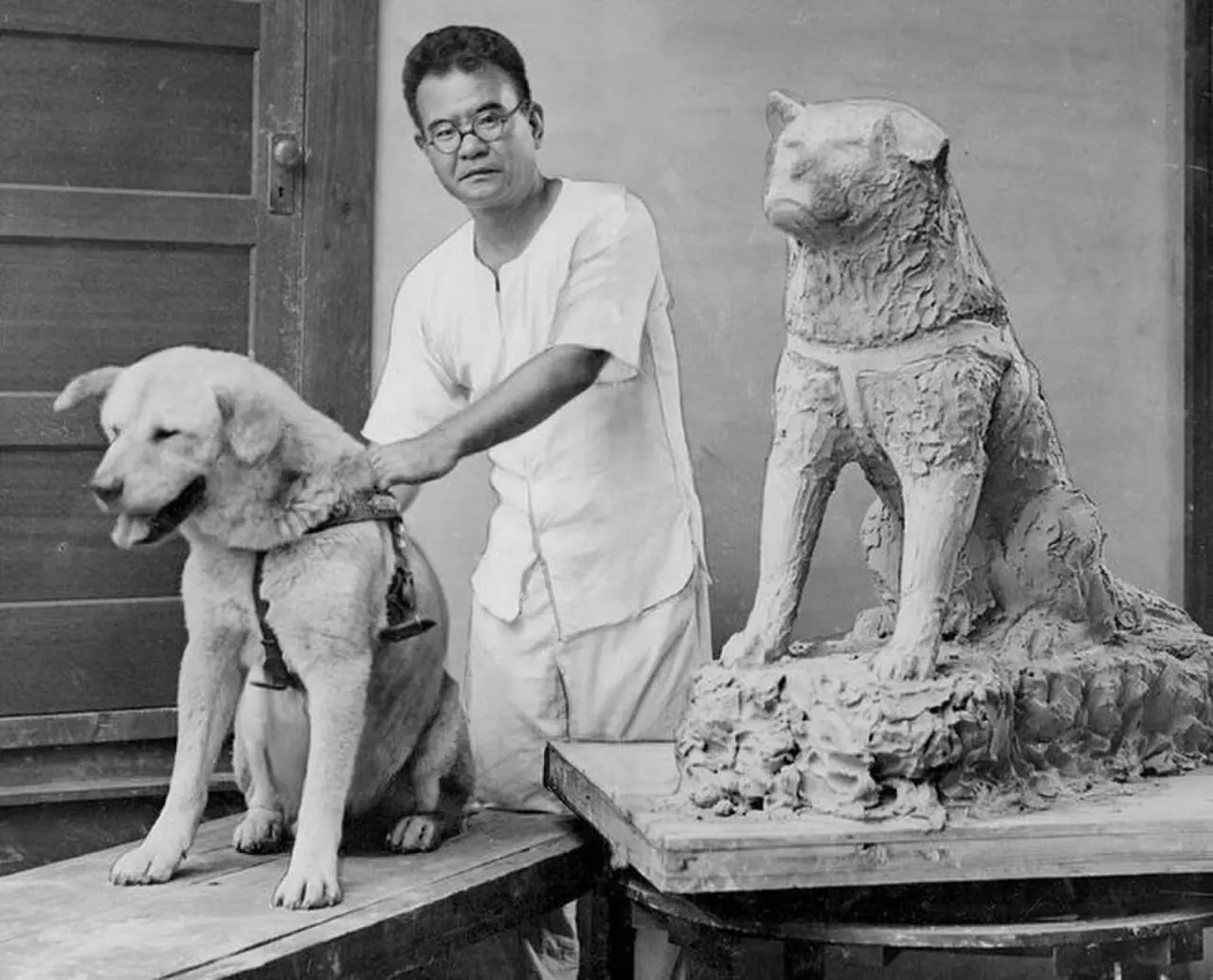

Hachi was found dead near Shibuya Station in the early hours of March 8, 1935, at the age of 11. Roughly ten years had passed since Ueno’s death. Shibuya’s public library, however, says Hachi waited at the station for “seven years.” Whether you count the time he spent in homes away from Shibuya seems to be the difference.
Was he just there for the yakitori?
One theory holds that Hachi went to the station for the yakitori, skewers of grilled chicken, handed out by food stalls. There is some evidence for this. Hachi’s body was examined at Tokyo Imperial University on the day he died, and the record notes four bamboo skewers, each about 5 cm (2 inches) long, in his stomach. Masaru Mizoguchi, a professor at the University of Tokyo, once spoke with an 86-year-old woman who had petted Hachi as a child. Every day, she recalled, she asked her father how Hachi was doing, and he would answer, “He was at the yakitori stall again today.” It seems safe to say Hachi was getting treats.
But loving yakitori and waiting for his master are not mutually exclusive. Saito wrote that he did not believe Hachi felt anything like a sense of duty or gratitude. What he had was simple, unconditional love for the master who had cherished him, and he stayed at Shibuya Station because he wanted to see the professor again.