Did an elephant once walk from Nagasaki to Edo?
Yes. A male elephant shipped from Vietnam to Nagasaki in 1728 walked about 1,400 km (870 miles) to Edo, present-day Tokyo, the following year, a journey of more than 70 days.
~1,400km
In the middle of the Edo period (1603–1868), an elephant walked the highways of Japan from Nagasaki, in the far southwest, all the way to Edo, today’s Tokyo. Most people then knew elephants only from Buddhist paintings, notes an explainer from Hiroshima Castle, so wherever the animal went, commotion followed.
A famous story even says the elephant was granted a court rank so it could appear before the emperor in Kyoto. How much of the tale holds up?
The shogun’s elephant
On the 13th day of the sixth month of 1728, by the old Japanese calendar, a ship belonging to the Chinese merchant Zheng Dawei arrived in Nagasaki carrying two elephants, a male and a female. They came from Quảng Nam in what is now Vietnam, and were accompanied by two handlers and two interpreters. The eighth shogun, Tokugawa Yoshimune, who was keenly interested in foreign learning, is said to have asked for them himself.
According to the Edo Meisho Zue, an illustrated guide to Edo published in the 1830s, the male was seven years old and the female five. The female died in Nagasaki that autumn. The male spent the winter there, and on the 13th day of the third month of 1729 set off for Edo.
A 1,400-kilometer walk
The route covered some 354 ri, or about 1,400 km (870 miles). The elephant crossed Kyushu, was ferried over the strait to Honshu, headed east along the San’yōdō highway to Kyoto, and then went on by the Tōkaidō and other roads to Edo.
The domains along the way received detailed instructions in advance. According to records of the Hagi domain held by the Yamaguchi Prefectural Archives, the shogunate told them that there must be no noise along the elephant’s route, though quiet watching was allowed; that bamboo leaves and greens should be ready, since it ate about 300 kin, or 180 kg (400 lb), of greens a day; and that its drinking water must be clean. It was 7 shaku (about 2.1 m, or 7 feet) tall and measured 1 jō 1 shaku (about 3.3 m, or 11 feet) from head to tail. It was to rest in a large stable, and because it slept as horses and cattle do, straw had to be laid down for it.
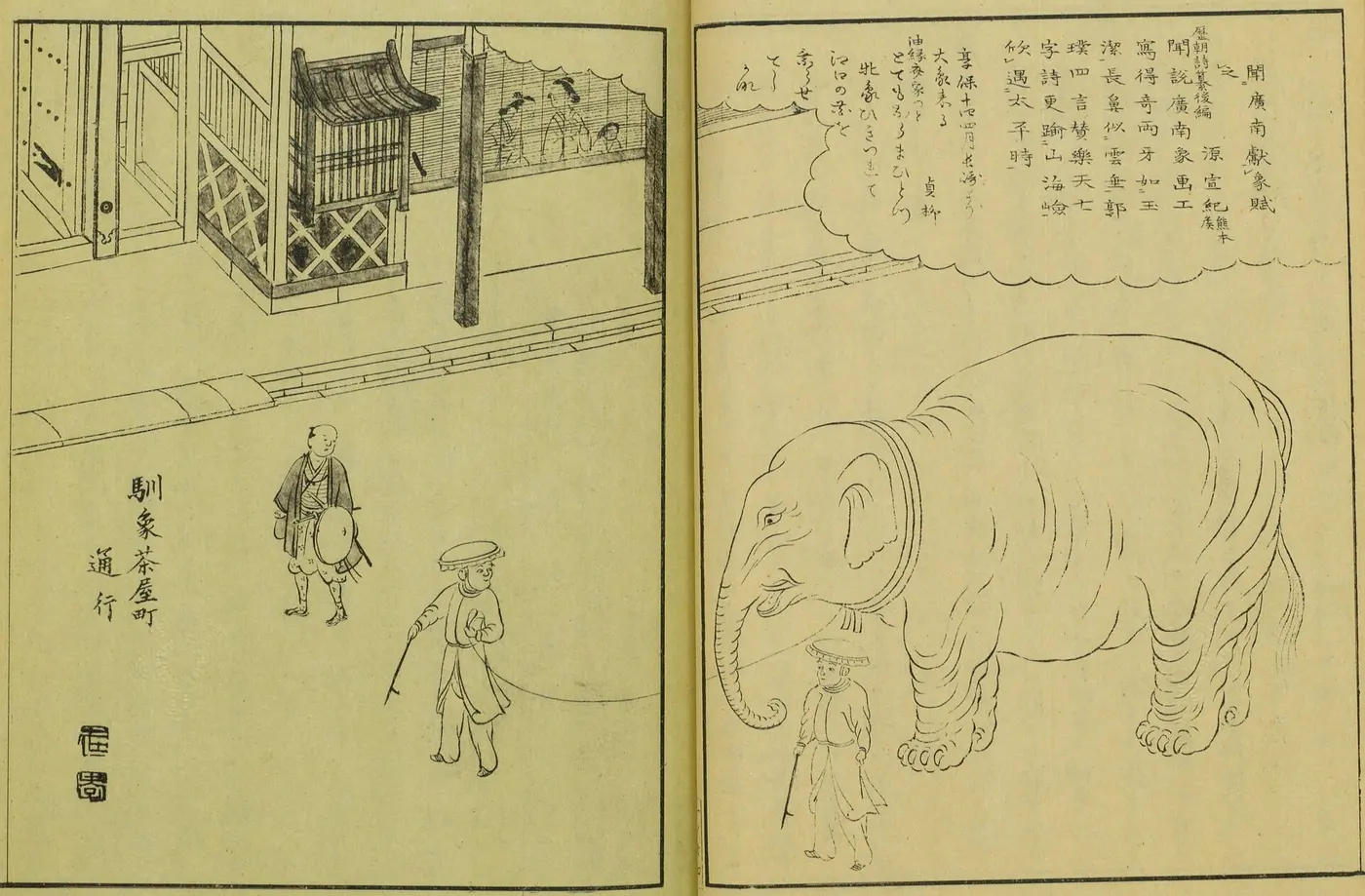

The Tokuyama domain told its people to keep cows, horses, dogs and cats out of the elephant’s sight and to watch only from indoors through bamboo blinds. Near Ogōri, in today’s Yamaguchi City, the elephant hurt its foot, and the schedule had to be reworked. According to the Edo Meisho Zue, its daily rations included not only grass and bamboo leaves but also 50 plain buns without bean paste and 50 bitter oranges.
A rank to meet the emperor?
On the 26th day of the fourth month, the elephant entered Kyoto, and two days later it was brought before Emperor Nakamikado at the imperial palace. Poems were even composed at court on the subject of the elephant.
This is where the rank comes in. According to the Edo Meisho Zue, since there was no precedent for anyone without rank entering the palace, the animal was granted the Junior Fourth Rank and called “Kōnan Jushii Hakuzō,” the White Elephant of the Junior Fourth Rank from Quảng Nam.
But that book appeared more than a century after the elephant’s visit, and it tells the story only as something “that is said.” The same passage also claims the elephant was kept in Nakano for more than 20 years and died around 1748–51, which does not match other records. The rank story is widely repeated, but whether it really happened is uncertain.
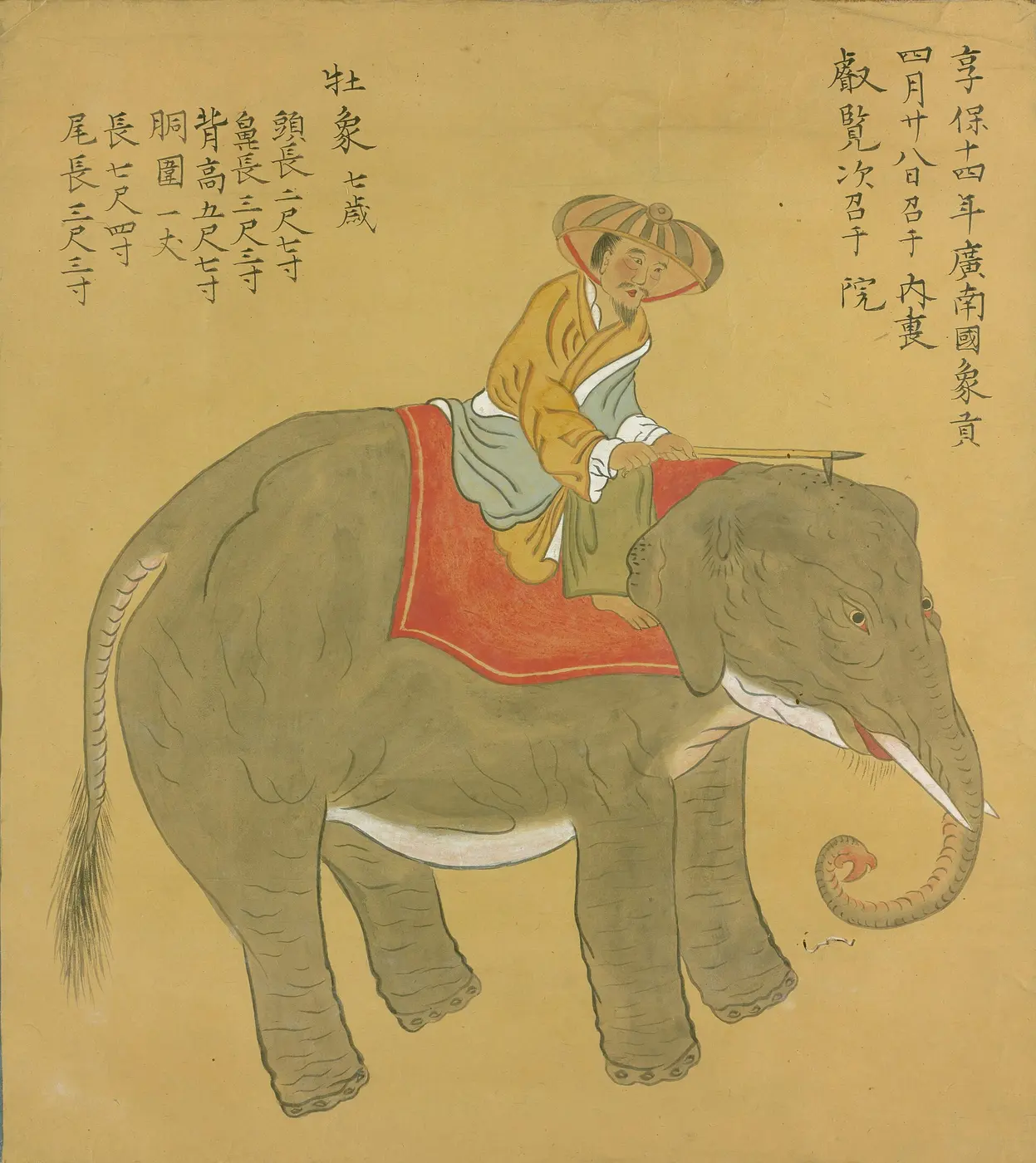

Elephant fever in Edo, and after
The elephant reached Edo on the 25th day of the fifth month, and two days later Yoshimune saw it at Edo Castle. The city went wild, buying elephant prints, board games and dolls.
The elephant was then kept at Hama Goten, a shogunal villa that is now Hama-rikyu Gardens. But partly for financial reasons, in 1741 it was handed over to Gensuke, a farmer in Nakano village. According to the director of the Nakano City Museum of History and Folklore, the elephant shed is said to have stood near what is now Asahigaoka Park, and crowds came from Edo to see the animal. Its dung was even sold as a medicine called zōhora, said to work against measles and smallpox.
The elephant died in the 12th month of the second year of Kanpō, at the turn of 1742 and 1743, some 14 years after it had landed in Nagasaki. Even then its skull, tusks and trunk skin went on show, and the Edo Meisho Zue says its bones were kept at Hōsenji temple in Nakano.