Why is glass transparent?
Its electrons can’t absorb the energy of visible light, and it has no grain boundaries to scatter light, so light passes straight through.
We look through windows at the view outside and check how much is left in a glass without picking it up. Every day we rely on glass being see-through without giving it a second thought.
When you think about it, though, it’s strange. Most window glass and bottles are made of “soda-lime glass,” which is silicon dioxide, or silica, with oxides of sodium and calcium added. Stone and pottery are also hard materials made largely of oxygen and silicon, yet you can’t see through them. Glass is transparent because it meets two conditions at once: it doesn’t absorb visible light, and it doesn’t scatter it.
Electrons that can’t take the light
Light carries its energy in tiny packets, and the size of each packet depends on the wavelength: the shorter the wavelength, the more energy. Visible light spans wavelengths of roughly 400 to 700 nanometers, and blue light carries more energy than red, while ultraviolet carries more still.
A material absorbs light when one of its electrons takes in that energy and jumps to a higher energy state. But the size of the jump an electron can make is fixed for each material. If the light’s energy falls short of that step, the electron simply can’t take it.
In glass, the electrons need far more energy to jump than visible light can provide. So light of every color, from red to violet, passes through without being absorbed. Ultraviolet light, with its bigger packets of energy, is absorbed. Window glass blocks almost all UV-B, the ultraviolet band from 280 to 315 nanometers that has the greater effect on living things, but it lets through the longer-wavelength UV-A. Some long-wavelength infrared is absorbed too, its energy used up in shaking the bonds between the atoms in the glass.
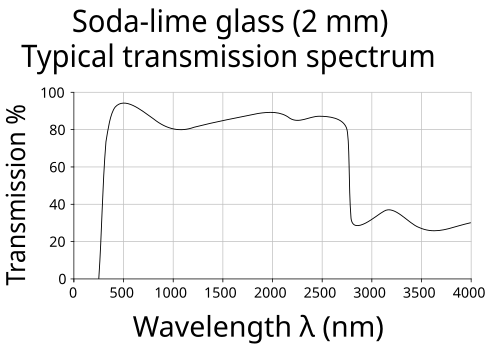

No grain boundaries, no scattering
A material that doesn’t absorb light isn’t necessarily transparent. Every time light hits a boundary between substances with different refractive indexes, part of it is reflected and the rest changes direction. In ceramics, which are made of countless tiny crystal grains, light is scattered in all directions at the boundaries between grains, so you can’t see through them.
Inside glass, the atoms froze in place in a disorderly arrangement, without forming crystal grains or the boundaries between them. On the scale of a wavelength of light, it is uniform throughout. That lets light travel straight on without being scattered.
Create lots of boundaries, on the other hand, and glass turns white. Clear glass ground into tiny pieces looks whitish, and frosted glass, whose surface has been roughened by sandblasting or etching with chemicals, scatters light and blurs whatever is behind it. Wet frosted glass becomes a little more see-through because water fills the tiny pits, and the difference in refractive index between glass and water is smaller than between glass and air, so less light is scattered.
Some light bounces off the surface
Even so, glass doesn’t let all light through. At the surface, where air meets glass, part of the light is reflected. Ordinary window glass has a refractive index of about 1.5, which means about 4 percent of light striking it head-on bounces back at each surface. That is why, at night, you can see your reflection in the window of a brightly lit room: with the outside dark, the reflected light is what stands out.

Why the edges look green
Look at a windowpane head-on and it seems perfectly clear, but look at a cut edge and it is green. The color comes from tiny amounts of iron, present as an impurity in the raw materials.
Some of the iron in glass gently absorbs light from the infrared into the red end of the visible spectrum, giving iron-bearing glass a faint blue-green tint. Looking straight through a pane, light passes through only a few millimeters of glass, too little for the color to show. Through the edge, it travels the full width of the sheet, the absorption adds up, and the color becomes obvious. Where true color matters, manufacturers also make high-transmission glass with reduced iron.