Why do frogs close their eyes when they swallow?
They pull their eyeballs down into the mouth, where the eyes help push the prey toward the throat.
Watch a frog eat an insect closely and you will notice a strange moment. After its tongue flicks the insect into its mouth, the frog squeezes its eyes shut, sinks its head a little and gulps.
NIFREL, an aquarium in Osaka, has pointed out the same thing in its mossy frogs: the frog with its eyes shut is not asleep, it is eating. For a blink, it looks like a lot of effort. So why do frogs close their eyes when they eat?
No bony floor under the eyes
The clue lies in the frog’s skull. Our own eyes sit in bony sockets called orbits, with bone underneath as well as around them. A frog’s skull, by contrast, is full of gaps, with large openings in what forms the roof of the mouth.
As a result, there is almost no bone beneath a frog’s eyeball. Below it lie only muscle and the lining of the mouth, and then the inside of the mouth itself. Each eye has one muscle that pulls it down and another that pushes it back up. When the retracting muscle contracts, the eyeball sinks into the head and presses down on the roof of the mouth. From the outside, that looks like the frog shutting its eyes.
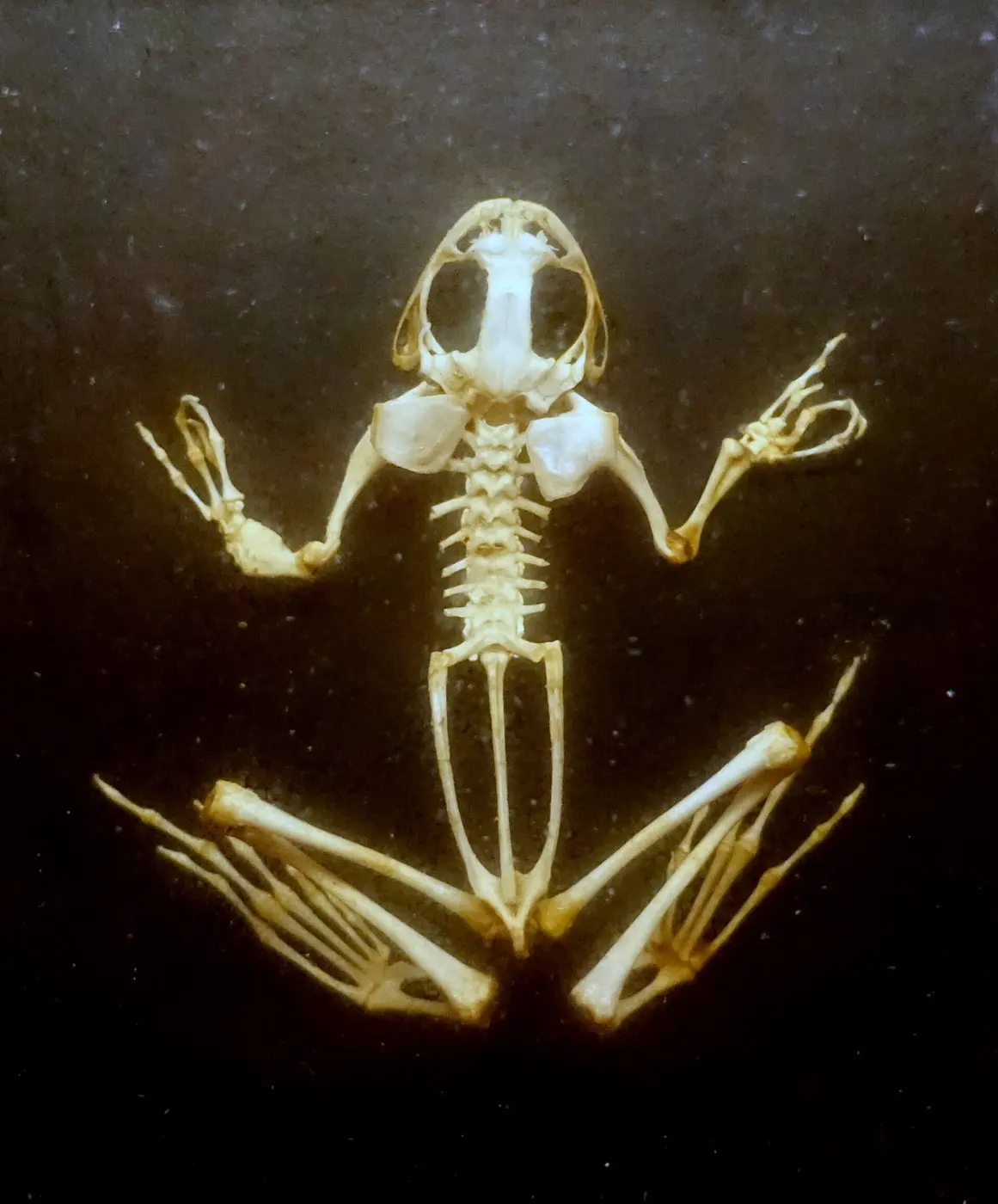

In fact, an ordinary frog blink works the same way. When the eyeball is pulled in, a translucent membrane tucked inside the lower lid, the nictitating membrane, is drawn up over the surface of the eye. For a frog, closing its eyes and pulling its eyeballs in are practically the same movement.
X-rays show the eyes pushing the prey
The experiment that showed the eyes really do help with swallowing was published in 2004 in the Journal of Experimental Biology by a team of American researchers.
The team fed northern leopard frogs, a North American species, crickets about 1.5 centimeters (0.6 inches) long and filmed them with X-ray video. As the frogs swallowed, the eyeballs and the muscles around them sank deep into the mouth and appeared to touch the prey. The eyes seem to push the food toward the esophagus, and may also hold it in place while the tongue moves it along.
The researchers then cut the nerves to the muscles that pull the eyes in, so the frogs could no longer sink their eyeballs. The frogs could still swallow crickets, but the number of gulps needed for each one rose from an average of 2.3 to 4.0, an increase of more than 70 percent. The eyes are not the main swallowing machinery, but they are a very useful helper.
A study published in 2019 tracked the eye movements of American bullfrogs in 3D. The eyes sank in mainly while the frogs were moving prey through the mouth, and there was no sign that they move their eyes to help them breathe.
Teeth, but nothing to chew with
Why would a frog need such a helper? Because frogs do not chew. They swallow their prey whole.
People often say frogs have no teeth, but most frogs do have small teeth in the upper jaw. These serve to hold prey and stop it escaping, not to crush it. Almost no frogs have teeth in the lower jaw, and a 2021 study found that teeth have been lost entirely more than 20 separate times over the course of frog evolution.
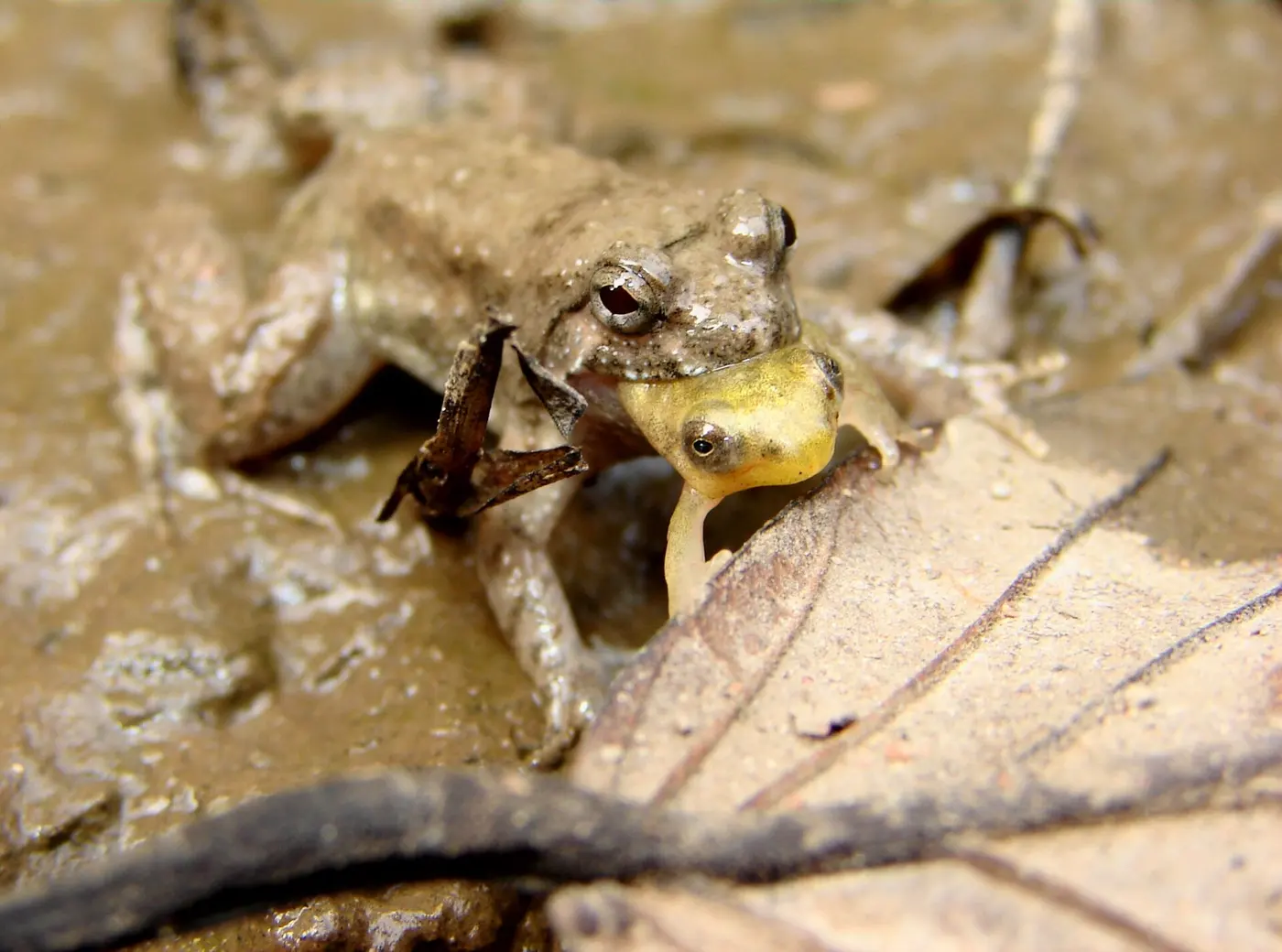

The tongue that catches the prey also plays its part. According to a research team at the Georgia Institute of Technology in the United States, a frog’s tongue is as soft as brain tissue, about ten times softer than a human tongue, and it absorbs the impact as it wraps around the prey. The saliva is runny like water at the moment of impact, spreading over the insect; it turns thick and sticky while the tongue snaps back, gripping its catch; and inside the mouth it becomes runny again, letting the insect go.
The tongue carries the prey in, and the eyeballs give it a final shove. When a frog shuts its eyes at mealtime, it is putting its whole head to work to swallow without chewing.