How do falling cats land on their feet?
They twist the front and back halves of the body separately, tucking and stretching their legs, to turn over in midair.
A cat slips off the top of a shelf, twists around in midair and lands neatly on its feet. This move is called the righting reflex. Kittens are said to start showing it at about three to four weeks old and to have it perfected by six to nine weeks.
It looks effortless, but it puzzled physicists for a very long time. The question even has a name: the falling cat problem.
Breaking the laws of physics?
In 1894, the French physiologist Étienne-Jules Marey took a rapid series of photographs of a cat released upside down. They clearly showed the cat twisting in the air and landing on its feet.
That surprised scientists. Physics has a rule called the conservation of angular momentum: an object that is not spinning cannot start spinning on its own unless something outside acts on it. A cat in midair has nothing to push against. Marey had also checked that the cat was not using air resistance or the hand that released it. And yet the cat had undeniably turned over.
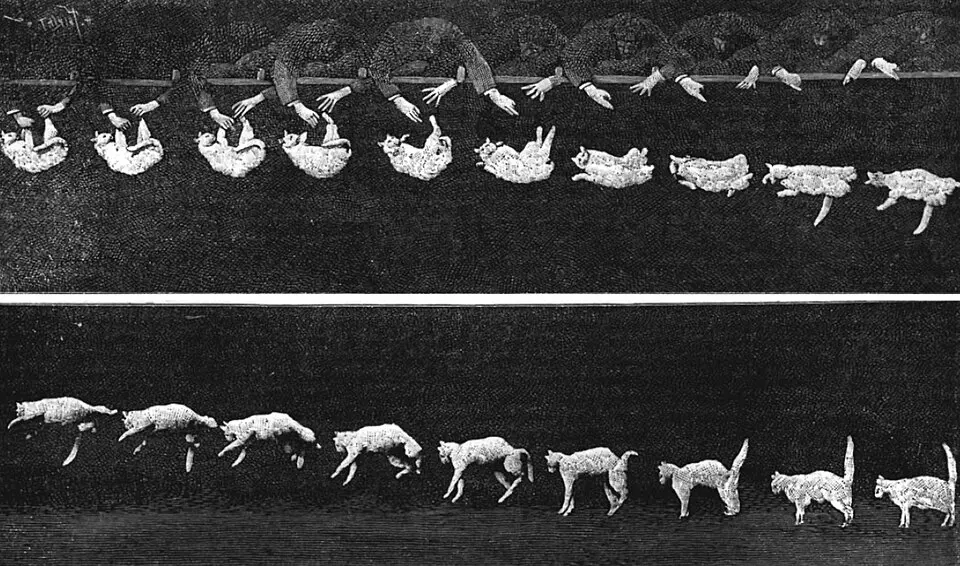

Turning the front and back halves separately
The key is that a cat’s body is not one rigid block. Marey himself thought the cat was making use of different positions of its front and hind legs.
A figure skater spins faster with arms pulled in and slower with arms spread out. A tucked-in body is easy to rotate; a spread-out body resists rotation. As a cat starts to fall, it first tucks in its front legs and stretches out its hind legs. The front half, now easy to turn, twists a long way, while the hard-to-turn back half rotates only a little in the opposite direction. Then the cat stretches out its front legs and tucks in its hind legs, and now it is the back half’s turn to rotate.
Because the two halves twist against each other, the body’s total rotation stays at zero throughout. Yet by switching leg positions, the cat ends up completely flipped over. In 1969, the American researchers Kane and Scher explained the motion with a mathematical model that treated the cat as two cylinders joined by a bend in the middle.
The tail may help, but it is not essential. Cats without tails can right themselves too.
The secret of a twisty chest
In 2026, a research group led by Yasuo Higurashi of Yamaguchi University in Japan published new data on the anatomy behind the twist.
Using the spines of five cats donated for post-mortem examination, the team mounted the chest section (the thoracic spine) and the lower-back section (the lumbar spine) in a testing machine and twisted them, measuring how much force produced how much rotation. The thoracic spine twisted as far as 171 degrees to one side, while the lumbar spine managed only 57. The thoracic spine also had a range of about 47 degrees to each side in which it twisted with almost no resistance at all. When the team filmed live cats righting themselves, the upper body, head included, finished turning over before the lower body.
A cat’s chest is extremely easy to twist, and that flexibility is thought to help it turn its upper half first. The researchers stress, however, that this does not fully solve the falling cat problem.
Landing on its feet is not the same as landing safely
So can cats fall from any height without harm? No.
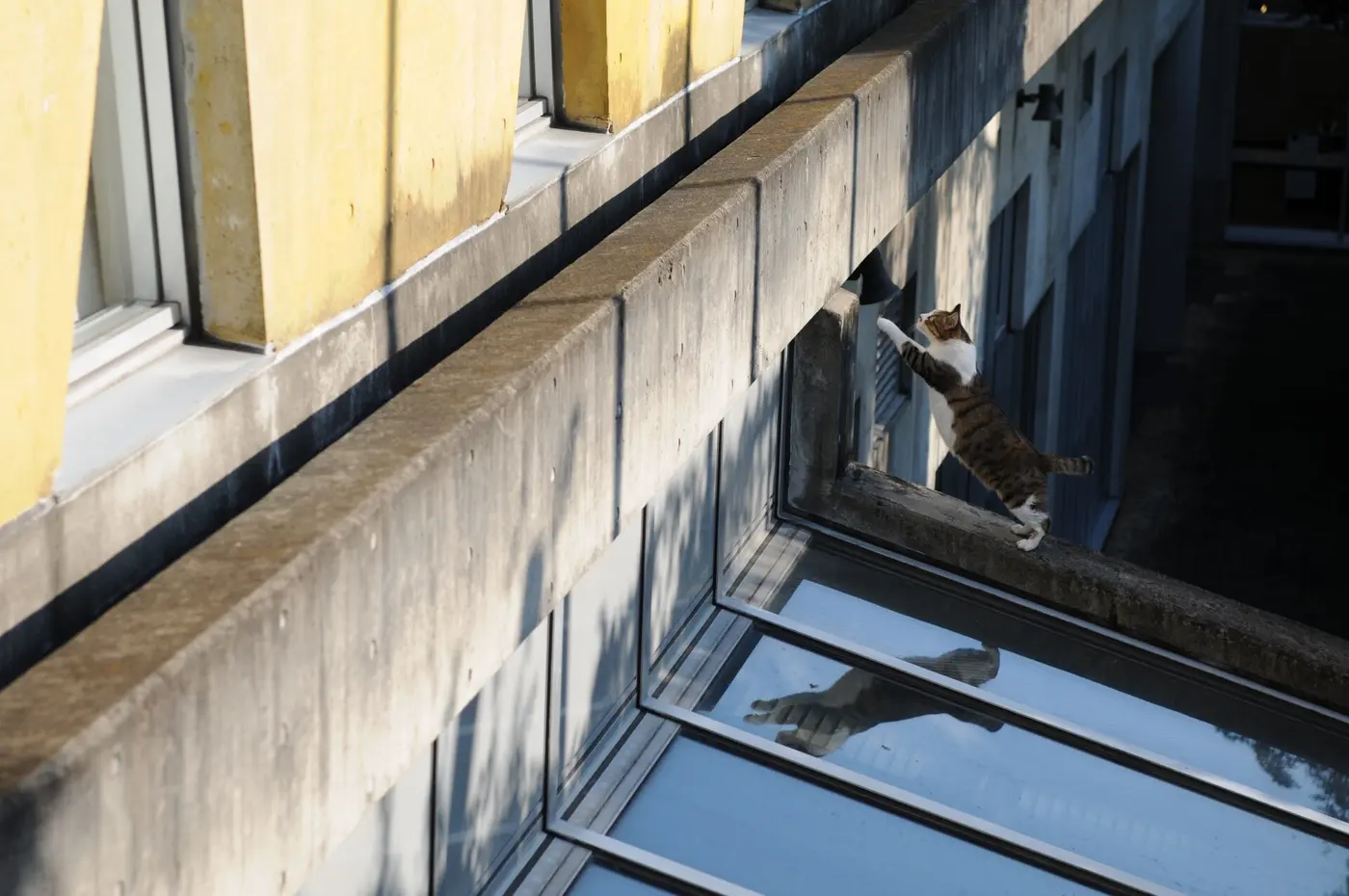

In 1987, veterinarians at an animal hospital in New York reviewed 132 cats brought in over five months after falling from high-rise buildings. Ninety percent of the cats that were treated survived, but 90 percent had chest injuries and nearly 40 percent had broken limbs. Even landing feet first, 17 percent hit their chins hard enough to fracture the bony roof of the mouth.
The study also reported that cats falling from above the seventh floor tended to be less badly hurt, which made headlines. One explanation is that the cats spread out their bodies and catch more air. But cats that die from a fall are never brought to a hospital, so the figures may be skewed. Securing windows and balconies remains essential.