Did the Frisbee come from a pie tin?
Only half of it. The plastic disc grew out of Fred Morrison’s cake-pan tossing in California; the pie tins of a Connecticut bakery gave it only its name.
25¢
Spinning across parks and beaches, the plastic flying disc is a toy for dogs and a piece of sports equipment for ultimate and disc golf. Its name comes with a famous origin story.
According to the story, students near a Connecticut bakery used to toss its empty pie tins around campus, and that game became the Frisbee. How much of that holds up?
Frisbie’s pies
According to ConnecticutHistory.org, a project of the state’s humanities council, William Frisbie opened the Frisbie Pie Company in Bridgeport, Connecticut, in 1871. Bridgeport is about 30 km (19 miles) from New Haven, home of Yale University, and the company’s metal pie tins were stamped on the bottom with the words “Frisbie’s Pies.”
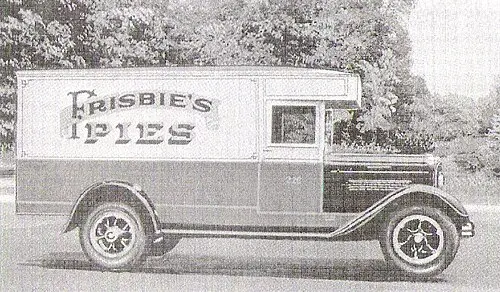

Accounts of students tossing the empty tins to one another, calling out “Frisbie!” as they threw, date back to the 1920s and possibly earlier. Even so, ConnecticutHistory.org describes the story as entertaining but unproven. The bakery itself closed in the late 1950s.
A cake pan in California
The plastic disc we throw today was dreamed up not by East Coast students but by a young Californian, Walter Frederick “Fred” Morrison (1920–2010). According to Phil Kennedy, who wrote a history of the disc with Morrison, the story begins on Thanksgiving Day 1937.
Morrison, then 17 and living in Los Angeles, spent the holiday with his high-school girlfriend, Lu, who later became his wife, at her uncle’s house. After dinner the party tossed around the lid of a popcorn can. When the lid got too battered, Fred borrowed a cake pan from his mother’s kitchen, and the couple took their game to the beach. There a beachgoer offered to buy the pan for 25 cents. A new cake pan cost five cents, and Morrison saw a business. Soon the couple were selling “Flyin’ Cake Pans” on beaches and in parks around Los Angeles.
Riding the flying-saucer craze
During World War II, Morrison flew a P-47 fighter-bomber over Italy for the Army Air Forces and spent time as a prisoner of war. In 1946 he sketched a more aerodynamic disc and named it the Whirlo-Way, after a champion racehorse. With Warren Franscioni, another former pilot, he decided to make it from injection-molded plastic.
By March 1948 the first plastic discs were coming out of the mold, stamped not “Whirlo-Way” but “Flyin-Saucer,” to cash in on the reports of UFOs that had filled the newspapers since 1947. Sales were disappointing, and in 1950 Morrison pulled out. In early 1955 he sat down at his kitchen table and designed a new disc, the Pluto Platter, named after what was then the most recently discovered planet. Lu wrote the instructions: “Flat flip flies straight, tilted flip curves. Experiment!”
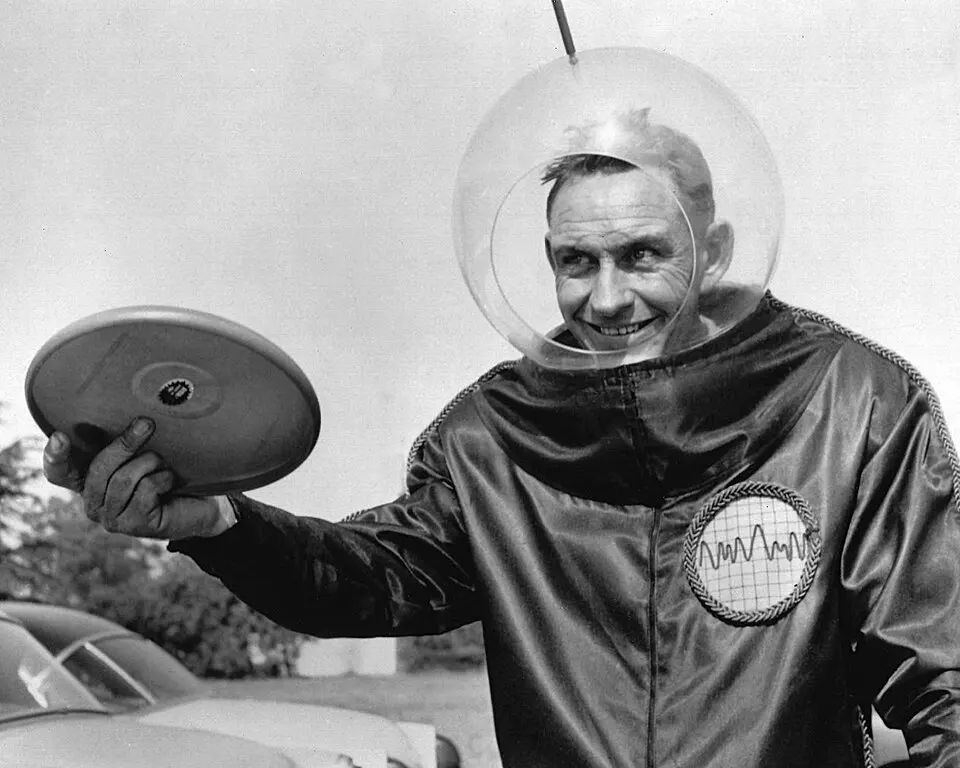

The name came from back East
The Pluto Platter’s sales caught the eye of Wham-O, a California company that made slingshots and boomerangs. On January 23, 1957, Fred’s birthday, the Morrisons signed over the manufacturing and marketing to Wham-O in exchange for royalties.
A few months later, Wham-O co-founder Richard Knerr learned that college students back East were calling the disc something else: a Frisbee. Kennedy believes Knerr read about it in a Sports Illustrated article of May 13, 1957, on a flying-disc craze at Princeton. That article, Kennedy notes, never mentions the pie company; it says that “nobody at Princeton seems to know who named the Frisbee, or why.” Knerr liked the name, and by June 17 Wham-O was selling the disc as the Frisbee, spelled with two e’s rather than the bakery’s “ie.” The trademark was registered in 1959.
Kennedy stresses that people were flipping tins and lids long before Frisbie’s bakery opened, and that Morrison, who never visited the East Coast except to pass through during the war, came up with his disc entirely independently. Still, he accepts that the name itself most likely did come from Frisbie’s pie tins, tossed by students at Yale, Harvard, Dartmouth and Princeton. The disc was born of a California cake pan; the pie tin supplied the name.