Was the fountain pen born from an ink blot?
Probably not. The tale of an insurance agent who lost a contract to a leaky pen first appeared in print years after his death, and fountain pens existed long before him.
11years
The fountain pen has a famous origin story. New York, the 1880s. An insurance agent named Lewis Edson Waterman is about to close a big policy. But just as the client puts pen to paper, the fountain pen gushes ink and ruins the contract. While Waterman hurries off for a fresh form, a rival agent swoops in and signs the client. Stung, Waterman devotes himself to building a pen that won’t leak.
It is a neat tale of failure turned into fortune. Pen historians, however, do not believe it.
The story appeared 11 years after his death
Waterman was a real person, and he did sell insurance for a time. He also patented a fountain pen part and built a successful company. The doubtful part is the ink blot.
The pen researchers George Rimakis and Daniel Kirchheimer, writing in The PENnant, the journal of a pen collectors’ society, traced when the story first appeared in print. The earliest version they found is an article in the May 1912 issue of Pearson’s Magazine. Waterman had died in 1901, eleven years earlier. A 1905 piece in Harper’s Weekly describes him as an insurance man who carried a pen and a small bottle of ink so as not to lose a customer at the critical moment, but there is no blot yet. In the early 1920s the tale spread through trade magazines, gaining embellishments with each retelling.
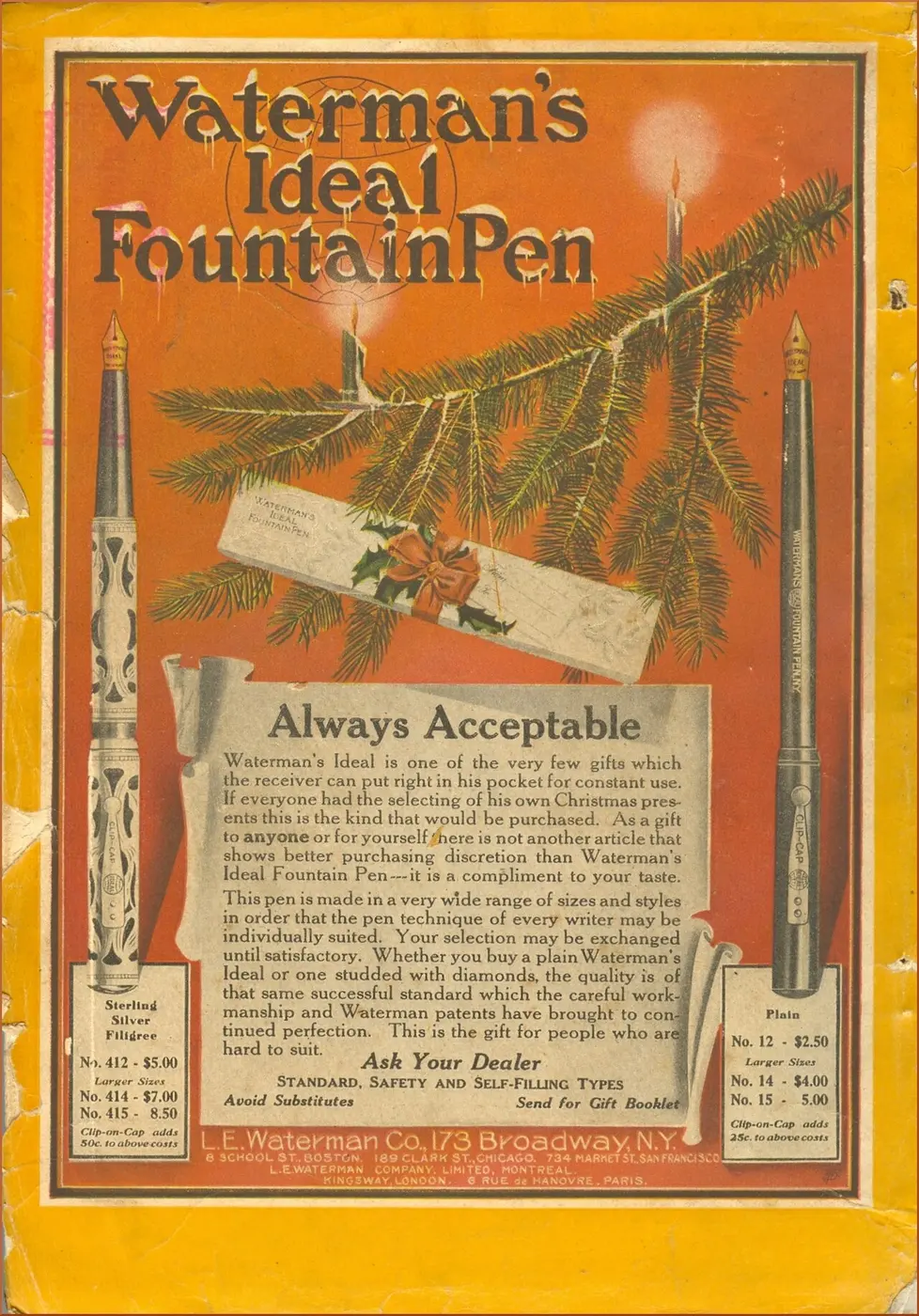

Waterman’s own account was different. In an 1896 interview in the advertising journal Printers’ Ink, he credited his success to advertising and to making a reliable pen. There is no contract and no blot.
According to the pen historian David Nishimura, the story is also missing from every Waterman catalog he examined up to 1933. Then, in 1934, the company celebrated its 50th anniversary with a special issue of its house magazine, and the ink-blot story was given pride of place. That article was reprinted in a serialized history for collectors in the 1980s, Nishimura explains, and the myth took root.
Fountain pens are much older
In any case, Waterman did not make the first fountain pen. In a 1981 paper, the historian C. E. Bosworth described a 10th-century account in which al-Mu‘izz, the Fatimid caliph who ruled North Africa and Egypt, asked for a pen that would not stain his hands or clothes. He was given a gold pen that held ink inside it and reportedly did not leak even when turned upside down.
On August 5, 1663, the English diarist Samuel Pepys wrote that he had received “a silver pen … to carry inke in, which is very necessary.” In 1809 a fountain pen was patented in England, and in 1819 John Scheffer’s “Penographic” became a commercial success.
Nishimura points out that these earlier pens were made, sold and used, so they must have been practical. The phrase “the first practical fountain pen” was a claim the Waterman company began making decades later.
Waterman’s idea: tiny grooves
So what did Waterman invent? His U.S. patent No. 293,545, granted on February 12, 1884, improved the feed, the piece that carries ink to the nib.
As the patent explains, when ink flows out of the barrel it tends to create a vacuum inside, and unless air can get in, the flow stalls. Air bubbles could also block the ink channel. Waterman cut a groove along the top of the feed and added very narrow slits, or “fissures,” at its bottom. Ink runs down the fissures by gravity and capillary action, the tendency of liquid to creep along narrow spaces, while air travels up the other side of the groove into the barrel. If ink starts to rush out, more air flows in, which slows the flow and keeps it even on its own.
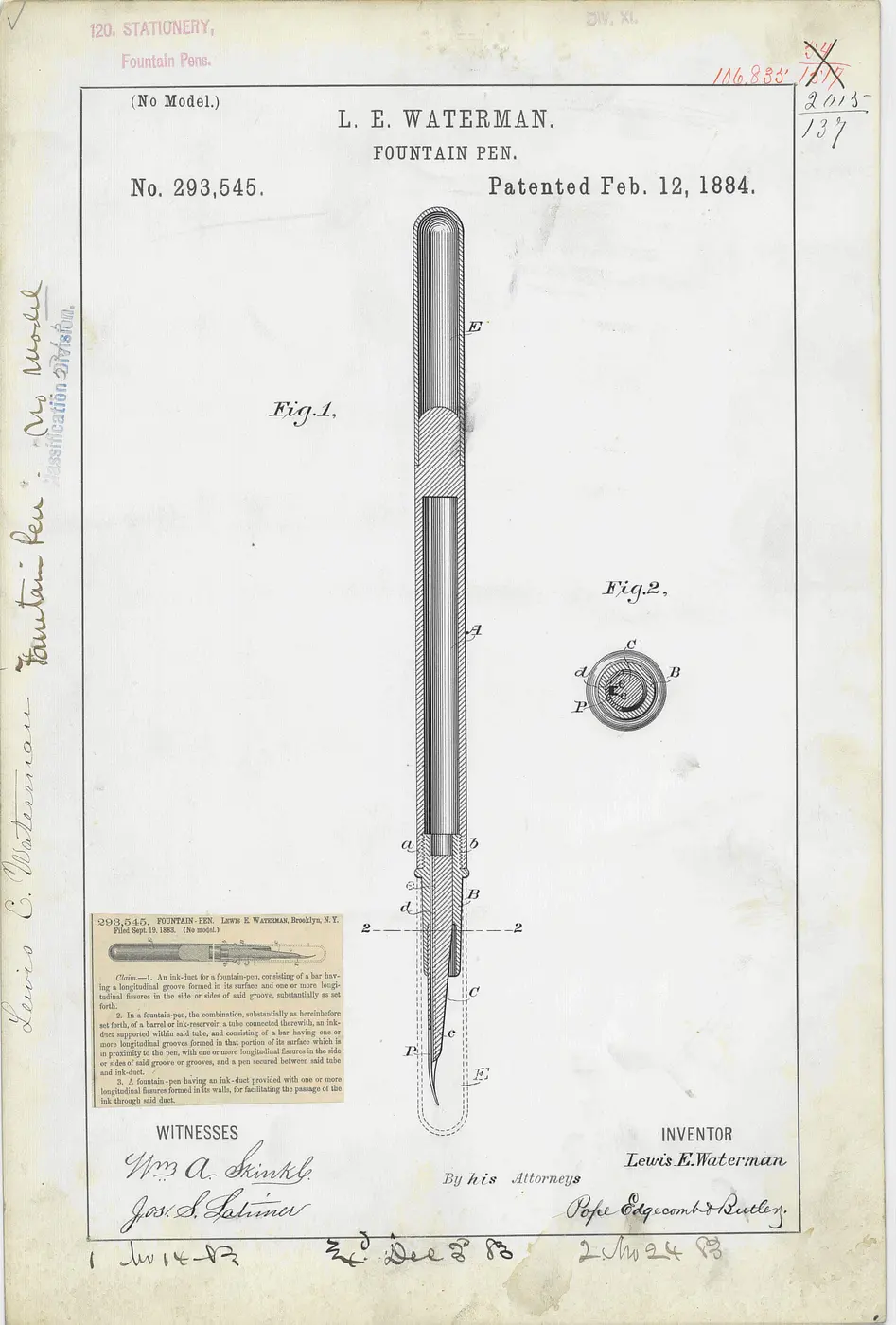

Many encyclopedias, including Japanese ones, still treat this patent as the beginning of the practical fountain pen. Nishimura, by contrast, calls the feed effective but by no means the first designed to use capillary action, an incremental step rather than a breakthrough. Waterman’s company made its name through advertising and grew into America’s leading pen maker. Perhaps the invention story was rewritten after the fact precisely because the company became so successful.