Can you swim any stroke in a freestyle race?
Yes. The stroke is up to you, but there are rules, such as staying underwater for no more than 15 meters.
15m
When a freestyle race begins on Olympic TV coverage, every single swimmer heads off doing the front crawl. Perhaps that is why so many people assume that freestyle simply means crawl.
Open the rulebook, though, and you won’t find a line saying freestyle must be swum as the crawl. Just as the name says, the choice of stroke really is free.
The rules don’t dictate the stroke
Under the rules of World Aquatics, the international governing body for swimming, freestyle is an event in which any stroke may be used. You can even switch strokes mid-race. Swim the whole way in breaststroke or backstroke, and as far as the rules go, that is perfectly fine.
The rules cover other things instead. For example, some part of the swimmer’s body must touch the wall at each turn and at the finish. Standing on the bottom of the pool won’t get you disqualified, but walking along it or pushing off it to move forward is not allowed.
And there is one more important rule. After the start and after each turn, a swimmer may stay completely underwater only until 15 meters from the wall. Beyond that point, the head must have broken the surface.
Is it faster under water?
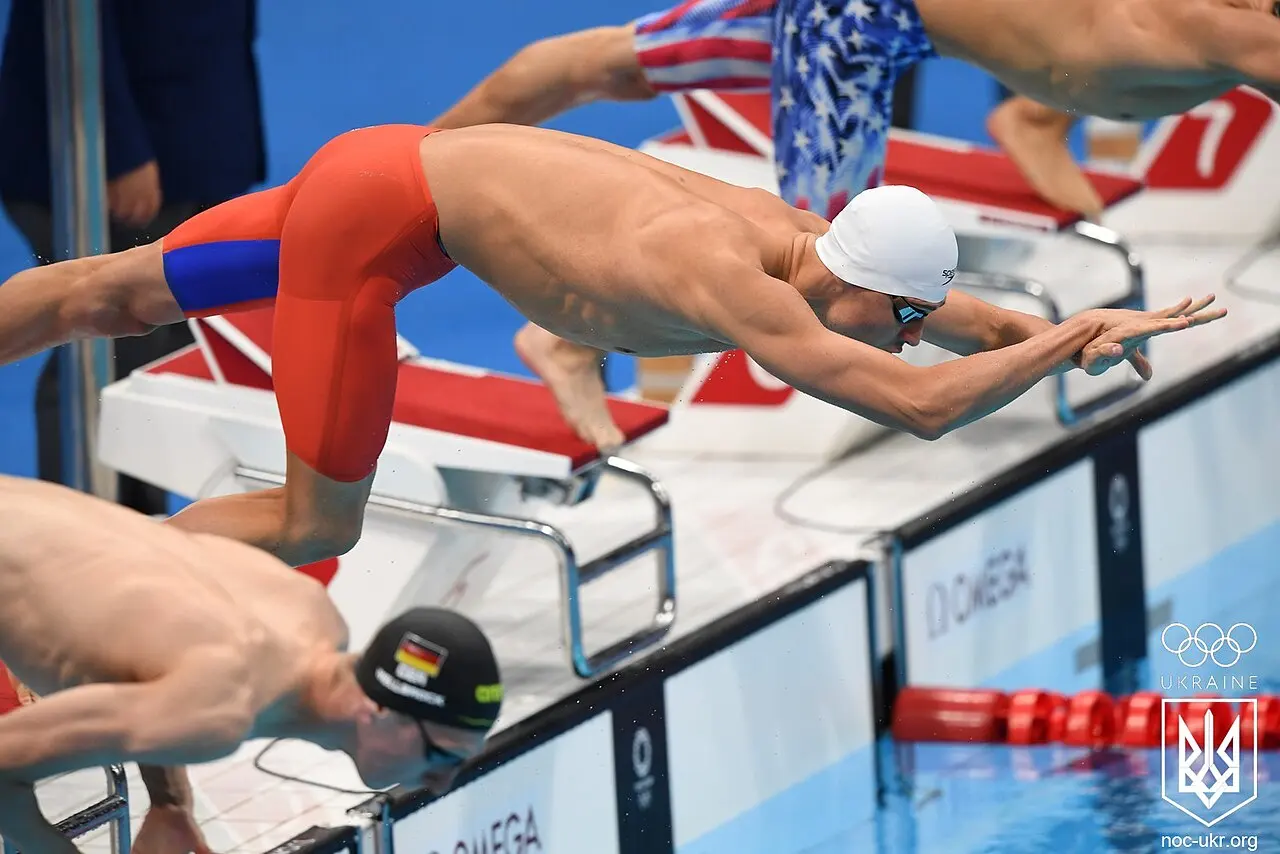
Why set a limit on underwater swimming at all? Because kicking underwater can sometimes be faster than swimming on the surface. A swimmer on the surface pushes a bow wave ahead of the body, and that wave is a major source of drag. Underwater, that wave resistance disappears. With a dolphin kick, legs together and body undulating, a swimmer can travel a long way at speed.
The issue drew wide attention at the 1988 Seoul Olympics. In the men’s 100-meter backstroke final, five of the eight finalists are said to have stayed underwater for 20 meters or more after the start, and Japan’s Daichi Suzuki, who used long underwater stretches as his weapon, won the gold medal. Afterward, the underwater distance in backstroke was restricted, and in 1991 it was set at the current 15 meters. Today the 15-meter limit applies to freestyle, backstroke and butterfly.

Why everyone still picks the crawl
If the stroke is free, why do all the top swimmers use the crawl? Simply because it is the fastest way to swim on the surface. The arms pull alternately and continuously, so propulsion rarely lets up, and the body stays flat and level in the water. Nor is there the big braking effect of breaststroke, where the arms and legs are drawn forward again on every stroke.
The crawl did not arrive fully formed, though. In the late 19th century the “trudgen,” in which the arms alternately recover over the water, caught on in Britain. In the early 20th century the “Australian crawl” is said to have been developed in Australia, partly modeled on the swimming of a boy from the Solomon Islands. Through refinements like these, the crawl became the star of freestyle.
At the Olympics, backstroke became a separate event from the 1900 Paris Games, and breaststroke from the 1904 St. Louis Games. With each stroke given its own events, freestyle effectively became the event for the fastest stroke of all.
The Japanese swimmers who didn’t know the crawl
Japanese swimmers first competed at the Olympics in 1920, in Antwerp. The two Japanese representatives, Uchida Masayoshi and Saitō Kenkichi, took on freestyle using koryū, Japan’s traditional swimming styles. But they were no match for the foreign swimmers and their modern crawl, and both were knocked out in the heats.
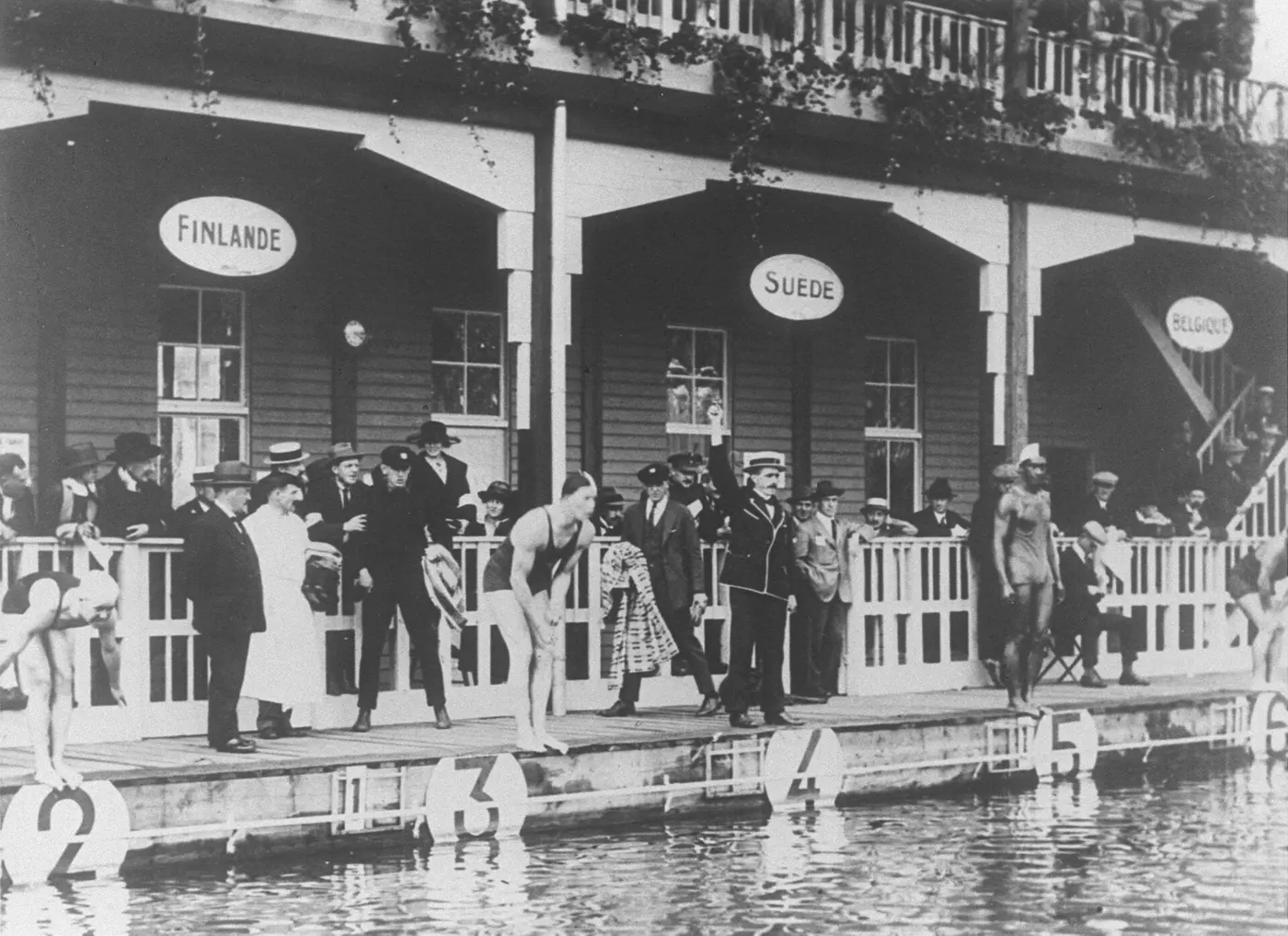

The men’s 100-meter freestyle at those Games was won by Duke Kahanamoku of Hawaii. Having seen how far behind the world he was, Uchida devoted himself to spreading the crawl after returning home. Twelve years later, at the 1932 Los Angeles Games, Japan’s men won gold in five of the six swimming events. Switching from traditional strokes to the crawl turned Japan into a swimming powerhouse in little more than a decade.