Did people in the Middle Ages think the Earth was flat?
No. Medieval European scholars took it for granted that the Earth was round.
Long ago, people believed the Earth was flat and feared that if they sailed far enough they would tumble off the edge like water over a waterfall. Then along came Columbus, declared that the Earth was round, and sailed west. Many of us remember hearing a story like this as children.
Historians reject it flatly. Educated people in medieval Europe knew perfectly well that the Earth was round. The idea that “people in the Middle Ages thought the Earth was flat” is itself a misconception born much later.
Round since ancient Greece
The idea of a spherical Earth appears in ancient Greek writings by around the fifth century BC. By about 330 BC, the philosopher Aristotle was offering evidence for it: the shadow of the Earth on the Moon during a lunar eclipse is always round, and the stars you can see change as you travel north or south.
Around 240 BC, Eratosthenes calculated the Earth’s circumference. His method used the difference in the Sun’s height at noon on the same day in two Egyptian cities. Accounts differ on exactly how long his unit of length was, but the very idea of estimating the size of the Earth this way assumed that it was round.
Common knowledge for medieval scholars
This knowledge was handed down through the Middle Ages. In 725, Bede, an eighth-century monk in England, wrote a guide to calendar reckoning, The Reckoning of Time, in which he explained why the length of the day varies from place to place, taking a round Earth as given.
In the 13th century, Johannes de Sacrobosco wrote an introduction to astronomy, On the Sphere. As evidence that the Earth is a sphere, he noted that stars rise and set, and lunar eclipses appear, earlier for people farther east; that stars around the North Pole are easier to see the farther north you go; and that climbing a ship’s mast lets you see farther. The book served as a university textbook for centuries, and in the two hundred years or so after it was first printed in 1472, it went through at least 84 editions.
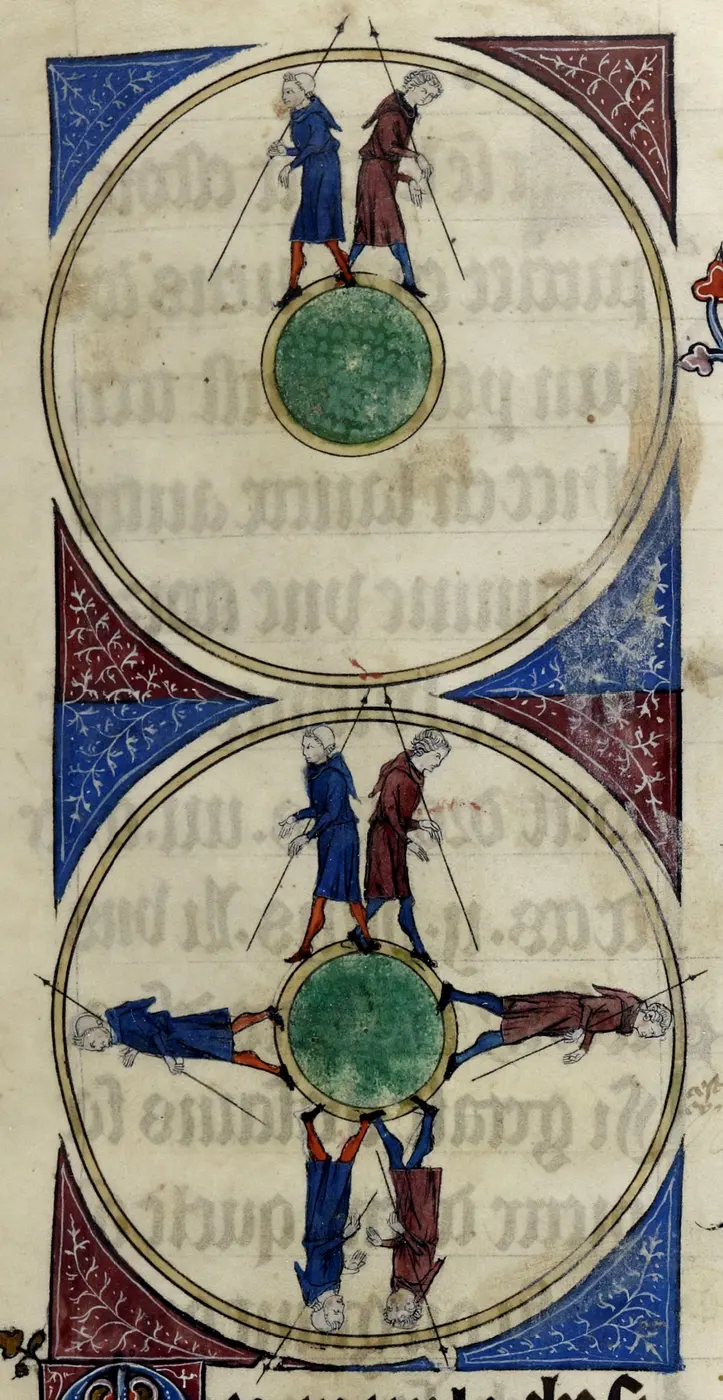

There were exceptions, of course. The fourth-century writer Lactantius and the sixth-century monk Cosmas rejected the idea of a round Earth. But they were in the minority and had little influence on later scholars. The historians of science David Lindberg and Ronald Numbers have written that there was scarcely a Christian scholar of the Middle Ages who did not acknowledge the Earth’s sphericity and even know its approximate circumference.
The real reason Columbus met resistance
So why was Columbus’s plan opposed? The dispute was not about the shape of the Earth but about its size.
By stringing together a series of convenient numbers, Columbus estimated that sailing west from the Canary Islands in the Atlantic, Japan lay only about 5,000 kilometers away. The real distance is about 20,000 kilometers. Spanish scholars believed the east coast of Asia was much farther away, too far for the small ships of the day to carry enough food and water. The scholars who opposed him were the ones who had it right. Columbus survived only because the Americas, a continent he knew nothing about, lay in the way.
The 19th century built the myth
The “flat Earth” story was spread by 19th-century writers. In 1828, the American author Washington Irving, best known for The Legend of Sleepy Hollow, published a biography of Columbus. This highly romanticized book includes a scene in which ignorant clergymen cite scripture to object to the idea of a round Earth, but no record supports it. Even so, many readers took it as history.
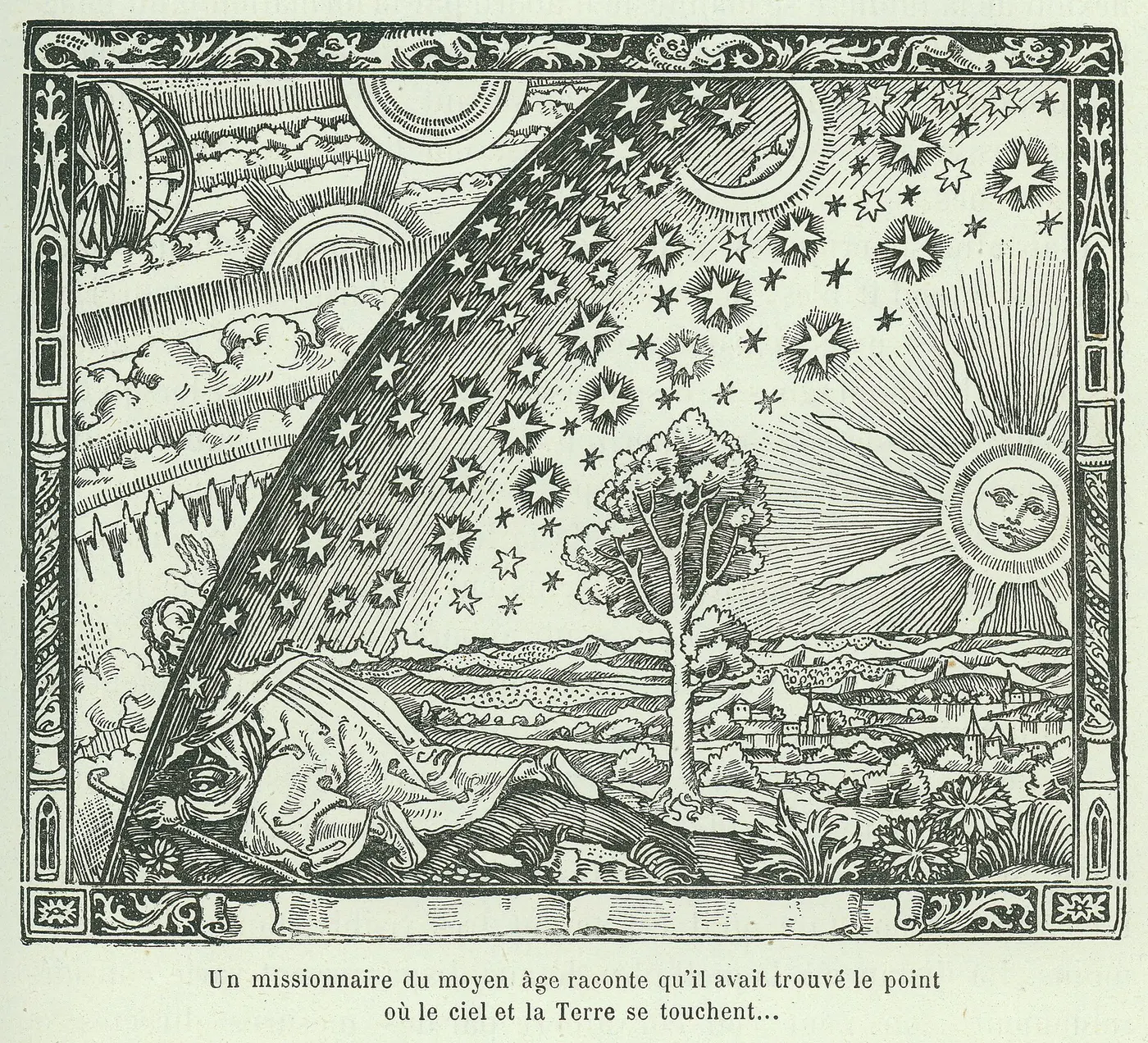

In the late 19th century, a string of books argued that religion and science had always been at war, and the claim that the medieval Church taught a flat Earth was used as “evidence.” According to the historian Jeffrey Burton Russell, the misconception was most widespread from about 1870 to 1920. The story even made its way into school textbooks in the 20th century, and the Flammarion engraving above was later sometimes presented as if it were a 16th-century work. For drawing a contrast between the dark Middle Ages and the enlightened modern age, a flat Earth was simply too handy a prop.