Why do fencers wear white?
White made touches easier for judges to see, and the tradition stuck even after electric scoring took over.
1936
Two figures dressed entirely in white, faces hidden behind wire-mesh masks, lunging at each other with thin blades. That is the image most of us have of fencing. Next to soccer or basketball teams in their bright jerseys, fencers stand out precisely because they are so plain.
The usual explanation is that touches used to be judged by eye, so fencers wore white to make the marks easy to see. That turns out to be broadly right. But before the white era, there was a surprising period when fencers favored black.
Judged by eye
A fencing bout is decided by whose blade lands on the opponent, and who lands first. The action, though, lasts a fraction of a second. According to Olympedia, a database of Olympic history, until the 1930s bouts were usually overseen by five officials, a president and four side judges, who watched the action and voted on whether a touch counted. Disputes over their fairness and competence were common.
When black was in fashion
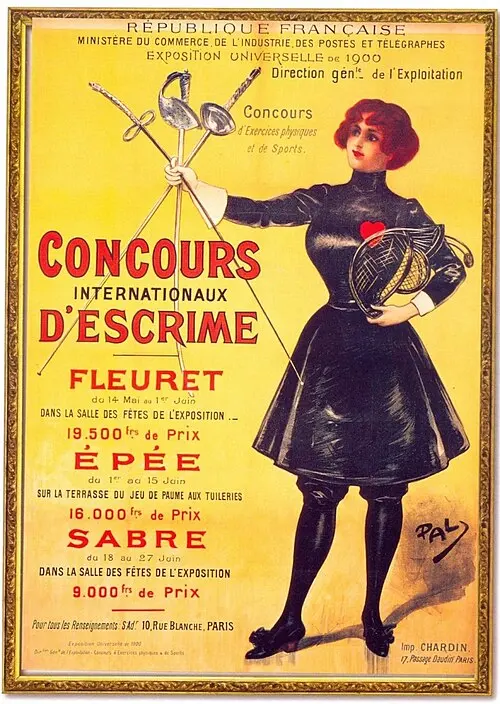
Patricia Reymond of the Olympic Museum in Lausanne, Switzerland, has pointed out something curious about fencing colors. Until the early 20th century, it was not unusual to see fencers in dark clothing. An 1893 French fencing manual teased competitors in white breeches and silk stockings for looking like brides, while describing black velvet as “chivalrous and romantic.”
The preference for black seems to have had a practical side. Touches were sometimes marked with white chalk, which shows up best on a dark background. Later, a system using black ink spots was introduced, and fencers then needed to wear white jackets so the judges could see the hits. Black gradually disappeared from competition and survived instead as the mark of the fencing master, the instructor who teaches the art.

Enter electricity
What ended judging by eye was electricity. When the tip of the blade is pressed in, it triggers an electrical circuit and a lamp lights up to signal the touch. An electric system for épée had been developed by 1934 and was used at the Olympics for the first time at the 1936 Berlin Games. The International Fencing Federation (FIE) adopted rules for electrically judged épée in 1936, for foil in 1957 and for sabre in 1988.
Today a valid touch lights a red or green lamp, and in foil a hit outside the target area lights a white one. In foil and sabre, where only part of the body counts as target, fencers wear an extra jacket woven from electrically conductive thread. That is why the fencers’ torsos look silver in the photo below.
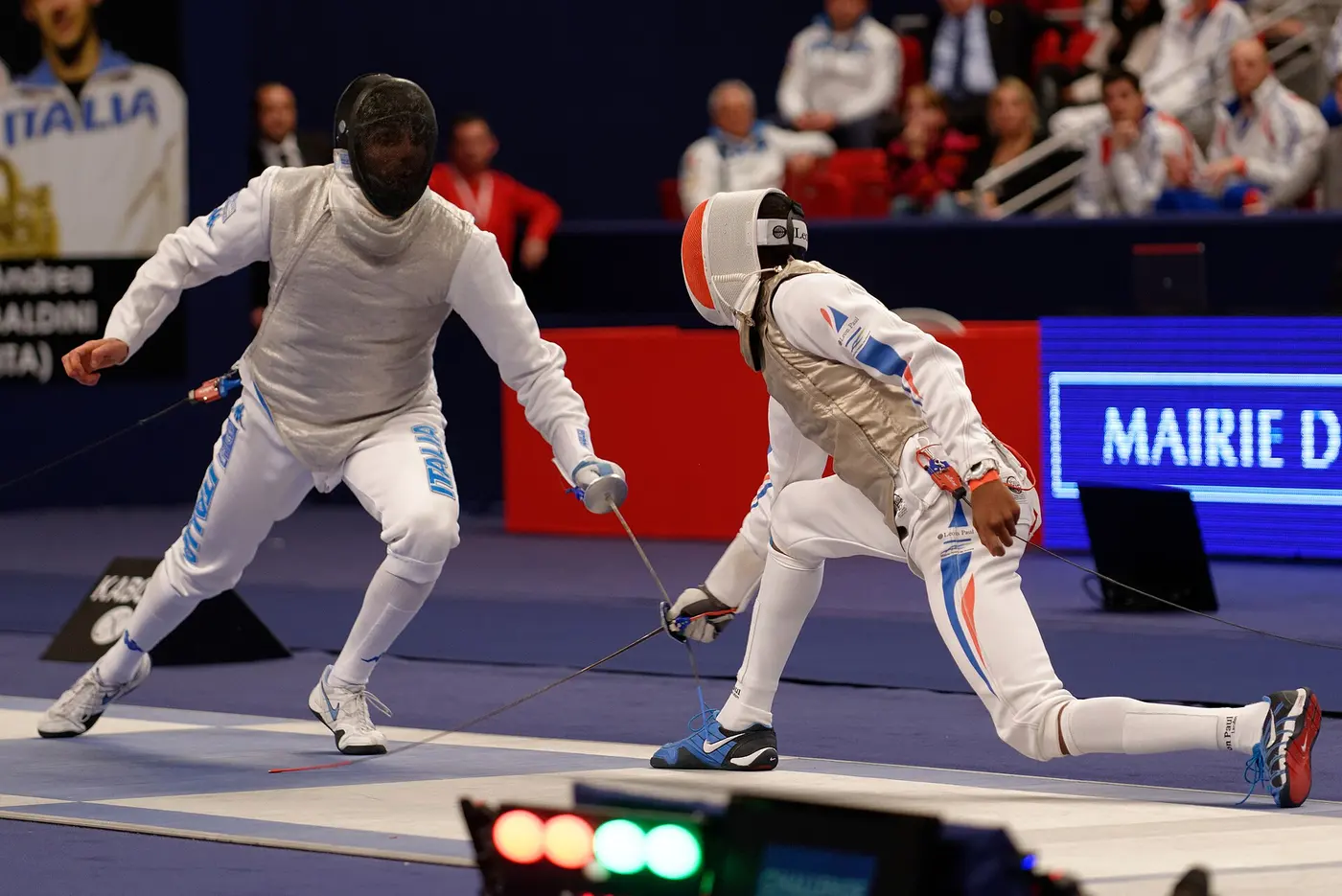

According to Reymond, the arrival of electric scoring had no effect on the tradition of wearing white. Even when no one needed to look for marks anymore, fencing remained a sport in white.
The rule: anything but black
Here is the surprise: the current rules do not actually require white. The FIE’s material rules (August 2026 edition) state that “fencers’ clothing may be of different colours, apart from black.” The same sentence was quoted in information for an international tournament in 2007, so by then at the latest, white was no longer strictly required. In 2015 the FIE reminded national federations that gloves count as part of the clothing and therefore cannot be black either.
What the rules do spell out in detail is national identity. At international events, fencers must wear their country’s colors on both legs, and the back of the jacket must carry the fencer’s name and national abbreviation in dark blue capital letters 8 to 10 centimeters (3 to 4 inches) high. If white still dominates, it seems to owe less to the rulebook than to the weight of tradition.