Do all Thoroughbreds descend from just three horses?
In the direct male line, yes: every Thoroughbred traces back to one of three stallions. But that is only the father’s side, and the breed’s ancestry as a whole is far more varied.
95%
Trace any racehorse’s pedigree back far enough, the saying goes, and you will always arrive at one of three stallions: the Byerley Turk, the Darley Arabian and the Godolphin Arabian, known as the foundation sires of the Thoroughbred.
All the world’s Thoroughbreds, descended from just three horses? That would be remarkable if it were true. But the claim comes with an important footnote.
Three stallions from the East
The Thoroughbred was developed for racing in England in the late 17th and 18th centuries, by crossing local mares with stallions brought from the Middle East and North Africa.
The oldest of the three, the Byerley Turk, is thought to have been foaled around 1680. The 1793 edition of the General Stud Book, the breed’s official register, records that he “was Captain Byerly’s charger in Ireland, in King William’s wars (1689, &c.).” The Darley Arabian was bought in Aleppo, Syria, in 1704 by an Englishman, Thomas Darley, who shipped him home to his family in Yorkshire. The Godolphin Arabian, foaled around 1724, was given as a gift to King Louis XV of France before making his way to England in the early 1730s, where he ended up in the hands of the Earl of Godolphin.
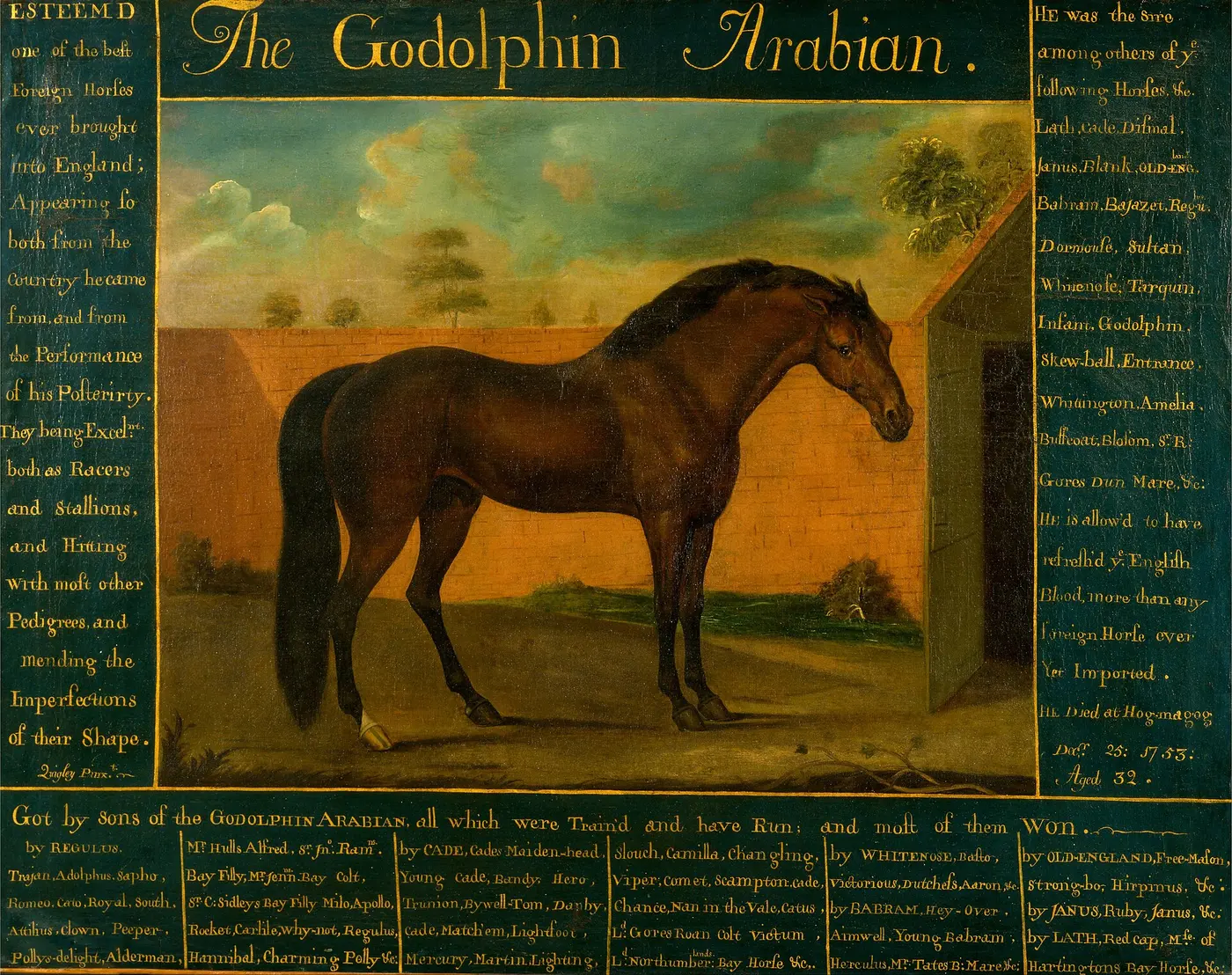

Three, but only on the father’s side
In fact, far more than three Eastern stallions were imported. According to the British racing historian Peter Willett, about 160 appear in the historical record as contributors to the breed. What makes these three special is that their male lines, passed from father to son to grandson, have survived unbroken to the present day. Every other stallion’s male line has died out.
Of the three, one dominates. In 2001 a team at Trinity College Dublin published an analysis of the DNA and pedigrees of 211 horses in the journal Animal Genetics. They found that 95% of the paternal lineages of modern Thoroughbreds go back to a single founding stallion: the Darley Arabian, mostly through his great-great-grandson, the famous racehorse Eclipse (foaled in 1764). The same study found that 72% of maternal lineages trace to ten founding mares.
DNA catches a pedigree error
Because the Y chromosome passes only from father to son, it offers a way to check whether the stud book is telling the truth. In 2019 a team led by researchers at the University of Veterinary Medicine Vienna reported in Scientific Reports that they could tell the three founders’ male lines apart by differences in the Y chromosome.
Along the way they found a discrepancy. St. Simon, a great 19th-century sire foaled in 1881, belongs to the Eclipse line on paper. Yet his descendants carry the Y chromosome of the Byerley Turk line. As early as the 19th century, some people had claimed that St. Simon’s sire, Galopin, was really fathered by a different horse than the one recorded, and the researchers say the DNA supports that claim.
Even the founders’ names deserve some caution. A 2017 study in Current Biology found that the Thoroughbred Y chromosome belongs not to the Arabian lineage among Eastern horses, but to that of the Turkoman horse of Central Asia. Whether the stallions called “Arabians” were really Arabian horses is less certain than it sounds.
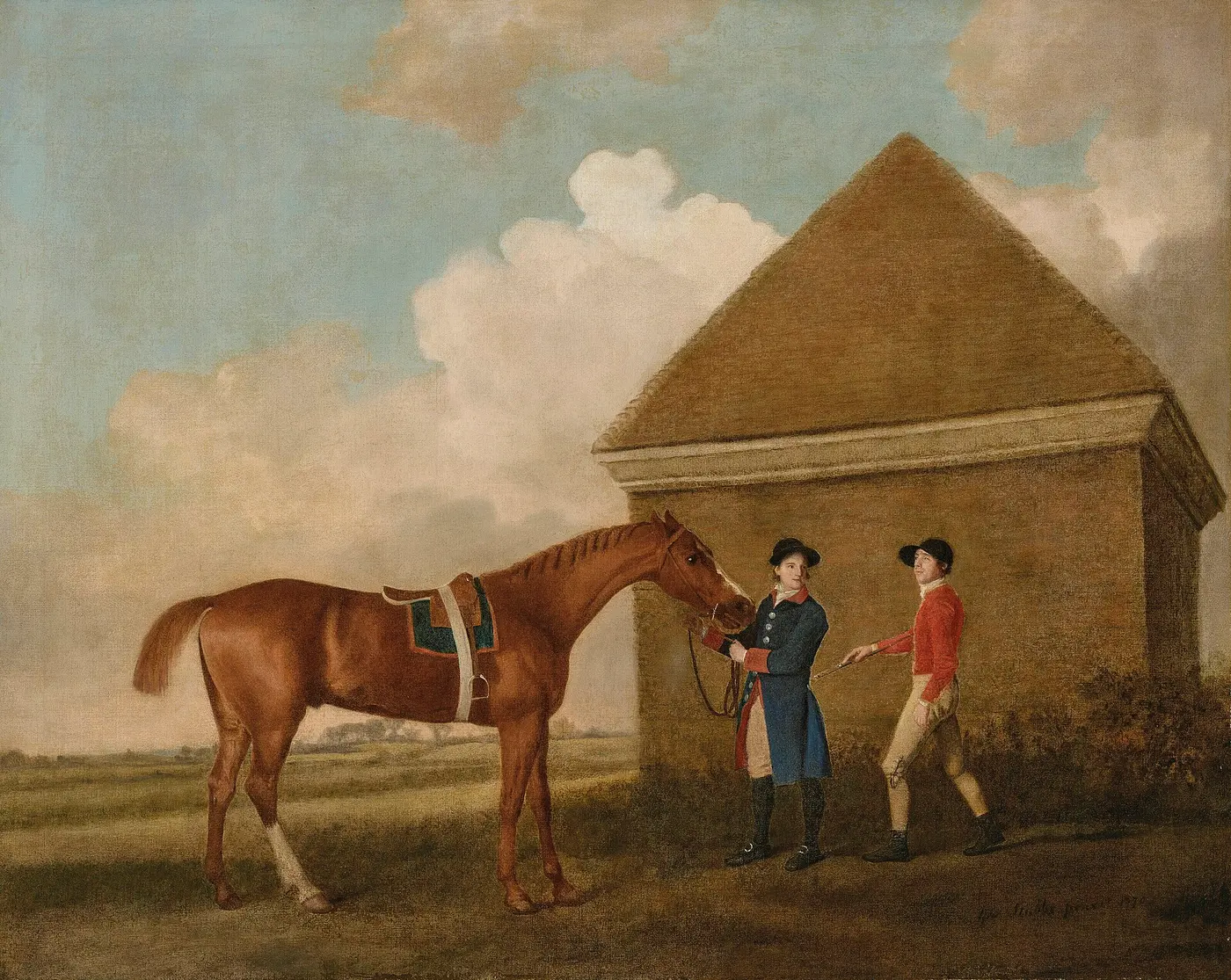
.jpg)
A more varied family on the mother’s side
Research on mitochondrial DNA, which passes from mother to offspring, tells another story. A 2002 study by the same Dublin group found that in nearly half of the female families thought to descend from a single foundation mare, some horses carried DNA that could not be explained by common descent, most likely because mares were confused in the records during the breed’s early years.
Then in 2011 a team including researchers from the University of Cambridge examined mitochondrial DNA from 1,929 horses, Thoroughbreds among them. They found that the breed’s maternal side was not mainly Arabian at all, but drew on many European sources, especially native horses of Britain and Ireland. The Thoroughbred’s closest maternal relatives were the Connemara pony and the Irish Draught.
So “three ancestors” is true only if you follow a single line from father to son. Look at the mothers as well, and the Thoroughbred turns out to be a blend of Eastern stallions and mares from many places.