What are the squiggly things floating in front of your eyes?
They are shadows cast on the retina by clumps in the vitreous, the clear gel that fills the eye. Most are harmless, but a sudden increase calls for an eye exam.
6–19%
Gaze up at a clear sky, or at a white wall or a bright screen, and you may notice them: threads, dots or little rings drifting through your field of vision. Move your eyes and they follow; try to look straight at one and it slips away.
In English they are called floaters. An older name, still found in medical dictionaries, is the Latin muscae volitantes, “flying flies.” In Japanese the condition is hibunshō, literally “flying mosquito symptom,” so people in very different places have reached for the same comparison. According to the Japan Ophthalmologists Association, floaters can appear at any age but become more common as people get older, especially if they are nearsighted, and most are nothing to worry about. A few, however, are a reason to see an eye doctor quickly.
The jelly inside your eye
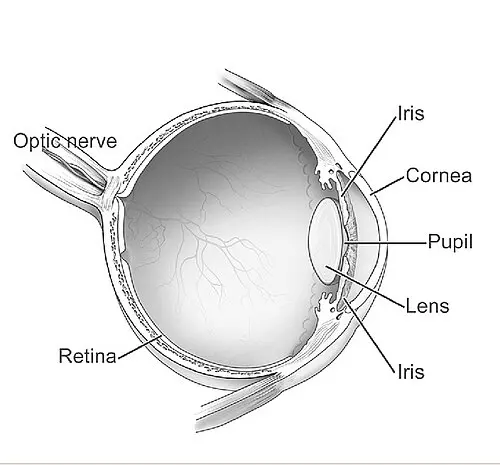
Most of the eyeball, from just behind the lens all the way to the retina, is filled with the vitreous. The Japan Ophthalmologists Association compares it to raw egg white: clear and gooey. An adult eye contains about 4 milliliters of it, and 98 to 99 percent of that is water. Among the small remainder, fine collagen fibers and hyaluronic acid form a mesh that holds the whole thing in a jelly-like state.
Light entering the eye passes through the cornea, the lens and then the vitreous before reaching the retina at the back. If something clouds the normally clear vitreous, it casts a shadow on the retina, and you see something that seems to float in front of you. That is all a floater is. Because the clump is inside your eye, it moves when your eye moves, drifting along with it. Floaters stand out most against plain, bright backgrounds, where their shadows are sharpest.

Some floaters are present from birth. Before birth, a blood vessel runs through the vitreous; it normally disappears by the time a baby is born, but traces of it can remain as small opacities.
Jelly that liquefies and shrinks
Most floaters in adults, though, come from changes in the vitreous with age. According to the Japan Ophthalmologists Association, the vitreous starts to change in a person’s forties, developing small pockets of liquid. Over the years these pockets grow, and the gel shrinks. Meanwhile, the collagen fibers that give the gel its structure clump together and begin to cast shadows on the retina.
Eventually the shrinking gel pulls away from the retina at the back of the eye. This is called a posterior vitreous detachment, and it is the most common cause of floaters that appear suddenly. In Japan it most often occurs in the early sixties, and about ten years earlier in people who are moderately or highly nearsighted. The American Academy of Ophthalmology says most people have one by age 70 and describes it as a normal part of aging, “much like wrinkles.”
A sudden shower means see a doctor
A vitreous detachment is not a disease in itself. The trouble comes if the gel is firmly stuck to the retina in places. As it pulls away, it can tug on the retina and tear it. The Japan Ophthalmologists Association says such a retinal tear occurs in 6 to 19 percent of posterior vitreous detachments. If fluid seeps through the tear and gets behind the retina, the retina can peel away. A retinal detachment can lead to blindness if it is not treated.


The warning signs listed by the National Eye Institute and the Japan Ophthalmologists Association include a sudden burst of new floaters, flashes of light like lightning at the edge of your vision, a sooty darkening of your sight, and a shadow or curtain blocking part of your field of view. If you notice any of these, see an eye doctor as soon as possible. A tear caught before the retina detaches can often be sealed with laser treatment in the clinic. Once the retina has detached, surgery is usually needed.
If an examination finds that your retina is healthy and your floaters are simply due to age or nearsightedness, you can relax. They often become less noticeable over time. But if they increase or new symptoms such as flashes appear, you should be checked again.