Are there trees that wait for wildfires?
Yes. Many Australian banksias release their seeds from fruits that open in the heat of a fire, and eucalypts sprout fresh shoots from their burned trunks.
450°C
In Australia, bushfires are a fact of life. Some have been devastating, like Victoria’s “Black Saturday” fires in February 2009, or the summer of 2019–2020, when huge areas of the country’s southeast burned.
Yet many of the plants that live there don’t merely survive fire. Some of them use it as a cue to sprout new shoots or scatter their seeds. Behind the greening of a blackened landscape lies a set of remarkably cunning strategies.
Buds hidden deep in the bark
The signature trees of the Australian bush are the eucalypts, known to many people as koala food. According to the online flora of New South Wales, published by the Royal Botanic Garden Sydney, there are more than 800 species, and all but 16 are found only in Australia.
After a fire sweeps through a eucalypt forest, green shoots burst from charred trunks all over. The botanist G. E. Burrows explained why in a 2002 paper. In most trees, he wrote, dormant buds sit in the outer bark, where a fire can kill them. In eucalypts, the greatest capacity to produce new buds lies deep inside, at the level of the cambium, the thin layer that makes a trunk grow thicker. That is where the bark is thickest and offers the most protection. This may explain why eucalypts are so good at sprouting from their trunks and branches even after moderate to intense fires.
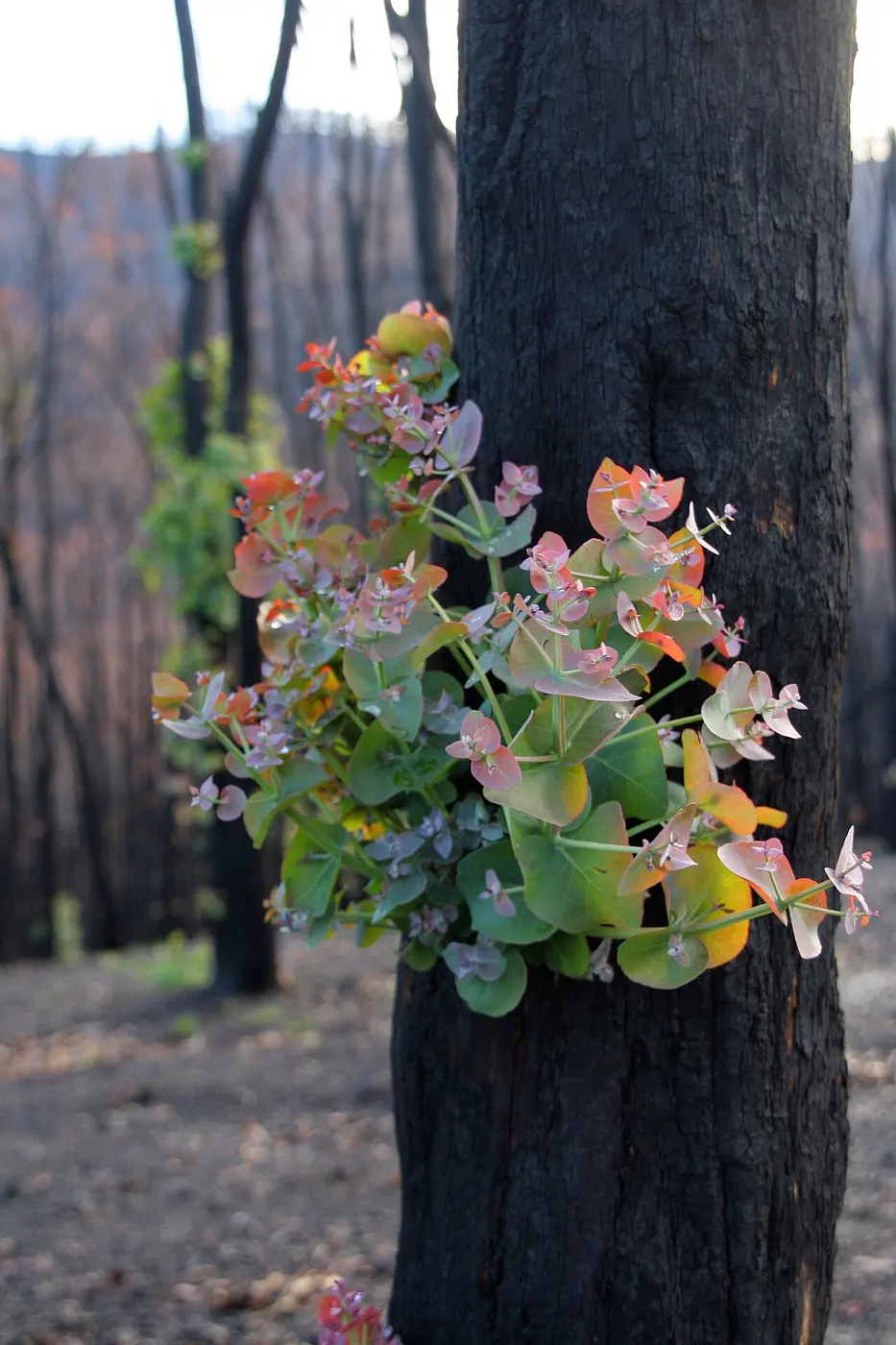

Even if the trunk is lost, a eucalypt may still have a backup. The same flora notes that many species form a lignotuber, a woody swelling at the base of the stem, below ground. It holds a store of buds, so the plant can resprout from it after the parts above ground have burned.
Do oily leaves burn better?
Hold a eucalyptus leaf up to the light and you can see tiny dots: glands full of oil, the source of the leaves’ distinctive scent when crushed. It is often said that this oil is what makes eucalypt forests burn so fiercely.
The reality seems to be more complicated. A 2024 review by researchers at the Australian National University and Western Sydney University compared 20 studies covering 35 eucalypt species. It concluded that the main factors deciding how readily a leaf burns are its water content, its area and how thin it is. The leaf’s chemistry does play a role in how it burns, the authors wrote, but only a minor one in how fire behaves across a landscape.
Fruits that open in the flames
The classic fire-waiting plants are the banksias, members of the protea family famous for their bottlebrush-like flower spikes. Nearly all of them grow only in Australia. According to the Japanese-language Britannica International Encyclopaedia, some species shed their seeds only after the heat of a fire splits their fruits open, the same strategy used by certain North American pines.
A banksia’s old flower spike is studded with hard, woody pods, each holding seeds. In a 2019 study led by the Max Planck Institute of Colloids and Interfaces in Germany, researchers held banksia fruits in flames for three minutes. The surface reached an average of about 450°C (840°F), yet the highest temperatures near the seeds were only about 75–95°C (167–203°F), depending on the species, and many native seeds can survive that. Two woody valves, a porous divider between the seeds and a thin layer of air around them worked together as insulation.
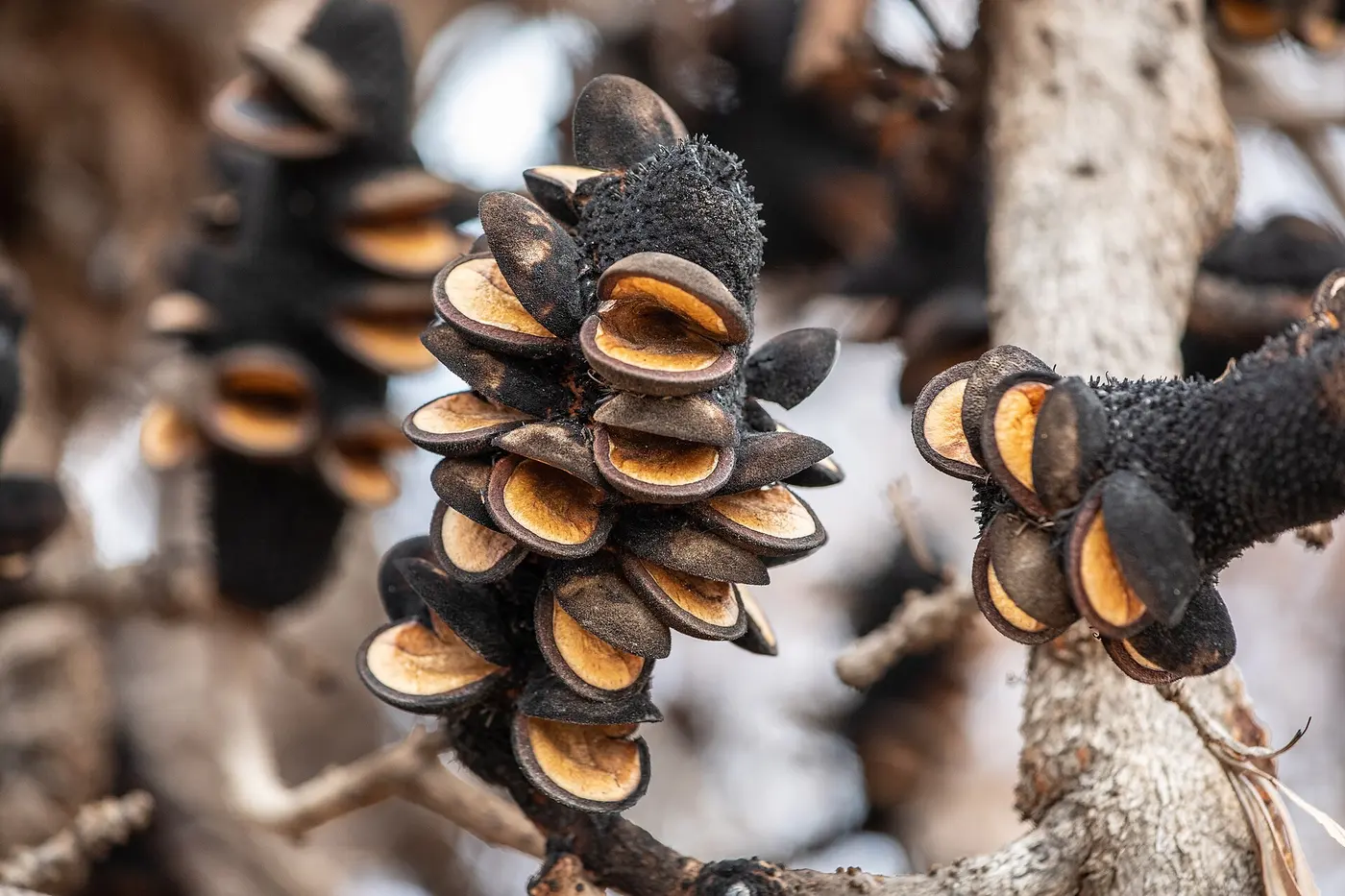

Some seeds take their cue from smoke instead. In 2004, a team from the University of Western Australia and other institutions reported in Science that they had identified a compound in plant smoke that stimulates the germination of seeds from a wide range of species.
When fire comes too often
Not every plant welcomes every fire, though. Some eucalypts are killed outright by intense fires and can only come back from seed. One of them is the alpine ash of the Australian Alps.
According to a study published in 2014, several very large fires since 2002 had burned 85% of that region. After a single intense fire, the adult trees died but seedlings sprang up in huge numbers. When a second fire followed soon after, however, it killed 97% of the young alpine ash. Even plants that wait for fire need it to come at the right pace.