Was the Eiffel Tower once hated?
Yes, by some. In 1887, while it was being built, leading writers and artists denounced it in a newspaper. Its future was in doubt again 20 years later, and it survived as a radio station.
300m
The Eiffel Tower turns up in just about any picture meant to say “Paris.” But this iron tower was not always loved.
When construction had barely begun, some of the city’s best-known writers and artists signed a protest against it. There is even a story that the writer Guy de Maupassant often ate at the tower’s restaurant because it was the only place in Paris from which he could not see it. How much of that is true?
“Useless and monstrous”
The tower was built for the Paris Exposition Universelle of 1889, the world’s fair held to mark the centenary of the French Revolution, by the company of the engineer Gustave Eiffel. At 300 m (984 feet), it was the tallest structure humans had ever built.
On February 14, 1887, the newspaper Le Temps printed a protest by artists. It took the form of an open letter to Adolphe Alphand, who was in charge of the works for the Exposition, and its signatories included the painters Ernest Meissonier and William Bouguereau, Charles Gounod, the composer of Faust, Charles Garnier, architect of the Paris Opera House, the writer Alexandre Dumas fils, the poet Leconte de Lisle, and Maupassant.
They protested “with all our strength” against building “the useless and monstrous Eiffel Tower” in the heart of the capital. People were already calling it the Tower of Babel, they said, and even commercial America would not want it. This “dizzyingly ridiculous tower” would loom over Paris like a gigantic factory chimney, dwarfing Notre-Dame and the Arc de Triomphe. And for twenty years, the shadow of this “odious column of bolted sheet metal” would spread across the city like an ink stain.
Eiffel answers back
In the same issue, Eiffel gave his reply in an interview. First, he pointed out that one of the signatories, Garnier, sat on the tower’s own commission. Nothing had been done without his approval, so he was protesting against himself.
The protest also came too late: the contracts were signed, the foundations laid and the iron ordered. Eiffel explained that after the Exposition the state would hand the tower over to the City of Paris, which had granted him the right to operate it for twenty years. After that, it would belong to the city outright, to do with as it pleased.
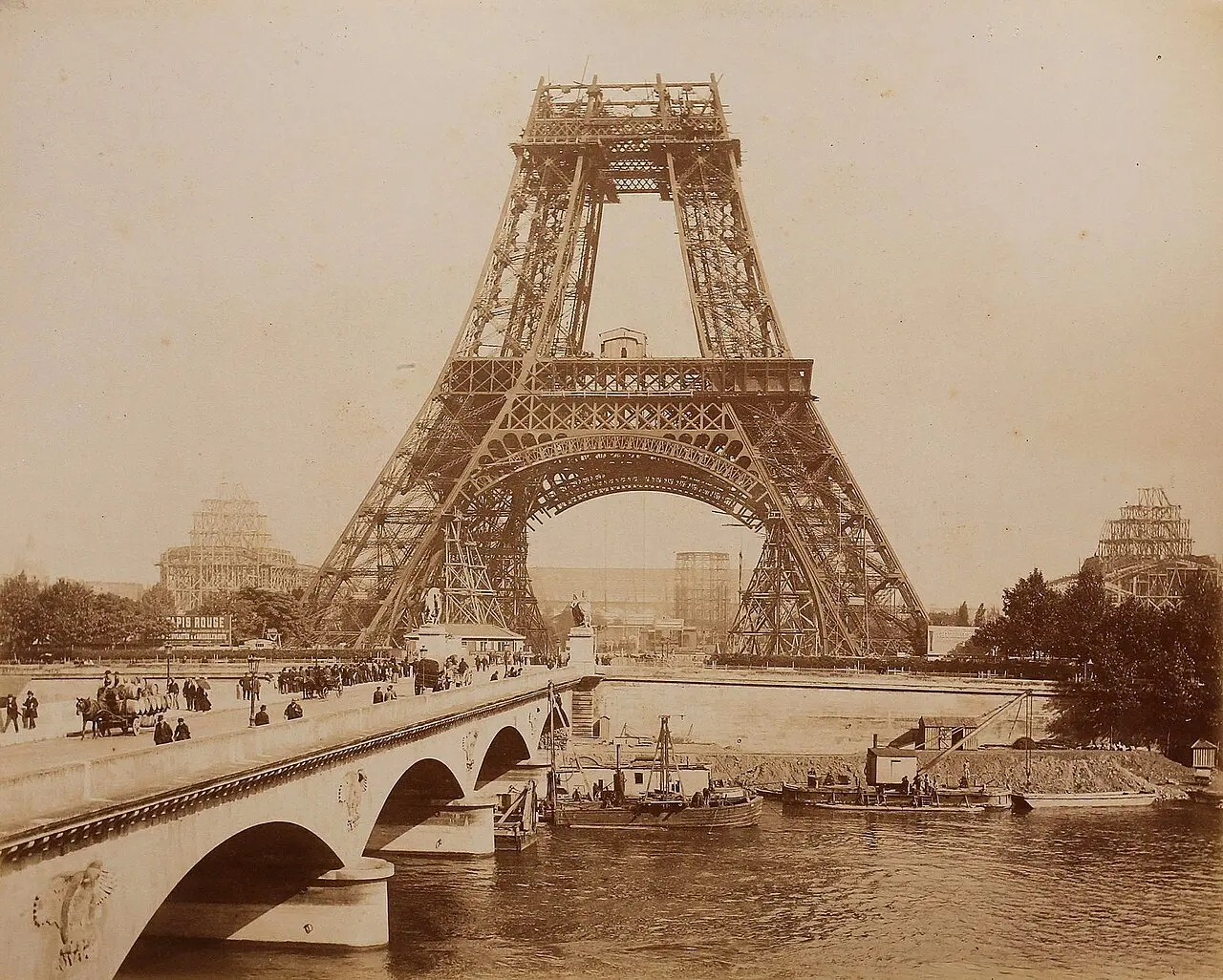

Besides, he asked, how could anyone judge a tower nobody had seen, from a mere drawing? The curves of its four edges, calculated to resist the wind, would give “a great impression of strength and beauty,” he said. “I believe, myself, that my tower will be beautiful.” And if the pyramids of Egypt were admired, why should the same thing be hideous and ridiculous in Paris?
A place where you can’t see it
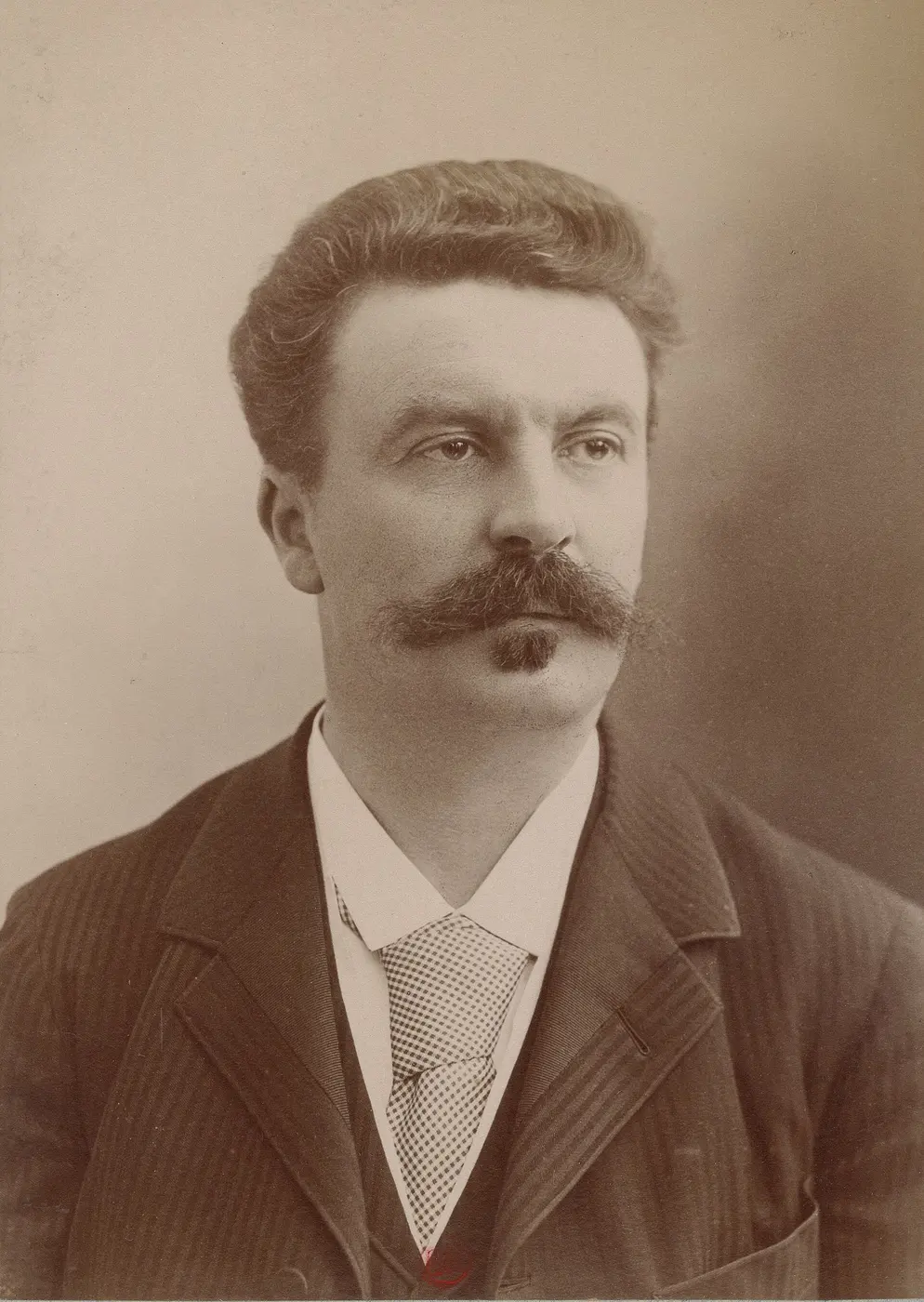
The tower was finished in 1889 and became one of the Exposition’s great attractions. Maupassant, however, does not seem to have changed his mind. He opened his 1890 travel book La Vie errante (“The Wandering Life”) like this:
I left Paris, and even France, because the Eiffel Tower had finally become too much of a bore.
You could see it from everywhere, he complained, and find it everywhere, reproduced in every known material in every shop window: “an inescapable and tormenting nightmare.” He called it a “tall, skinny pyramid of iron ladders” and a “giant, ungainly skeleton.”
So what about the restaurant? The story became widely known through the opening of “The Eiffel Tower,” an essay the French critic Roland Barthes published in 1964. Barthes wrote that Maupassant often lunched at the tower’s restaurant, though he did not care for the food, because, he used to say, it was the only place in Paris where he did not have to see it. But Barthes gave no source, and he was writing more than 70 years after Maupassant’s death in 1893. What can be confirmed in Maupassant’s own words is the opening line of La Vie errante.

Saved by radio
Eiffel’s twenty years ran out on December 31, 1909. The tower is often said to have been “scheduled for demolition” after two decades, but as Eiffel described the deal in 1887, the city could simply do as it liked with it once the term was up. Still, visitor numbers had fallen, and some did suggest tearing it down.
Eiffel set out to prove the tower useful to science. In 1898 the engineer Eugène Ducretet sent wireless signals from the top to the Panthéon, about 4 km (2.5 miles) away. In 1903 Captain Gustave Ferrié of the army proposed using the tower for a military radio network. According to the Société astronomique de France, Eiffel agreed that December to fund the project himself, to the tune of 40,000 francs. By 1908, signals were found to reach as far as 6,000 km (3,700 miles).
The tower had become an indispensable antenna, and its concession was extended for 70 years from January 1, 1910. The tower once denounced as useless had survived by being useful.