Why were Japan’s “Black Ships” black?
The name first meant Portuguese ships of the 16th century, whose hulls were coated in black tar. Commodore Perry’s squadron inherited a label that was already more than 250 years old.
266years
On July 8, 1853, four American warships under Commodore Matthew C. Perry dropped anchor off Uraga, at the mouth of Edo Bay (now Tokyo Bay). The Japanese called them kurofune, “black ships,” and the name has been part of the story of Japan’s opening to the world ever since.
The word itself, however, was more than 260 years old by then. The first black ships were not American at all.
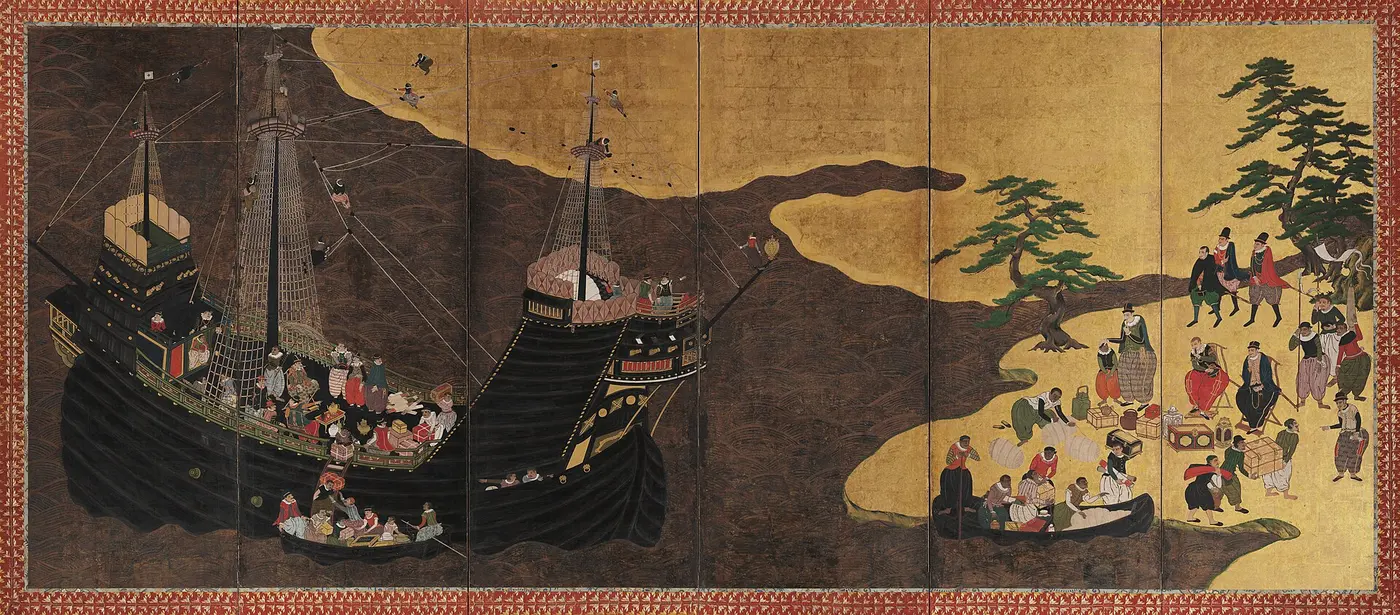
The first black ships were Portuguese
According to the Yamakawa dictionary of Japanese history, the word kurofune first appears in the historical record in 1587, in the edict with which the warlord Toyotomi Hideyoshi ordered Christian missionaries out of Japan. The missionaries had to leave, the edict said, but the black ships came for trade and were a different matter: commerce could go on.
The black ships of that time were the large sailing ships that came from Portugal’s outposts in Asia. According to the Nihon Kokugo Daijiten, Japan’s largest dictionary, the name began as a way of telling these black-hulled European vessels apart from ships of the Chinese type that came from Ming China, Vietnam and Siam. Curofune even appears in the Japanese–Portuguese dictionary that Jesuit missionaries printed in Nagasaki in 1603–04.
The Portuguese ships carried Chinese raw silk to Japan, much of it by way of Macau. A collection of comic tales from 1628 mentions a year in which the black ship failed to come and the price of silk thread soared in Nishijin, Kyoto’s weaving district. The black ships could sway the fortunes of the capital’s silk weavers.

Black from tar
So why were they black? The Yamakawa dictionary and the Japanese edition of the Britannica both say the Portuguese hulls were coated with black tar.
Tar and pitch are sticky black substances made by slowly charring wood, especially pine, and they were smeared on wooden ships to keep water out of the seams and the hull. European ships of the 16th century used them in quantity. A 1985 paper in Nature analyzed the pitch from the Mary Rose, the English warship that sank in 1545, and noted that large amounts of it had soaked into the ship and many of the objects aboard. Chemical fingerprinting showed it was made from pine.
The name survived Japan’s long period of seclusion. By the final years of the Edo period (1603–1868), when Western ships, steamers among them, began calling more and more often, kurofune had come to mean any Western-style ship, according to the Nihon Kokugo Daijiten.
Only two of Perry’s four were steamers
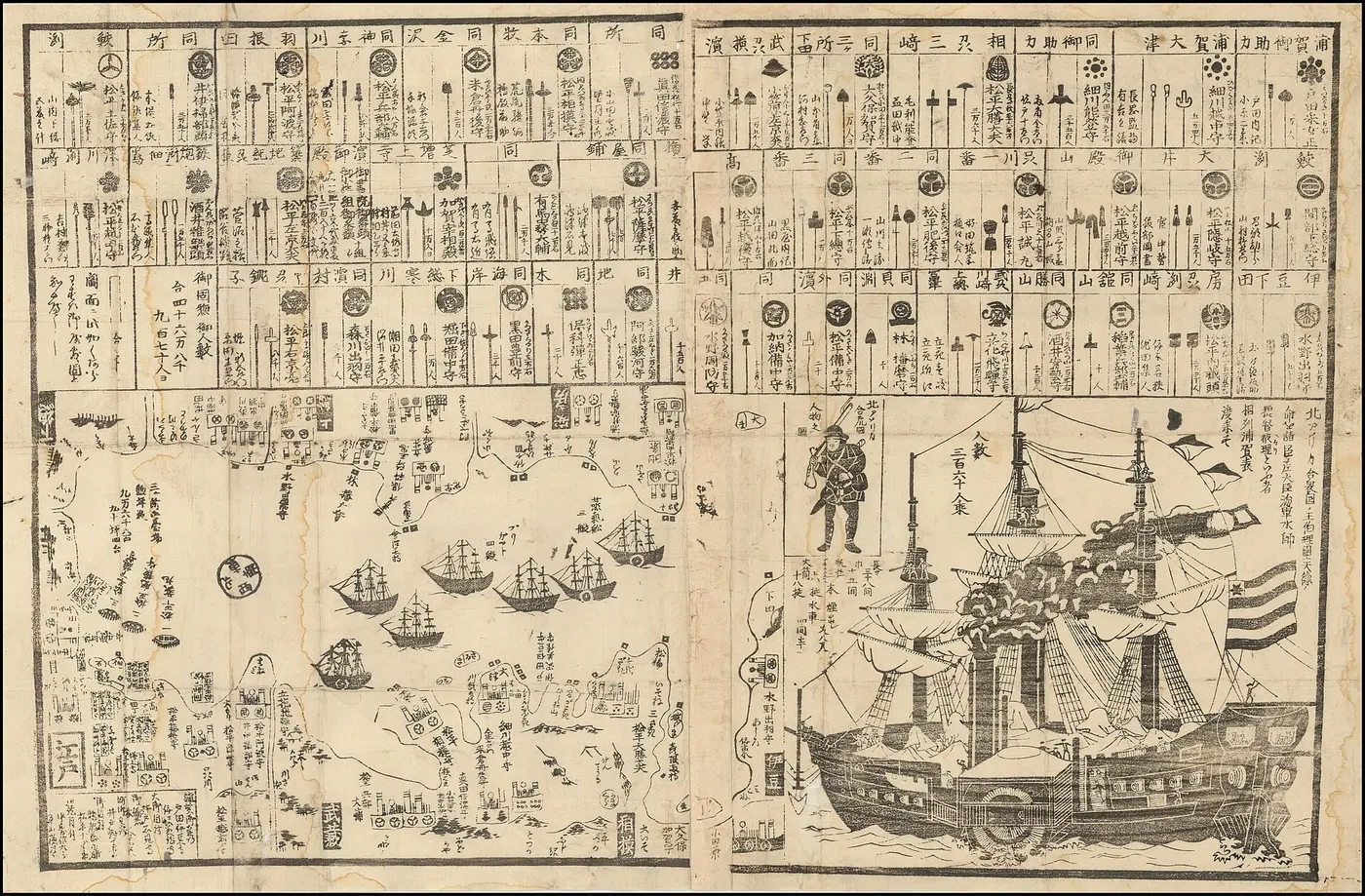
Perry’s squadron in 1853 consisted of two side-wheel steam frigates, the Susquehanna and the Mississippi, and two sailing sloops, the Saratoga and the Plymouth. According to the American historian John W. Dower, the two steamers entered the bay towing the sloops, under a cloud of black smoke and without a sail in sight.
Dower also notes that Japanese artists and illustrators rushed out to draw the black ships almost the moment they appeared. Ships that moved without wind and belched smoke made a deep impression, and the old name stuck to them. Perry returned in 1854 with nine vessels, three of them steamers, and that year Japan signed its first treaty with the United States.

“Just four cups”
Perry’s arrival is famously linked to a satirical verse: “Jōkisen, the tea that wakes us from our peaceful sleep; just four cups, and we can’t sleep at night.” According to the Nihon Kokugo Daijiten, jōkisen was a fine grade of a green tea called Kisen. The verse is a pun: jōkisen sounds like the Japanese word for steamship, and the word for “cups” is also a counter for boats. Four cups of strong tea, or four ships, and the whole country lies awake. In fact, only two of the four were steamships.
The verse was passed down anonymously, and some have questioned whether it really dates from 1853. Papers in Kaikokushi Kenkyū, the journal of a Yokosuka-based society that studies the opening of Japan, have examined the verse. One of them, published in 2010, showed that a version beginning “Taihei no nemuke o samasu jōkisen” was already circulating just after the fleet arrived. The wording differed a little, but people seem to have been joking about the tea and the steamers almost at once.