Who took the first picture of Earth rising over the Moon?
The famous “Earthrise” was taken by astronaut Bill Anders on Apollo 8 in 1968. But an uncrewed probe, Lunar Orbiter 1, had photographed Earth above the Moon’s horizon two years earlier.
Over the Moon’s barren horizon, a blue-and-white Earth hangs half in shadow. The photograph known as “Earthrise” was taken in 1968 on Apollo 8, the first mission to carry people around the Moon, and a NASA film describes it as an iconic image of the 20th century.
Yet the picture wasn’t in the flight plan. Nor was it the first time a camera had caught Earth rising over the Moon.
An unscheduled shot
Apollo 8 launched on December 21, 1968, with Frank Borman, Jim Lovell and Bill Anders aboard, and entered lunar orbit on December 24.
According to NASA’s account of a later reconstruction, it was a few minutes after 10:30 a.m. Houston time on the 24th, and the spacecraft was coming around from the far side of the Moon for the fourth time. Borman, the commander, was turning the spacecraft as scheduled. Anders was looking at the Moon through his side window and taking pictures with a Hasselblad camera fitted with a 250 mm telephoto lens. Then Earth came into view.
The onboard tape recorder caught the moment. “Oh my God, look at that picture over there! There’s the Earth comin’ up. Wow, is that pretty!” Anders exclaimed. Borman replied, “Hey, don’t take that, it’s not scheduled.” Anders took a black-and-white shot anyway, then called out, “You got a color film, Jim? Hand me a roll of color, quick, would you?” Lovell found one, and Anders took two color frames as Lovell read out the exposure: “Two-fifty at f/11.” One of those color frames became the Earthrise that went around the world.
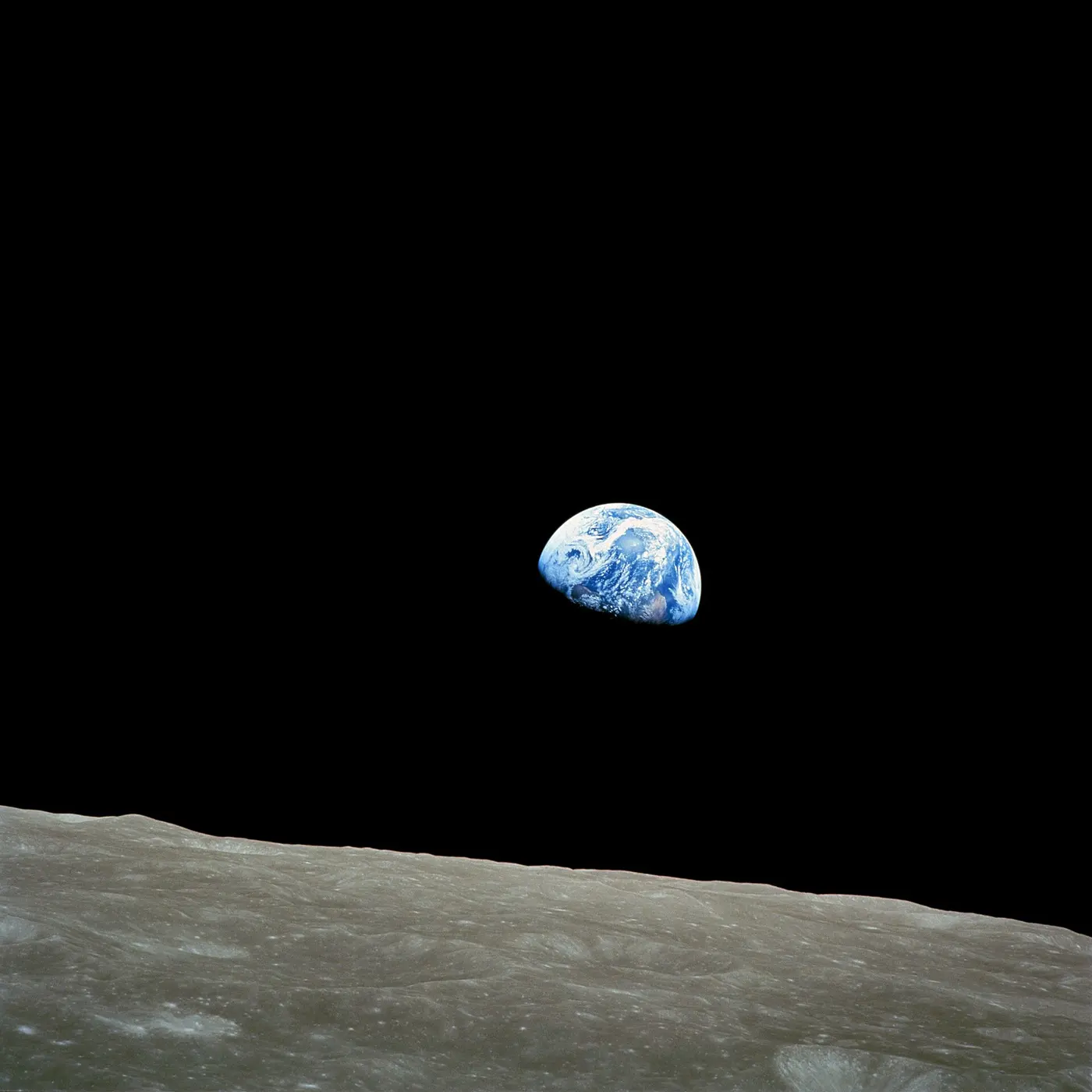

Who took it?
For decades, the photographer’s identity was disputed. In his autobiography, Countdown, Borman wrote that he had taken the famous color picture. And because Borman’s and Anders’s voices sound alike on the tape, it was hard to tell who had first cried out at the sight.
The answer came from a spacecraft launched four decades later. In 2013 Ernie Wright of NASA’s Goddard Space Flight Center combined detailed terrain maps from the Lunar Reconnaissance Orbiter with photos that a camera mounted in one of Apollo 8’s windows had taken every 20 seconds. That let him work out exactly how the spacecraft was oriented and through which window Earth appeared. NASA’s resulting reconstruction identifies Anders as the one who cried out and credits all three photos to him.
There is another surprise. Apollo 8 was orbiting near the Moon’s equator, and from the spacecraft, Earth emerged beside a vertical lunar horizon. According to the Apollo Flight Journal, Anders himself has said that this is how he sees the image. The familiar version was rotated so that the horizon runs left to right, like a sunrise photographed on Earth.
Beaten by a robot
The Moon’s horizon and Earth had in fact been photographed together more than two years before Apollo 8, by NASA’s uncrewed Lunar Orbiter 1.
Lunar Orbiter 1 was built to photograph the lunar surface and help choose safe landing sites for the Surveyor and Apollo missions. According to NASA, on August 23, 1966, on its 16th orbit and just about to pass behind the Moon, it photographed a crescent Earth. The image was received at NASA’s tracking station near Madrid, Spain, and released as the first view of Earth taken by a spacecraft from the vicinity of the Moon. Strictly speaking, since the probe was heading around to the far side, Earth was not rising in that picture but setting.
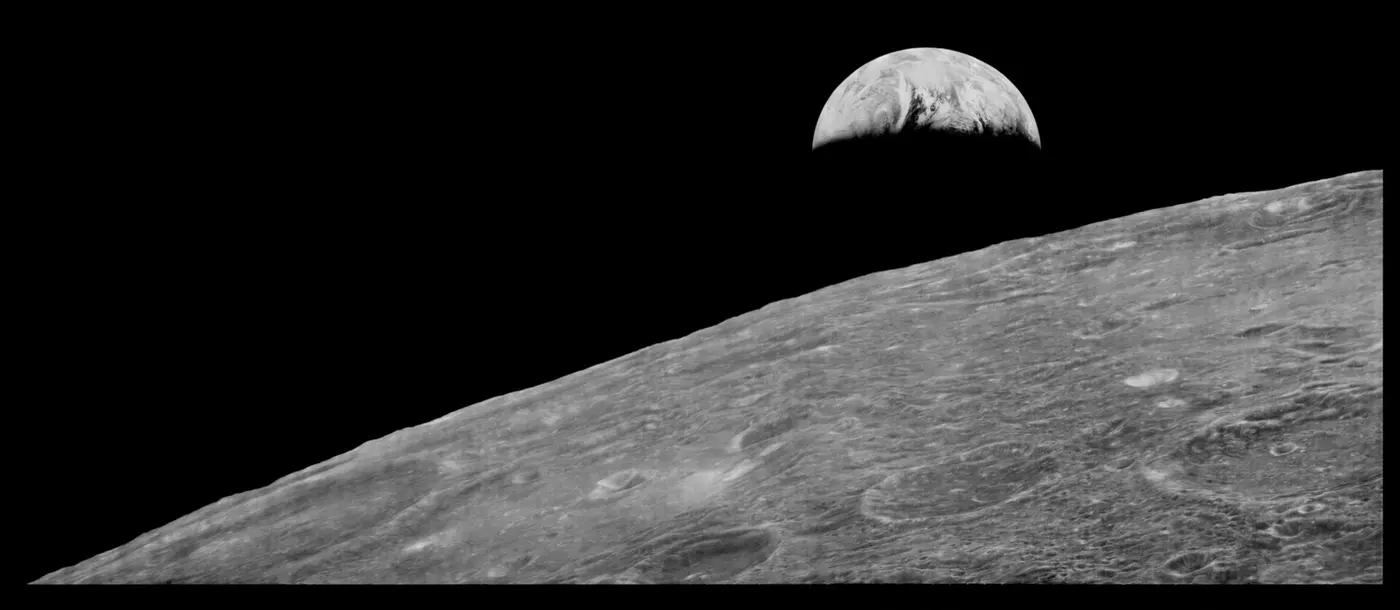

That picture was grainy and black and white, though in 2008 NASA restored it from the original data at a far higher resolution. Apollo 8’s black-and-white frame, meanwhile, was the first photograph of an Earthrise taken by a human watching it happen. And the color frame went on to show the world its blue planet floating in the dark.
You can’t watch it from the surface
Could you stand on the Moon and watch Earth rise? No. The Moon always keeps the same face toward Earth, so from the near side, Earth stays in almost the same spot in the sky. Earth rises over the horizon only for a spacecraft orbiting the Moon.
The Japan Aerospace Exploration Agency (JAXA) and the broadcaster NHK made the same point in November 2007, when Japan’s lunar orbiter Kaguya took the world’s first high-definition video of an Earthrise. In April 2008 Kaguya also filmed a “full Earthrise,” with Earth fully lit, catching an alignment of the Moon, Earth, Sun and the spacecraft’s orbit that occurs only twice a year.