How does the toilet on the space station work?
It uses airflow to pull waste away from the body. Urine is recycled into drinking water, and solid waste is packed into a cargo ship that burns up in the atmosphere.
45min
Toilets on Earth rely on gravity. Whatever you leave drops into the bowl, and water flushes it away. Aboard the International Space Station (ISS), nothing falls. Without care, whatever you leave behind starts drifting around the cabin.
When NASA sent a new toilet to the ISS in 2020, it introduced it by calling “how do astronauts go to the bathroom in space?” the “space-age old question.” The key to the answer is air.
A toilet that runs on air
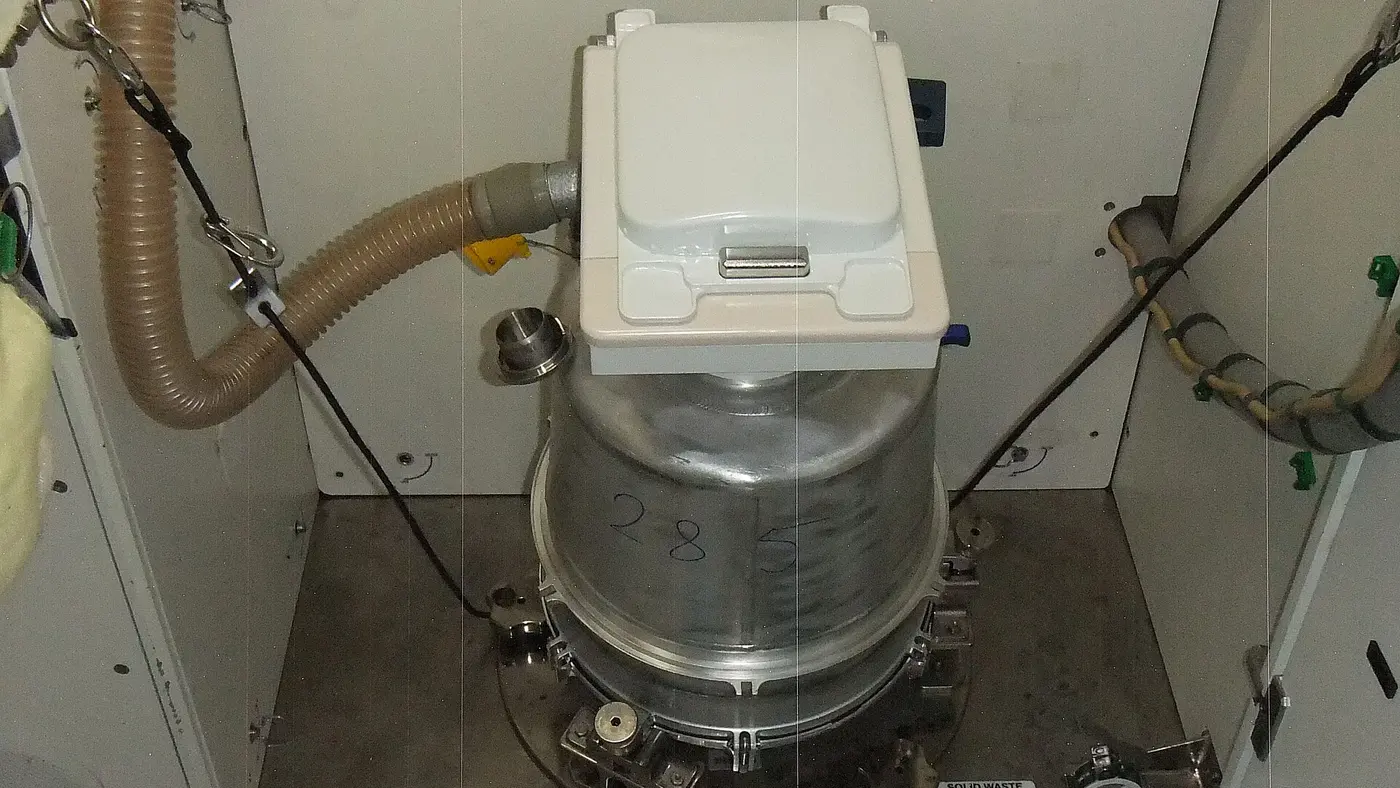
According to NASA, space toilets use airflow, instead of gravity, to pull urine and feces away from the body and into the proper containers. Urine goes into a funnel attached to a hose. For bowel movements there is a small seat, which NASA admits looks uncomfortably small and pointy, but in microgravity it gives just the right body contact to make sure everything goes where it should. Foot restraints and handholds keep the user from floating away.
Solid waste goes into individual watertight bags, which are compacted in a removable canister. A few canisters are returned to Earth for study, but most are loaded into a cargo ship that burns up when it reenters the atmosphere.
In October 2020, a Northrop Grumman Cygnus cargo ship delivered a new toilet to the ISS, the Universal Waste Management System (UWMS). NASA says it is 65 percent smaller and 40 percent lighter than the station’s previous toilet. Airflow starts automatically when the lid is lifted, which also helps control odor, and the funnel and the seat can be used at the same time, a feature that reflects feedback from female astronauts.

Urine isn’t thrown away; it becomes drinking water. A urine processor distills water out of it, and that water is purified along with moisture collected from the crew’s sweat and breath. In 2023, NASA announced that the system had reached its goal of recovering 98 percent of the station’s water. As NASA astronaut Jessica Meir put it, “today’s coffee is tomorrow’s coffee!”
America’s first astronaut went in his suit
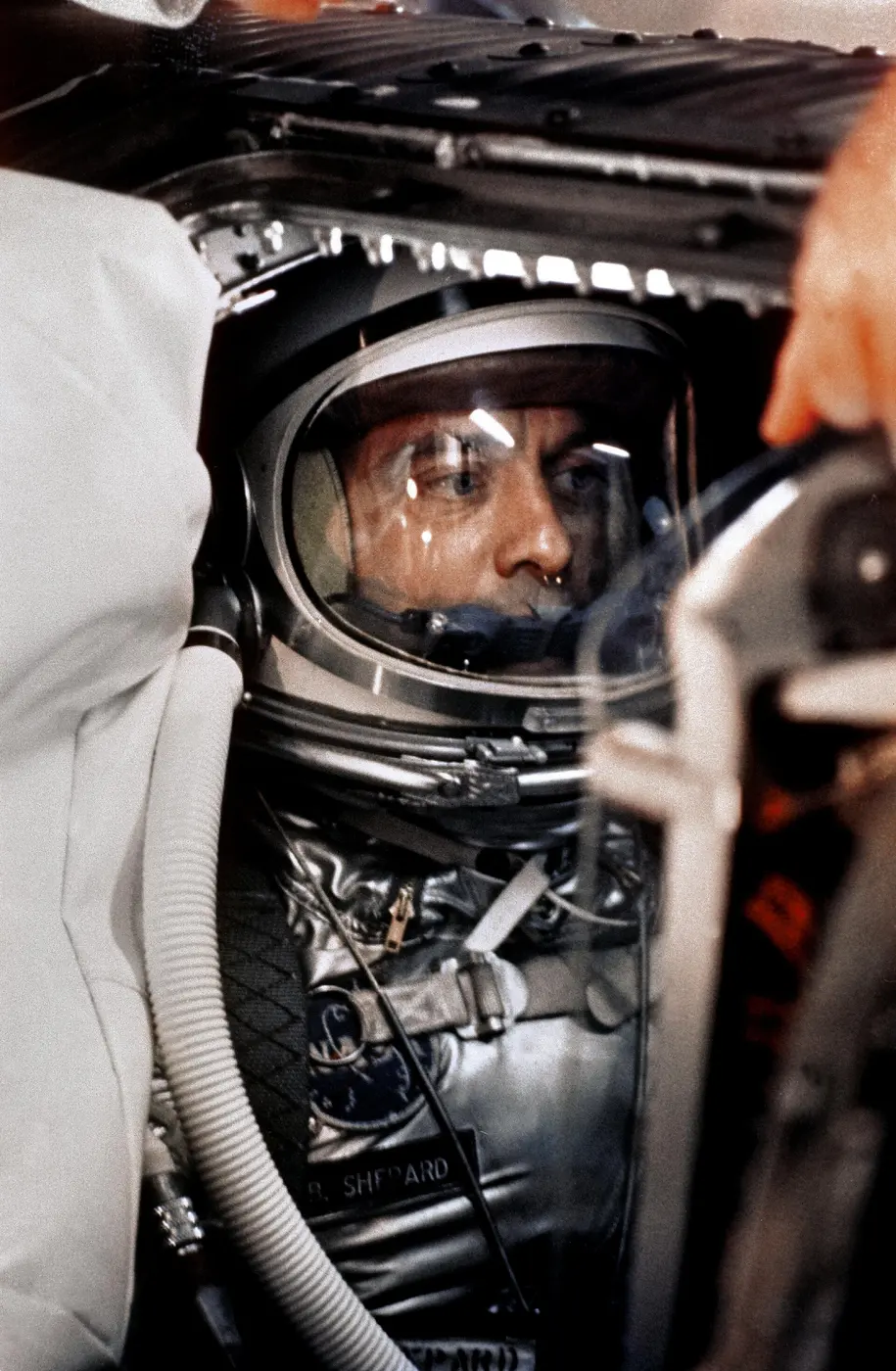
Space toilets weren’t there from the start. On May 5, 1961, Alan Shepard waited for launch on the first American human spaceflight in a spacesuit with no way to urinate. According to a 2013 paper by Hunter Hollins of the Smithsonian’s National Air and Space Museum, NASA had discounted the need, since the flight was planned to last only about 15 minutes. But the wait before launch dragged on, and Shepard ended up relieving himself in his suit, short-circuiting the electronic sensors attached to his body. When John Glenn orbited Earth on February 20, 1962, he wore a urine collection device.
The Apollo spacecraft that flew to the Moon had no toilet either. According to the National Air and Space Museum, astronauts used a bag with an adhesive rim that they stuck to themselves. Afterward, they sealed it with a germicide, put it in an outer bag, and stowed it in a box built into the spacecraft. A NASA medical document records Apollo crews reporting that the whole process took about 45 minutes, and that the bag “doesn’t stick to your butt well,” making it “a complete mess.”

Diapers and a broken toilet
Astronauts who can’t take off their spacesuits can’t use a toilet. According to NASA medical documents, they wear a diaper-like Maximum Absorbency Garment (MAG) under their suits for launch, landing and spacewalks. NASA advises removing MAGs as soon as possible afterward because they irritate the skin.
When a space toilet breaks, it’s a crisis. In May 2008, a pump failed in the toilet in the Russian segment of the ISS, and it could no longer collect urine properly. The Russians rushed a replacement pump to the launch site, and it flew up on the space shuttle Discovery, along with the pressurized laboratory of Kibo, Japan’s research module, and the Japanese astronaut Akihiko Hoshide. According to NASA, cosmonaut Oleg Kononenko installed the pump and returned the toilet to service.