Was doria invented in Japan?
Yes. It is said to have been created at the Hotel New Grand in Yokohama by its Swiss head chef, for a guest who was feeling unwell.
Buttered rice, a layer of creamy sauce, a blanket of cheese, all baked in the oven until bubbling and golden. In Japan, doria is a fixture of yoshoku, the Western-style dishes that Japanese cooks adapted from European cuisine, and it turns up everywhere from old-fashioned diners to family restaurant chains. With its European-sounding name, it often appears on the menus of Italian restaurants, too.
Yet doria was born in Japan. According to the story, it was improvised by a hotel chef in Yokohama, the port city next to Tokyo, for a single guest.
A dish for a guest under the weather
The scene is the Hotel New Grand in Yokohama. The hotel opened in 1927 as a symbol of the city’s recovery from the Great Kanto Earthquake of 1923, which had left Yokohama in ruins. Its first head chef was a Swiss cook named Saly Weil. According to the hotel, Weil was recruited from Paris and arrived in Japan on October 29, 1927, at the age of 30.
The hotel tells the story of doria like this. One day, a foreign banker staying at the hotel told the kitchen that he was not feeling well and asked for something that would be easy to swallow. Weil improvised: he spooned shrimp simmered in cream over buttered rice, poured on a gratin sauce, sprinkled it with cheese and baked it. The guest was delighted, and the dish became one of the hotel’s signatures under the name “Shrimp Doria.”
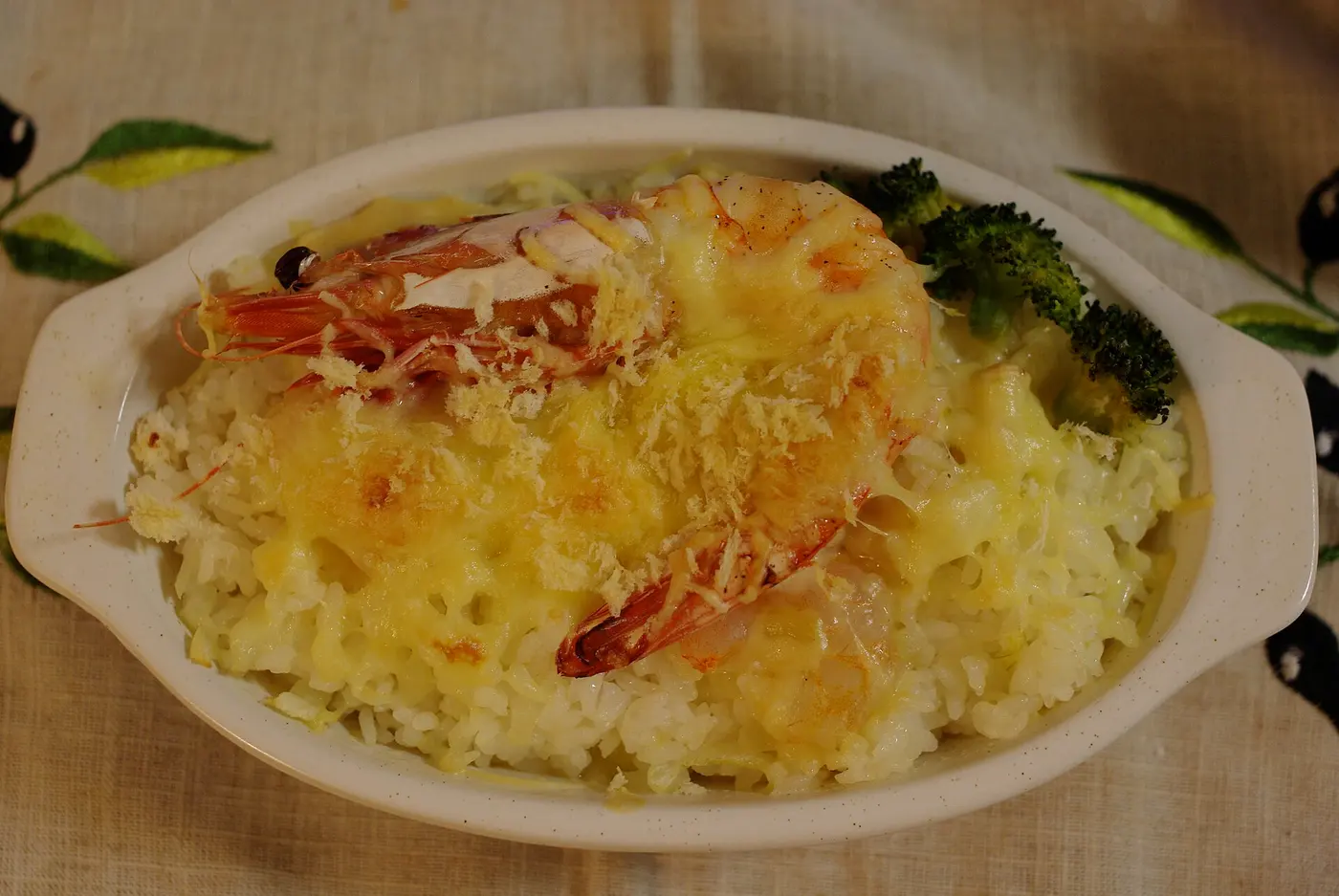

The hotel does not say exactly when this happened. Some accounts give a date of around 1930, but we could not find a record to support it. If the hotel’s story is right, it took place while Weil was head chef.
The “Swiss Papa” and his legacy
Alongside classic French cuisine, Weil introduced à la carte dining, then still unusual in Japan, so that guests could order a single dish and enjoy their meal more casually. After the war he returned to Switzerland, where he continued to help Japanese cooks who wanted to train in Europe. His many protégés called him “Swiss Papa,” the hotel says.
According to the hotel, doria quickly became popular and spread from there across Japan. Today it is everywhere, from hotel dining rooms to the frozen food aisle. The same hotel is also credited with another yoshoku classic: after the war, its second head chef, Shigetada Irie, created the dish regarded as the forerunner of spaghetti Napolitan. A single hotel in Yokohama gave Japan several of its best-loved Western-style dishes.
What’s in a name?
So why “doria”? The name was not Weil’s invention. French cooking already had a number of dishes called “Doria.”
Open the 1907 edition of Le Guide Culinaire by the great French chef Auguste Escoffier and you will find consommé Doria, sole meunière Doria and chicken sautéed Doria. What they have in common is a garnish of cucumber. None of them looks anything like a rice gratin. Escoffier himself added a note: because recipes called “à la Doria” were made in so many confusingly different ways, he had decided to follow the majority view and treat the cucumber garnish as the defining feature. Even in France, in other words, the name had no settled meaning.


The name is often said to honor the Doria family of Genoa, one of the great noble houses of Italy, whose most famous member was the 16th-century admiral Andrea Doria. But no clear record explains which dish was linked to the family, or how, so this remains a popular theory rather than an established fact. Nor does the hotel’s account explain why Weil gave the name to a dish without a single slice of cucumber.
Either way, calling rice baked with sauce and cheese “doria” is a Japanese usage. The Japanese food dictionary Sekai no Ryori ga Wakaru Jiten defines doria as buttered rice or pilaf topped with béchamel sauce and baked in the oven, and notes that it is said to have been created by Weil.