Are Marie Curie’s notebooks still radioactive?
Yes, they still carry radioactive contamination. But standing in front of two of them in a display case for ten minutes gives a dose about 5,000 times smaller than what we get from natural background radiation in a day.
1,600years
Marie Curie (1867–1934), born Maria Skłodowska in Poland, pioneered the study of radioactivity with her husband Pierre and discovered two elements, polonium and radium. She won the Nobel Prize in Physics in 1903 and the Nobel Prize in Chemistry in 1911.
Her laboratory notebooks are now held by the Department of Manuscripts at the Bibliothèque nationale de France (BnF) in Paris. Online, you will often read that they are still radioactive, that they are kept in lead-lined boxes, and that anyone who wants to see them must wear protective clothing and sign a liability waiver. Let’s check that against what the BnF itself says.
Ore handled with bare hands
According to the BnF, Marie Curie took up the physicist Henri Becquerel’s research on the rays given off by uranium for her doctorate. Between September 1897 and March 1898, with Pierre’s help, she studied two uranium ores, pitchblende and chalcolite. By separating their components step by step, the couple tracked down two new elements far more active than uranium: polonium, named after Marie’s native Poland, and radium.
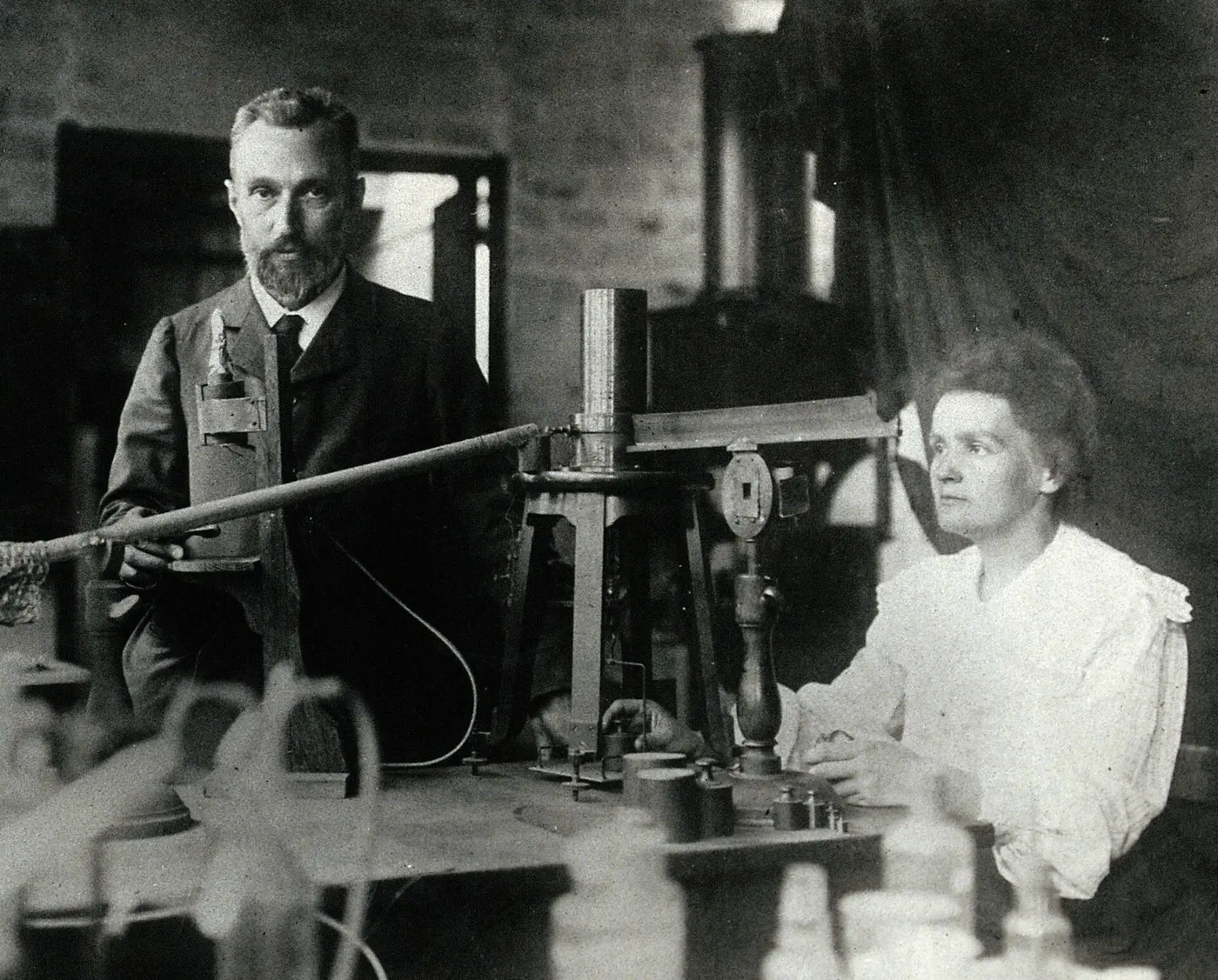
At the time, no one knew radiation was dangerous. The BnF points out that photographs show the Curies at work without masks, gloves or lab coats. The powdery radioactive materials got everywhere: on the workbenches, on their hands, on their clothes and on paper. Every time they jotted down a calculation, turned a page or left a notebook open on the bench while waiting for the next measurement, they contaminated their own records. Particles absorbed into the paper and covers, especially cloth covers, are still active today.

According to France’s Laboratoire National Henri Becquerel, it takes about 1,600 years for half of a given amount of radium-226, the radium the Curies worked with, to decay. So if radium remains in the notebooks, roughly 95 percent of it should still be there, nearly 130 years after its discovery.
How the BnF protects them
The notebooks came to the library thanks to a donation by Curie’s descendants, first planned in 1967. According to an article in the BnF’s magazine Chroniques, the contamination was taken into account from the start. Measurements, decontamination and microfilming were carried out under the supervision of specialist services of the French health ministry and the Institut de physique nucléaire. The most contaminated sheets were encapsulated, and some covers were sealed in plastic, to block alpha and beta radiation. Only then, in 1970, did the papers formally enter the collection.
Further safety reviews followed in 1996 and from 2020, and the most recent one led to stronger measures to protect people and the environment. Today the original volumes can be consulted only in response to very specific requests, under a strict monitoring protocol. Microfilms were made so the originals could stay put, and many pages can now be viewed online in Gallica, the BnF’s digital library.
The BnF’s own accounts, however, say nothing about lead boxes or waivers signed by readers. Those details may simply be embellishments picked up as the story was retold.
Ten minutes at the display case
The BnF has displayed two of Curie’s notebooks in a glass case in its museum. For the display, Marc Ammerich, a radiation protection expert and former nuclear inspector at France’s Alternative Energies and Atomic Energy Commission (CEA), measured the radiation around the case.
His finding: someone standing in front of the case for ten minutes would receive about 2 nanosieverts. According to the BnF, that is about 5,000 times less than the dose we receive from natural radiation in a single day. Looking at the notebooks through glass is nothing to worry about.
Curie’s own health
The person who really paid the price was Curie herself. According to the American Institute of Physics (AIP), she learned in 1920 that she had cataracts in both eyes, a condition that radiation is now known to cause, and needed four operations. That same year she wrote to her sister, “Perhaps radium has something to do with these troubles, but it cannot be affirmed with certainty.”


In May 1934 she went home sick from the lab and never returned. She died on July 4, 1934, at a sanatorium in Savoy, in the French Alps. The sanatorium’s director reported that the disease was “an aplastic pernicious anemia of rapid, feverish development,” adding that “the bone marrow did not react, probably because it had been injured by a long accumulation of radiations.” Her chemistry laboratory at the Radium Institute was so contaminated that it had to be cleaned up when it was reconstructed in 1981.