Do toilets flush the other way in the Southern Hemisphere?
No. The direction a toilet swirls is set by the shape of the bowl and the way the water flows in. Earth’s rotation is far too weak to show up at that scale.
24 hours
Fill a sink, pull the plug, and a little whirlpool forms over the drain. In the Northern Hemisphere, so the story goes, it always turns counterclockwise, and in the Southern Hemisphere clockwise, thanks to the “Coriolis force” produced by Earth’s rotation.
Hurricanes and typhoons really do spin in opposite directions on either side of the equator. So do sinks and toilets follow suit?
The force that turns hurricanes
The Coriolis force is an apparent force that acts on anything moving across a rotating surface. It is named after Gaspard-Gustave de Coriolis, the French engineer and mathematician who worked out its theory in the early 19th century. On Earth, it deflects moving objects to the right in the Northern Hemisphere and to the left in the Southern Hemisphere.
That is why hurricanes and typhoons turn counterclockwise, seen from above, in the north and clockwise in the south. As air rushes toward a storm’s low-pressure center, it is steadily nudged to one side, and the whole system winds up into a spiral.
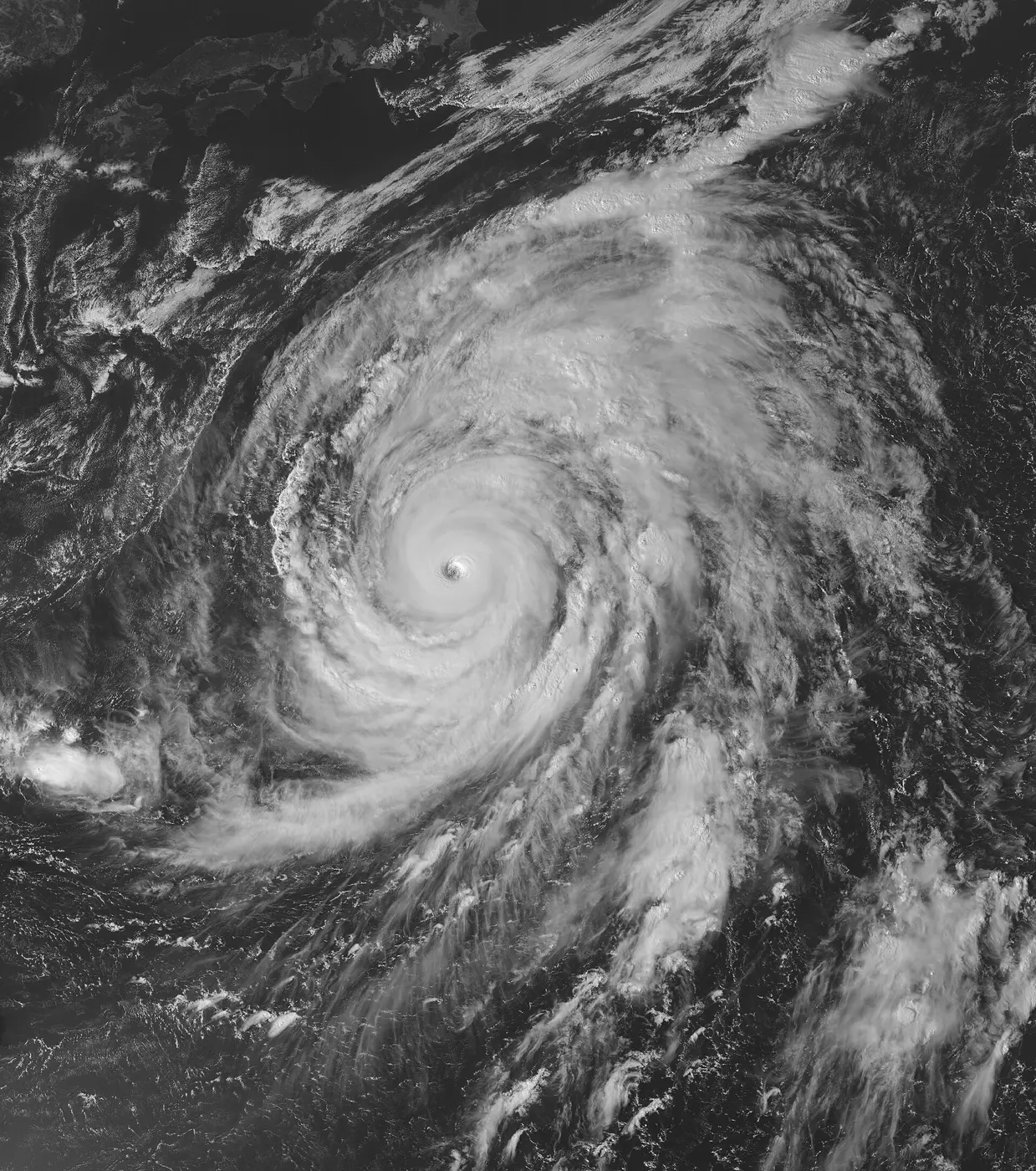

But the force is extremely weak. The Japanese edition of the Britannica encyclopedia notes that even a train traveling east at 250 km/h (155 mph) feels a Coriolis force only about a thousandth as strong as gravity. In a storm hundreds of kilometers across that lasts for days, those tiny nudges add up. In anything small and quick, they barely register.
Lost in the noise
Writing for Scientific American’s website, Thomas Humphrey, a scientist at the Exploratorium in San Francisco, explained that at mid-latitudes the Coriolis acceleration is about one ten-millionth the acceleration of gravity, far too small to matter in a sink or toilet. Any basin of water carries some leftover swirl from being filled, and that easily overwhelms Earth’s rotation. Asymmetries such as an off-center faucet also steer the direction.
Alistair Fraser, a meteorologist at Penn State University, adds a sense of scale: Earth turns once a day, while water going down a drain spins around in a few seconds. In a toilet, the swirl comes from the way water squirts out from under the rim when you flush. The same model of toilet swirls the same way whichever hemisphere it is installed in.
A day’s wait
Can Earth’s spin be seen in a basin at all? In 1962, Ascher Shapiro, a mechanical engineer at the Massachusetts Institute of Technology (MIT), set out to find out under the most careful conditions he could manage.
He filled a round, bathtub-size tank with about 15 centimeters (6 inches) of water, covered it with plastic sheeting to keep out drafts, and controlled the room’s temperature. He deliberately swirled the water clockwise as it went in, so that a counterclockwise vortex could not be blamed on the filling. Then he let the water sit for 24 hours and drained it through a small hole in the center of the bottom.
A float made of two crossed slivers of wood sat over the drain. For the first 12 to 15 minutes of the 20-minute drain, it did not move. Then it began to turn, almost imperceptibly, counterclockwise, eventually reaching about one revolution every three to four seconds.
Shapiro reported his results in Nature that year. In everyday sinks and bathtubs, he wrote, the direction seems to vary unpredictably, but under well-controlled conditions an observer in the Northern Hemisphere will always see a counterclockwise vortex. Researchers at the University of Sydney later used the same method and found a clockwise vortex in the Southern Hemisphere. The effect is real. It just takes a full day of stillness to see it.
The equator show
At some tourist spots near the equator, you can watch the effect “demonstrated.” In Nanyuki, Kenya, performers have carried a basin of water a short way north and then south of the equator line, pulled the plug, and shown the water swirling one way, then the other, and then draining straight down right on the line.


According to Fraser, it’s a trick. Moving such a short distance makes no real difference to the Coriolis force, and on the equator itself the horizontal effect is zero. The performer, he explains, uses a nearly square pan and quietly sets the water turning while walking. When Fraser tried the stunt himself, it worked the first time.