Why do speed skates have heels that come loose?
Letting the heel lift lets skaters push with the ankle right to the end of each stroke while the whole blade stays on the ice. It made them about 5 percent faster.
5%
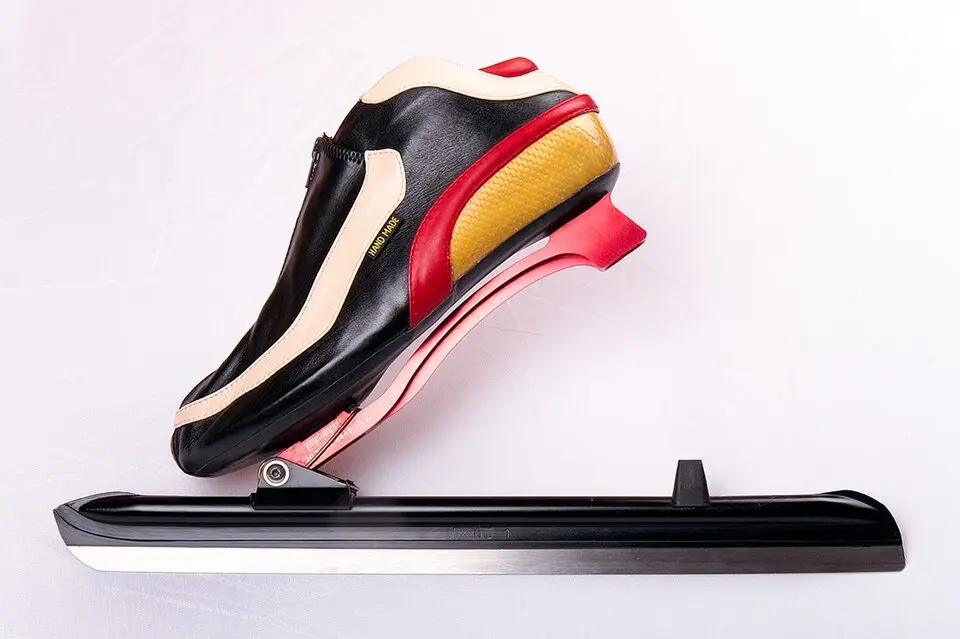
Watch a long-track speed skating race closely and you will notice something odd. Each time a skater pushes off, the heel of the boot lifts away from the blade, then clicks back into place as the leg swings forward. This is the clap skate, also known as the slapskate, or klapschaats in Dutch.
The blade is attached to the boot only by a hinge under the ball of the foot, and a spring pulls the heel end back down. So why would anyone want a skate whose heel comes loose?
The problem with a fixed blade
On a traditional speed skate, the blade is fixed firmly to the sole. Speed skaters move forward by gliding the blade over the ice while pushing sideways. If they extend the ankle at the end of the push to get in one last shove, the boot tips forward, the front of the blade digs into the ice, and the glide is ruined.
So skaters had to fight the urge to point their toes, keeping the blade flat on the ice right to the end of the stroke. The calf muscles, one of the strongest engines in the leg, could never be used to their full extent.

What a loose heel changes
On a clap skate, extending the ankle simply lifts the heel off the blade, while the whole length of the blade stays in contact with the ice. The ankle’s push goes into the ice without spoiling the glide.
A team at the Vrije Universiteit Amsterdam in the Netherlands asked 10 elite skaters to skate four 400-meter laps at full effort on both conventional skates and clap skates, and analyzed their movements in detail. Their results, published in 2000, showed that on clap skates the skaters were on average 5 percent faster, thanks to an average of 25 watts more power.
The difference appeared in roughly the last 0.05 seconds of each push. On a conventional skate, the foot pivots around the long front end of the blade, which makes the push-off inefficient. Moving the pivot to just under the ball of the foot made that final shove count.
A 19th-century patent, and a decade of neglect
The idea of a skate with a loose heel is much older than you might think. In 1894, Karl Hannes of Germany applied for a patent on a hinged skate.
The man who developed it seriously was Gerrit Jan van Ingen Schenau, a biomechanist at the Vrije Universiteit Amsterdam who studied the movements of speed skating. He began working on a hinged skate in 1979, and in 1985 the Dutch maker Viking began testing clap skates in cooperation with him. According to Dutch media, when his team tried to patent the design, a search turned up Hannes’s old patent, and they were not granted one.
The bigger obstacle was the skaters themselves. The new skate demanded a different technique, and top athletes feared it would damage the skills they already had. For more than a decade, it stayed out of the limelight.
1997: the record book is rewritten
Things changed in the 1996–97 season, when the Dutch women’s team began using clap skates. In 1997, Tonny de Jong won the European all-round championships on them. Germany’s Gunda Niemann, the reigning world champion, finished second and argued that the skate was illegal and should be banned.
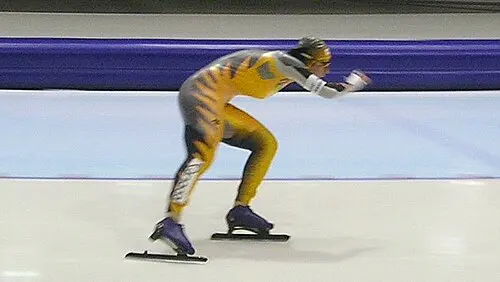

There was no stopping it. In the 1997–98 season, the world records in all 10 Olympic distances for men and women were either broken or equaled. The 1998 Winter Olympics in Nagano, Japan, produced five world records, and Hiroyasu Shimizu won the men’s 500 meters with an Olympic record, Japan’s first-ever Olympic gold in speed skating.