Where was the first electronic calculator made?
In Britain. The ANITA, announced in 1961, is regarded as the world’s first electronic desktop calculator.
535,000yen
Next to the cash register, on the accountant’s desk, on the kitchen table with the household bills: your phone can do sums, but the dedicated calculator, with its rows of buttons and glowing digits, is still everywhere. In Japan it is called dentaku, a shortening of the Japanese for “electronic desktop calculating machine,” a nickname that stuck as the machines caught on.
Many people link calculators with Japanese companies such as Casio and Sharp. The first one, however, was British. And the fierce competition that later broke out in Japan led to an invention that changed the history of computing.
ANITA, the calculator that ran on tubes
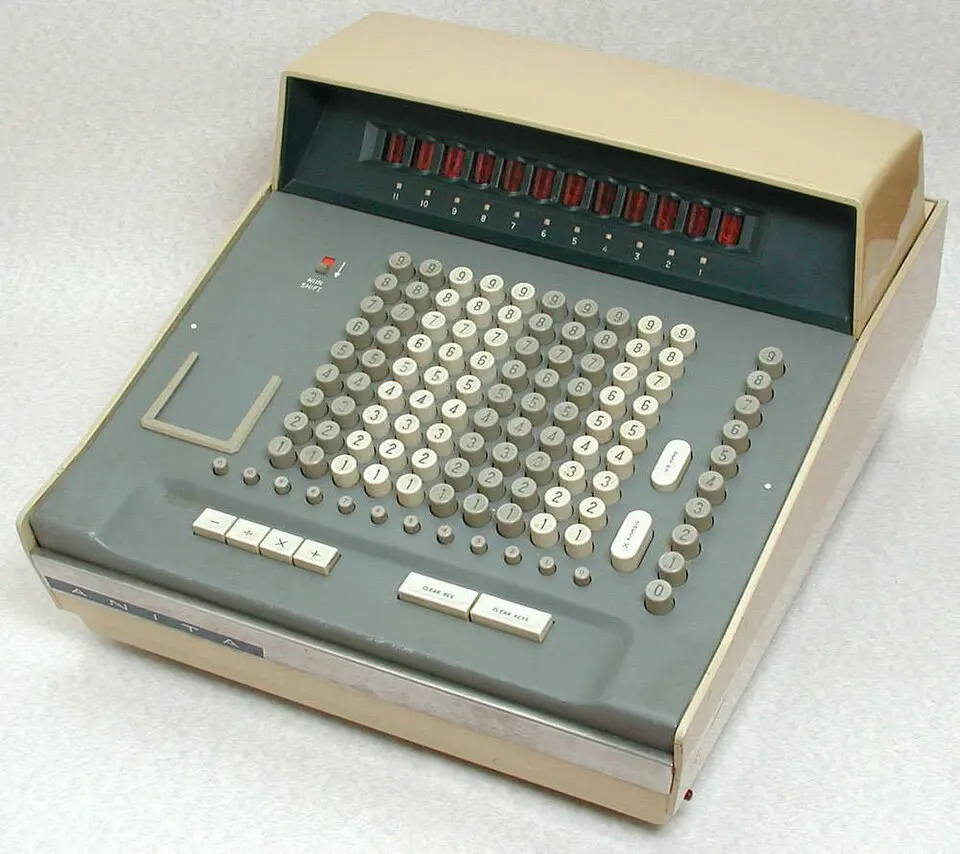
The machine generally credited as the world’s first electronic desktop calculator is the ANITA, developed by the Bell Punch Company in England. Bell Punch had been making mechanical adding machines that totted up numbers the moment a key was pressed. Work on the ANITA began in 1956, and in October 1961 the ANITA Mk 8 was unveiled at a business equipment exhibition in London. That same month, a sister model for continental Europe, the Mk VII, was announced in Germany.
Inside the ANITA, the calculating was done not by transistors but by cold-cathode tubes, a kind of vacuum tube. The keyboard was a “full keyboard,” with a column of keys from 0 to 9 for every digit. The Mk 8 weighed about 14 kilograms (31 pounds) and in 1964 cost £355. The name is said to stand for “A New Inspiration To Arithmetic,” or “To Accounting.”
According to the Vintage Calculators Web Museum, a British website devoted to calculator history, the ANITA had the electronic calculator market to itself for about two and a half years, until 1964, and tens of thousands were sold worldwide.

Japan joins in, 1964
Japan’s first electronic calculator arrived in 1964: the CS-10A from Hayakawa Electric, the company now known as Sharp. Hayakawa had set up a research lab in 1960 with the aim of building large computers, but it changed course toward a small machine that anyone could use anywhere, much like an abacus.
The CS-10A was built from about 4,000 parts, including 530 germanium transistors and 2,300 diodes, and weighed 25 kilograms (55 pounds). It cost 535,000 yen, roughly the price of a popular car at the time. The Information Processing Society of Japan describes it as the world’s first electronic desktop calculator built entirely with transistors and diodes. In the same year, though, American and Italian manufacturers also launched transistor calculators, so there is more than one way to count “first.”
Casio, meanwhile, had led the field since 1957 with the 14-A, a calculator built from relays. According to the company’s own history, the arrival of the British electronic calculator and of Japanese rivals pushed it to switch to electronics, and it launched its first electronic model, the 001, in 1965.
Calculator wars and the Casio Mini
As integrated circuits, and then large-scale integrated circuits, packed more and more electronics onto tiny chips, calculators became easier to make and companies rushed in. Casio says that at the peak some 40 makers were fighting it out in what came to be called the “calculator wars.”
The battle was largely decided in 1972 by the Casio Mini. By cutting the display to six digits, Casio made a machine a quarter of the size of typical calculators at a third of the price: 12,800 yen. At a time when selling around 100,000 units a year counted as a hit, it sold a million in its first ten months. The idea, Casio says, came from bowling, then a craze in Japan, whose scores were added up by hand.
A chip born from a calculator
The calculator wars produced one more major invention. Masatoshi Shima, an engineer at the Japanese calculator maker Busicom, went to the United States in June 1969 to develop calculator chips together with a young company called Intel, working alongside Intel engineers Ted Hoff, Stan Mazor and Federico Faggin.
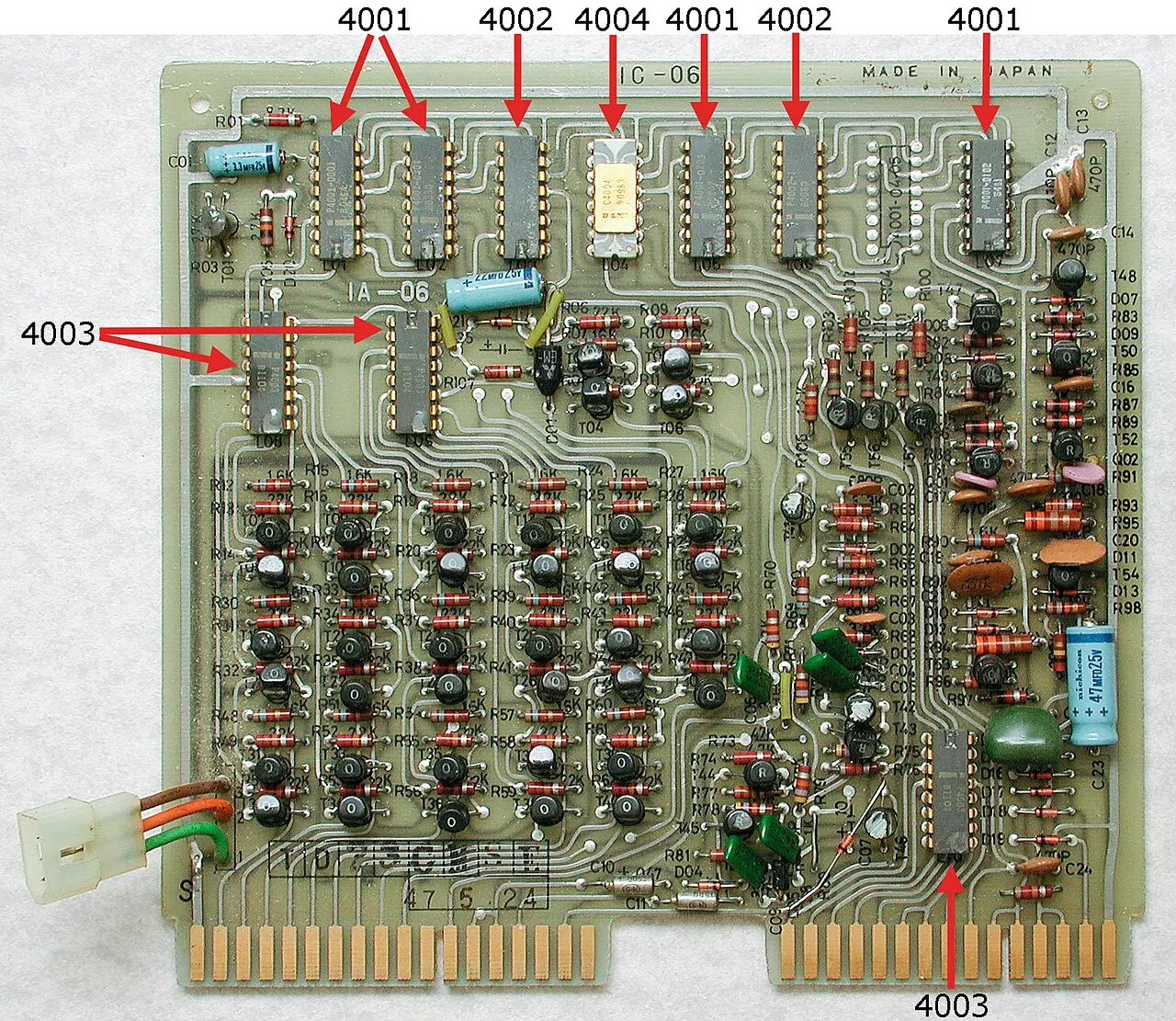

The result, completed in March 1971, was the 4004, a single chip holding the central processing unit, with about 2,300 transistors. Combined with three other chips, including a ROM for storing instructions and a RAM for storing data, it ran a printing calculator. On November 15 that year, Intel advertised the chip in the trade paper Electronic News. The Computer History Museum in California calls it the first advertisement for a microprocessor. Microprocessors went on to become the brains of personal computers and countless other machines.