Did the butterfly stroke come from breaststroke?
Yes. Swimmers exploited a gap in the breaststroke rules by bringing their arms forward over the water, and in the 1950s that style was split off as a stroke of its own.
1956
Competitive swimming has four strokes: freestyle, backstroke, breaststroke and butterfly. Butterfly, with both arms swinging forward over the water together and both legs beating up and down as one, is the youngest of them.
It was born inside breaststroke. A new way of swimming slipped through a gap in the rulebook, came close to swallowing breaststroke whole, and finally became a stroke of its own. Japanese swimmers played a big part in the story.
What the rules didn’t say
Until the mid-1930s, breaststroke rules required swimmers to push both arms forward together on the recovery. What they did not say was that the arms had to come forward under the water.
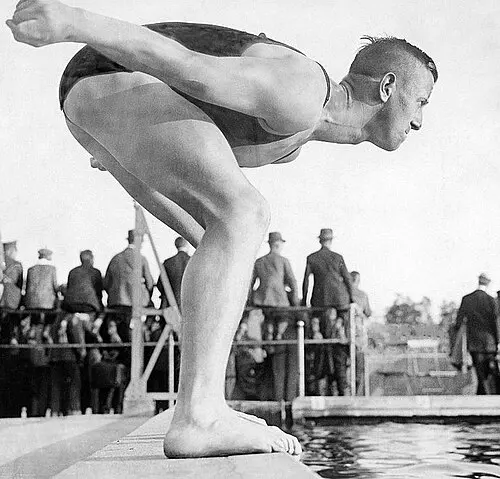
One of the first to see the opening was Erich Rademacher of Germany, who broke breaststroke world records again and again. Coming off the turns and in the final strokes of a race, he would sometimes swing his arms forward over the surface. According to the International Swimming Hall of Fame, in the 200-meter breaststroke final at the 1928 Amsterdam Olympics he used the over-water arm action once off each turn. The gold medal, however, went to Yoshiyuki Tsuruta of Japan, the first Japanese swimmer ever to win Olympic gold.
In 1933, the American Henry Myers swam the entire breaststroke leg of a medley race in Brooklyn, New York, bringing his arms over the water on every stroke. The officials did not quite know what to make of it, but they had to agree that the rules allowed it. Without the drag of pushing the arms forward underwater, the stroke was faster.

The stroke that ate breaststroke
The new style came to be called butterfly breaststroke: the arms swung over the water like a butterfly’s wings, while the legs still did the frog-like breaststroke kick. According to Swimming World magazine, by the 1936 Berlin Olympics the over-water recovery was one of several legal arm movements in breaststroke.
As it spread, orthodox breaststroke was pushed toward extinction. At the 1952 Helsinki Olympics, every finalist in the 200-meter breaststroke swam with butterfly arms. Japan was no different. The Nihon Kokugo Daijiten, Japan’s largest historical dictionary, cites a 1949 essay as an early example of the Japanese word for breaststroke, and the passage says that breaststroke must, of course, be swum with the butterfly method, which demands enormous stamina.
Something had to give. After the Helsinki Games, the congress of the international swimming federation, FINA (now World Aquatics), narrowly voted to split breaststroke in two, and new rules took effect in 1953. Breaststroke would again be swum with the arms recovering underwater, and butterfly became a separate stroke.
A kick like a dolphin
The new butterfly rules also allowed a kick with both legs moving up and down together: the dolphin kick. The kick itself had been worked on in the 1930s at the University of Iowa and elsewhere in the United States, but breaststroke rules banned up-and-down leg movements, so it could not be used in races.
In Japan, the name most associated with the dolphin kick is Jiro Nagasawa of Waseda University. Nagasawa finished sixth in the 200-meter breaststroke at Helsinki in 1952, but hard training had left him with painful knees. According to the Japanese edition of Britannica, in May 1954, while practicing butterfly for a national student championship, he tried kicking up and down to spare his knees and found his times improved dramatically. That, the encyclopedia says, was the origin of the two-kicks-per-arm-stroke rhythm still used today.
Nagasawa set a butterfly world record in September 1954 and went on to lower it several times. When he died in 2010, Japanese newspapers described him as the inventor of the dolphin kick. The International Swimming Hall of Fame, which inducted him in 1993, is more careful: he was not the first to swim butterfly breaststroke, it says, but he was one of the first to swim it with the dolphin kick, and he introduced the stroke to Japan and Asia. Given the earlier experiments in America, the kick probably cannot be credited to any one person.
An Olympic event at last
Even then, butterfly’s place at the Olympics was not settled. According to Swimming World, the Americans and Australians saw butterfly as an advance in breaststroke, while Japan and the Soviet bloc regarded it as a completely new stroke. In the end, lobbying by the Australians got butterfly added as a separate event at the 1956 Melbourne Games.


In the first Olympic men’s 200-meter butterfly, Bill Yorzyk of the United States took gold and Takashi Ishimoto of Japan took silver. The women swam 100 meters, and Shelley Mann of the United States became the first women’s Olympic butterfly champion.