Did the Olympics once award medals for art?
Yes. At seven Games from 1912 to 1948, medals went to sport-inspired works of architecture, literature, music, painting and sculpture.
7Games
Olympic medals are meant for people who run fastest, jump highest or throw farthest. But in the first half of the 20th century, painters and poets won Olympic medals too.
These art competitions were held at seven Games, from Stockholm in 1912 to London in 1948. There were five categories: architecture, literature, music, painting and sculpture. The one condition was that every work had to be inspired by sport.
Coubertin’s pet project
The driving force behind the art contests was Pierre de Coubertin of France, the founder of the modern Olympic Games. In 1904 he reportedly wrote in the newspaper Le Figaro that the time had come to restore the Olympics to their original beauty. To him, the Games were incomplete with sport alone.
The first contests were improvised affairs. According to Olympedia, a database of Olympic history, the Swedish organizers of the 1912 Games handed the International Olympic Committee (IOC) 5,000 French francs and left the art competitions to it. Entries were sent to Coubertin’s address in Paris, and Olympedia suggests that he may well have been the entire jury himself.
A gold medal under a false name
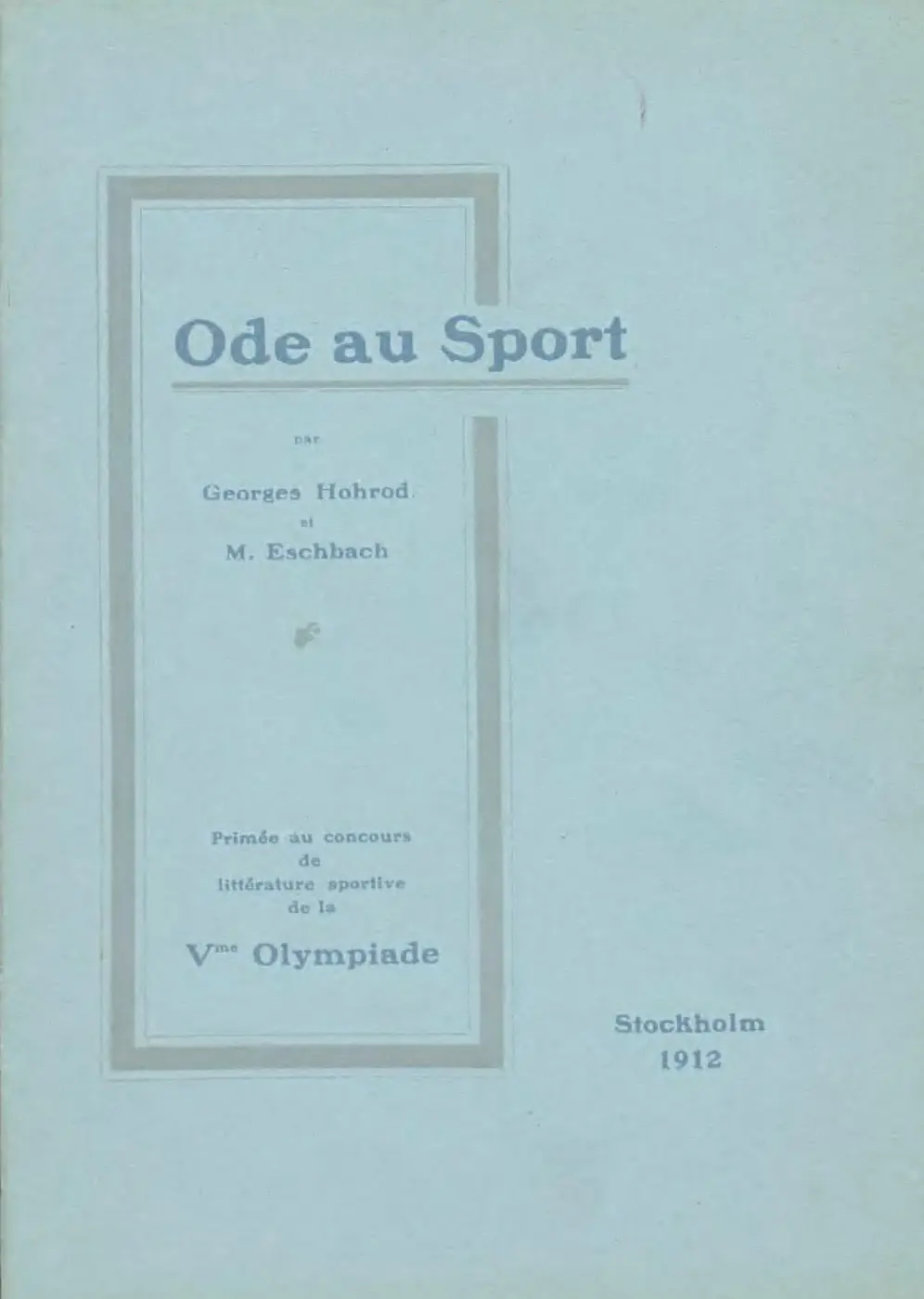
The gold medal for literature in 1912 went to Ode to Sport, a poem credited to “Georges Hohrod and M. Eschbach” of Germany. Its real author was none other than Coubertin. In other words, the judge may well have awarded a gold medal to himself.
Coubertin had used the name Georges Hohrod before, when he published an autobiographical novel in 1899. “M. Eschbach” is thought to have been his wife, Marie, who translated the poem into German. Both names turn out to come from two villages next to Luttenbach, near Colmar in Alsace, where her family had a home. The ode was submitted in French, English and German, in a contest that drew seven entrants from four countries. In Olympedia’s records, the gold medal still belongs to Germany.

Bronze for Japan in Berlin
The art competitions grew with each Games. The 1936 Berlin Olympics featured a record 15 art events, the exhibition drew 70,000 visitors, and host nation Germany won 12 medals.
Two Japanese painters won bronze medals in Berlin: Ryūji Fujita (1907–1965) for Ice Hockey, and Sujaku Suzuki (1891–1972) for Classical Horse Racing in Japan. Fujita’s painting was bought by the Nazis and has not been seen since. One of his students, Ryū Seihō, later attempted to re-create it. Suzuki, whose real name was Kōtarō, worked mainly in woodblock prints, silkscreens, watercolors and lithographs, and many of his pictures appeared as illustrations in books and magazines.
A few people won medals in both sport and art. Walter Winans of the United States won a shooting gold at the 1908 London Games, then took the sculpture gold in 1912 with a statuette called An American Trotter. Alfréd Hajós of Hungary won two swimming golds at the first modern Olympics in Athens in 1896, and a silver in architecture in Paris in 1924 for a stadium design. According to Olympedia, they are the only two people to have done it.

Why the arts disappeared
The 1948 London Games were the last to hold art competitions. A report to the IOC in 1949 concluded that nearly all the entrants were professional artists, which clashed with the Olympics’ amateur ideals, and recommended replacing the contests with an exhibition without medals. Critics had also complained that the judging was too subjective. At the 1952 Helsinki Games, an art exhibition was held instead, with no medals at stake.
The art medals were later reportedly dropped from the official national medal counts as well, and today they are largely forgotten. Still, the link between the Olympics and the arts lives on in the cultural programs that accompany each Games.