Why does a boomerang come back?
Its spinning wings get more lift at the top than at the bottom, and that imbalance, acting on a spinning object like a gyroscope, gradually turns the boomerang around in a circle.
40,000 years
Throw a bent piece of wood with a good spin, and it swings around in a big arc and returns to your hand. Come to think of it, that is a strange thing for a thrown object to do. Why doesn’t it just keep going straight?
The top wing works harder
The arms of a returning boomerang have a cross-section shaped like an airplane wing, so they generate lift as they move through the air. A boomerang is thrown standing almost upright, spinning, with a forward flick.
As it spins and travels forward at the same time, the arm at the top is moving in the same direction as the boomerang as a whole, so it meets the air faster. The arm at the bottom is moving backward relative to the flight, so it meets the air more slowly. Since lift increases with airspeed, the top arm gets pushed sideways harder than the bottom one.
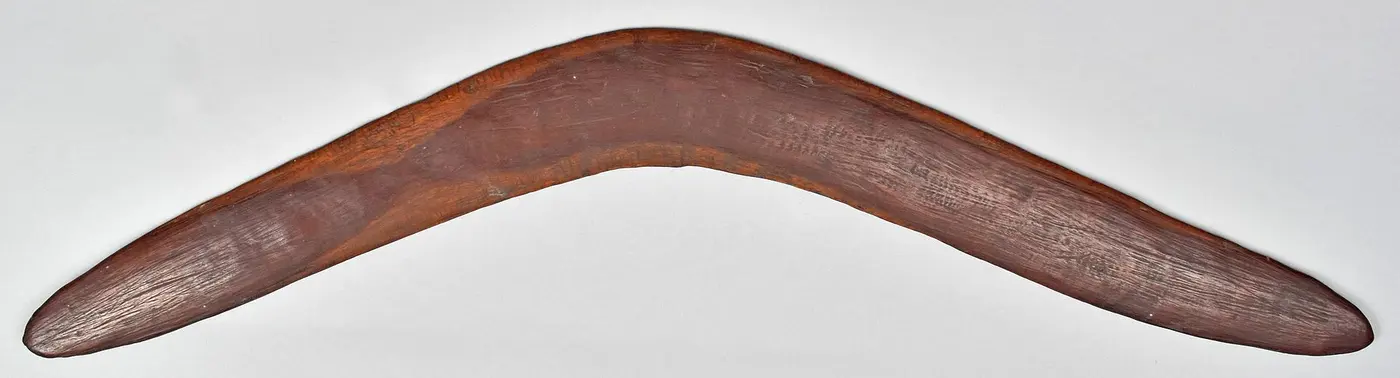

That uneven push tries to tip the boomerang over sideways. But a spinning object doesn’t simply topple in the direction it is pushed. Instead, its axis swings around at right angles to the push, a little at a time. It’s the same effect that keeps a spinning top from falling over and makes it wobble around instead, known as gyroscopic precession.
So the boomerang keeps changing its heading, bit by bit, until it has flown around in a circle. HyperPhysics, the physics reference site at Georgia State University, explains that for a typical boomerang the heading turns counterclockwise, seen from above. The slight tilt from vertical in a good throw lets some of the lift hold the boomerang up against gravity.
Hunting boomerangs don’t come back
Boomerangs are best known as tools of Aboriginal Australians. But as the Pitt Rivers Museum at the University of Oxford puts it, “Most boomerangs are non-returning. These types are used for hunting.” The returning kind was used mainly for sport and entertainment. In the Noongar language of southwestern Australia, a flat, curved piece of wood used for hunting animals and birds is called a kylie.
A weapon meant to strike its target has no need to come back. Even so, in the early days of colonial Sydney, rumors spread that Aboriginal people could throw a boomerang, hit a kangaroo, and have it return to their hand. The Boomerang Association of Australia calls this a physical impossibility that arose from confusing two very different kinds of throwing stick.
A 40,000-year-old boomerang
Boomerangs are not only Australian. In 1985, archaeologists excavating Obłazowa Cave in southern Poland found a boomerang carved from a mammoth tusk, and they reported it in Nature in 1987. Later throwing experiments showed that its shape can fly as a non-returning boomerang.
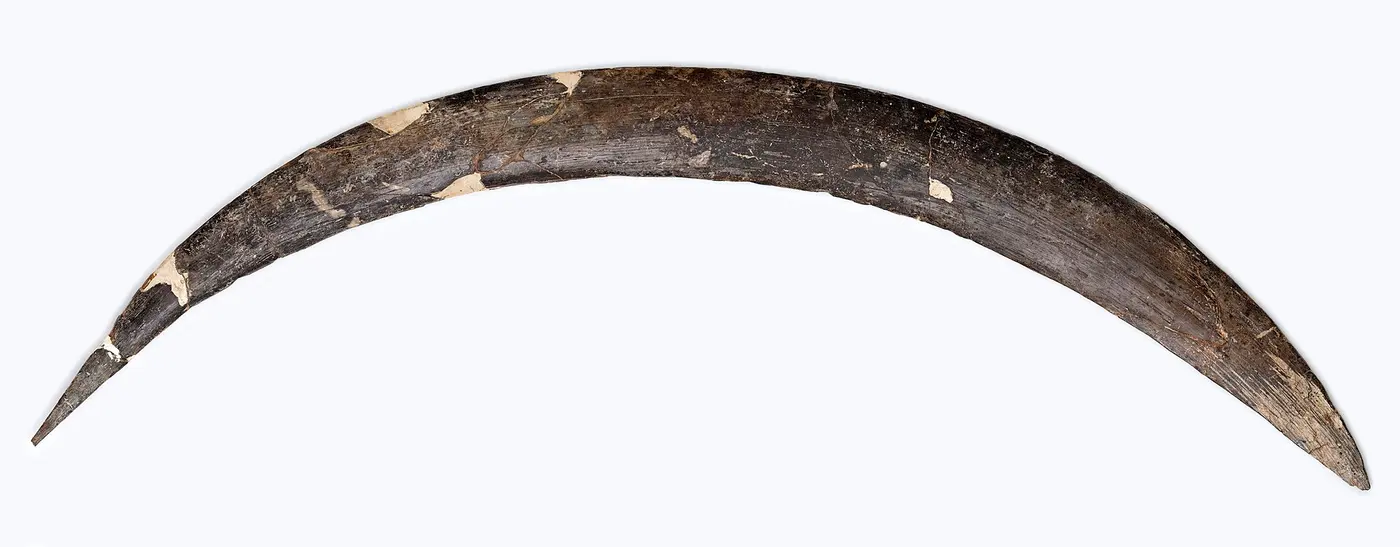

In 2025, a team of researchers from Italy, Poland and elsewhere radiocarbon dated bones from the same layer of the cave and estimated the boomerang’s age at roughly 42,000 to 39,000 years. That makes it one of the oldest known boomerangs in Europe, and possibly in the world. The oldest wooden boomerang found in Australia, from Wyrie Swamp in South Australia, is about 10,000 years old.
Back to the hand in space
On March 18, 2008, Japanese astronaut Takao Doi threw a boomerang aboard the International Space Station, at the request of Yasuhiro Togai, a world boomerang champion. According to the video released by the Japan Aerospace Exploration Agency (JAXA) and Doi’s own commentary, his first throw hit a wall, but the second and third came right back to his hand.
A boomerang still returns in weightlessness because what turns it is the air pushing on its wings, together with gyroscopic precession, not gravity. In the vacuum outside the station it would not fly at all. Doi’s throw was not the first in space, either: according to boomerang enthusiasts’ records, the German astronaut Ulf Merbold threw one in the Spacelab laboratory aboard the Space Shuttle in 1992.