Does electric current flow the opposite way to electrons?
Yes. The direction of current was fixed before electrons were discovered, and electrons carry negative charge, so they travel the other way.
Connect a small bulb to a battery and, as we learn in school, current flows out of the positive terminal, through the bulb and back into the negative terminal.
A little later in science class, though, we are told something else. Electric current is really a flow of electrons, and electrons move from the negative terminal toward the positive one. The direction of the current and the direction the electrons travel are exact opposites. How did things end up so confusing?
Franklin chose which side was “positive”
The story goes back to the eighteenth century, when electricity produced by rubbing things together was thought to come in two kinds. In 1733 the French scientist Charles du Fay named them “vitreous” electricity, which appears on glass rubbed with silk, and “resinous” electricity, which appears on amber rubbed with fur.
The American Benjamin Franklin began experimenting with electricity in late 1746 and by 1750 had arrived at a different idea. Electricity, he proposed, was a single invisible fluid; some objects simply had too much of it and others too little. Franklin called the state of having more, as in glass rubbed with silk, positive, and the state of having less, as in amber, negative. The fluid would flow from where there was more to where there was less, in other words from positive to negative. That is where today’s direction of current comes from.
There was, however, no way to tell which kind truly deserved to be called positive. Franklin’s choice was essentially a coin toss.


The electron, found some 150 years later
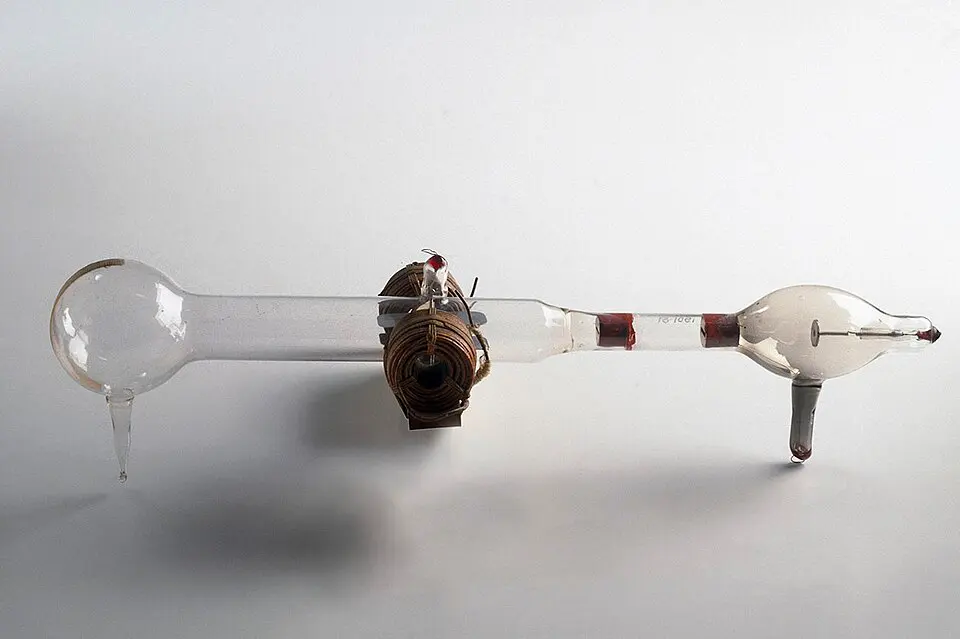
The answer to that coin toss came much later. In 1897 the British physicist J. J. Thomson studied cathode rays, the beams that shoot out of an electrode inside a glass tube pumped nearly empty of air, and showed that they were particles carrying negative charge and weighing less than a thousandth as much as the lightest atom. These were electrons.
In a metal wire, it is these electrons that carry electricity. Being negatively charged, they are drawn toward the positive terminal, so they travel from negative to positive. That is exactly the opposite of the direction Franklin had chosen.
The direction of current was left as it was all the same. For nearly 150 years, electrical theory and circuit conventions had been built around current flowing from positive to negative. Besides, negative charge moving to the left and positive charge moving to the right give exactly the same results in any calculation. Redefining the direction would have gained almost nothing.
Not exactly a mistake
In fact, what carries electricity is not always electrons.
In a liquid such as salt water, positively charged ions and negatively charged ions move in opposite directions, and both carry the current. Ions are on the move inside batteries too. In semiconductors, “holes,” gaps left where electrons are missing, behave like positively charged particles and move in the same direction as the current.
Current, then, is a convention that describes which way positive charge would effectively be flowing, a handy yardstick that works no matter what is actually moving.

Slow electrons, instant signal
Another surprise is how slowly the electrons in a wire actually move. Run a current of 10 amperes through a copper wire about 2 millimeters thick, and the electrons drift along it at an average of only about 0.2 millimeters per second. In a whole hour they travel less than a meter (about 3 feet).
Yet a light comes on the moment you flip the switch. That is because the wire is already packed with electrons, and the “signal” that the switch has been flipped races along the wire at close to the speed of light, setting electrons all along it moving at once.