Can you really slip on a banana peel?
Yes. Japanese researchers found that stepping on a peel cuts the friction between shoe and floor to about a sixth.
0.07
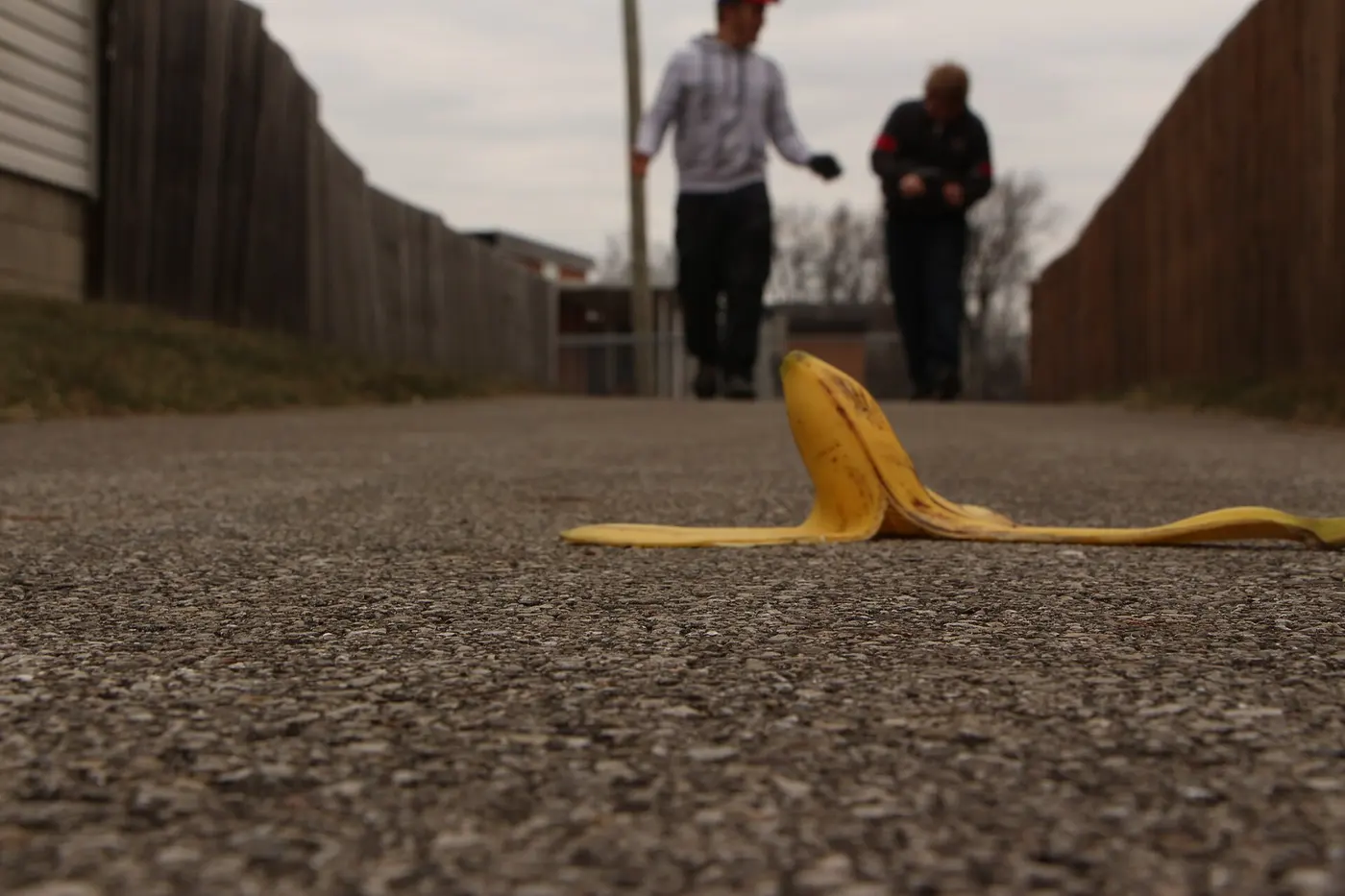
Someone steps on a banana peel, their feet fly up and they land flat on their back. Cartoons, comic strips and slapstick comedy have been playing out this scene for generations.
But is a banana peel really that slippery? Everyone “knows” it is, yet for a long time nobody had actually measured how slippery. A team of Japanese researchers decided to find out.
Measuring a shoe on a peel
Kiyoshi Mabuchi of Kitasato University’s School of Allied Health Sciences was a researcher of smoothly moving artificial joints. In 2012 his team published a paper in the journal Tribology Online with a no-nonsense title: “Frictional Coefficient under Banana Skin.”
They placed a force sensor under a linoleum floor panel and laid a banana peel on top, inner side down. A person then stepped on the peel and pushed the shoe forward, as if starting to slide. The sensor measured the downward force and the sideways force at the same time, and the ratio between them gave the coefficient of friction. The lower the number, the more slippery the surface.
Across 60 measurements, five each on 12 banana peels, the average coefficient of friction was 0.066. Without the peel, the same shoe sole on linoleum gave 0.412, so the peel cut the friction to about a sixth. On a wooden board, the result was much the same, at about 0.08.
As slippery as skis on snow
How low is 0.07? According to the paper, the friction between ordinary materials is usually above 0.1. Values below 0.1 belong to well-lubricated surfaces, such as skis on snow, ice on ice or the cartilage in our joints. A shoe on a banana peel, in other words, slides about as easily as a ski on snow.
The paper also works through the mechanics of walking. With a coefficient of 0.066, simply putting your foot down at the usual angle of about 15 degrees is enough to make it slip. It also cites earlier research finding that when the coefficient of friction drops below 0.1, the risk of falling exceeds 90 percent. The cartoon gag turns out to be good physics.

The secret is a gel
Why is a banana peel so slippery? When the team looked at peels under a microscope, they found the inner side packed with tiny sacs a few micrometers across, filled with a gel made mainly of polysaccharides, long chains of sugar molecules. When you tread on the peel, the sacs burst, the gel oozes out and merges into a smooth fluid that lubricates the gap between shoe and floor.
Changing the conditions changed the results. A peel placed outer side down gave 0.123, and a completely dried peel 0.329. Apple peel came in at around 0.1 to 0.13, and citrus peels at around 0.2. None could match the banana. Fresh banana peel is about 85 percent water, and that water, together with the gel-filled sacs, is what makes it so treacherous.
The paper also lists joint cartilage among the well-lubricated surfaces that banana peel resembles, and Kitasato University has said the findings could one day help in designing better artificial joints. In 2014 the study won the Ig Nobel Prize in Physics, awarded for research that makes people laugh and then think. Mabuchi attended the ceremony at Harvard University on September 18.
A real hazard in old New York
The banana peel joke grew out of a real danger. The paper itself notes that soon after bananas began to be imported into North America in the mid-19th century, it became common knowledge that their peels were slippery and could cause accidents.
By the late 1800s, bananas were cheap street food in New York, sold from pushcarts, and newspapers regularly reported people injured after slipping on discarded peels. In January 1896 the New York Herald, after a young man broke his leg falling on a banana skin, demanded that the police act. A month later Theodore Roosevelt, then president of the city’s police board and later President of the United States, gathered his officers and read them the city ordinance against throwing fruit and vegetable peels into the street. Offenders faced a fine of up to $5 and 10 days in jail.


From the streets, the slip is said to have made its way onto vaudeville stages and into silent films, where it became the classic gag we still know today.