Is spinach’s iron reputation just a decimal-point error?
There is no evidence for the famous misplaced decimal point. But spinach’s iron content really was badly overestimated in the 19th century.
2.0mg
Popeye squeezes open a can of spinach, gulps it down, and his forearms swell like balloons. Spinach has long had a reputation as a vegetable bursting with iron.
There is a well-known twist to this. Spinach, it is said, only got that reputation because a 19th-century scientist misplaced a decimal point and overstated its iron content tenfold, and Popeye’s creator fell for the error. It is often repeated as a lesson in not trusting received wisdom. Yet the story itself turns out to be shaky.
The article that spread the story
The version most people know was popularized in 1981 by Terence Hamblin, a British hematologist, in a piece about scientific fakery for the Christmas issue of the British Medical Journal. As an opening anecdote, he wrote that spinach had been found in the 1890s to be as valuable a source of iron as red meat, but that German chemists reinvestigating it in the 1930s had shown that the original workers “had put the decimal point in the wrong place and made a tenfold overestimate of its value.” For a source of iron, he joked, Popeye “would have been better chewing the cans.”
Hamblin, however, gave no source for that part of his story.
A criminologist investigates
The person who set out to trace the tale was Mike Sutton, a British criminologist. In 2010 he published his findings in the online Internet Journal of Criminology. When he asked Hamblin where the story came from, Hamblin replied that he had forgotten the original source.
Sutton combed through old analyses of spinach and could find no misplaced decimal point. He argued that the old figures were too high because of poor analytical methods. As early as 1907, Henry C. Sherman, a chemist at Columbia University, had warned that little weight could be attached to the iron figures in the standard tables of plant analyses, because they were largely based on methods that “greatly overestimated the iron.” He also warned of iron creeping in from utensils and laboratory dust. Sutton later found that Arnold Bender, a British nutrition scientist, had mentioned the decimal point in a lecture in 1972, nearly a decade before Hamblin. Hamblin had not made it up.
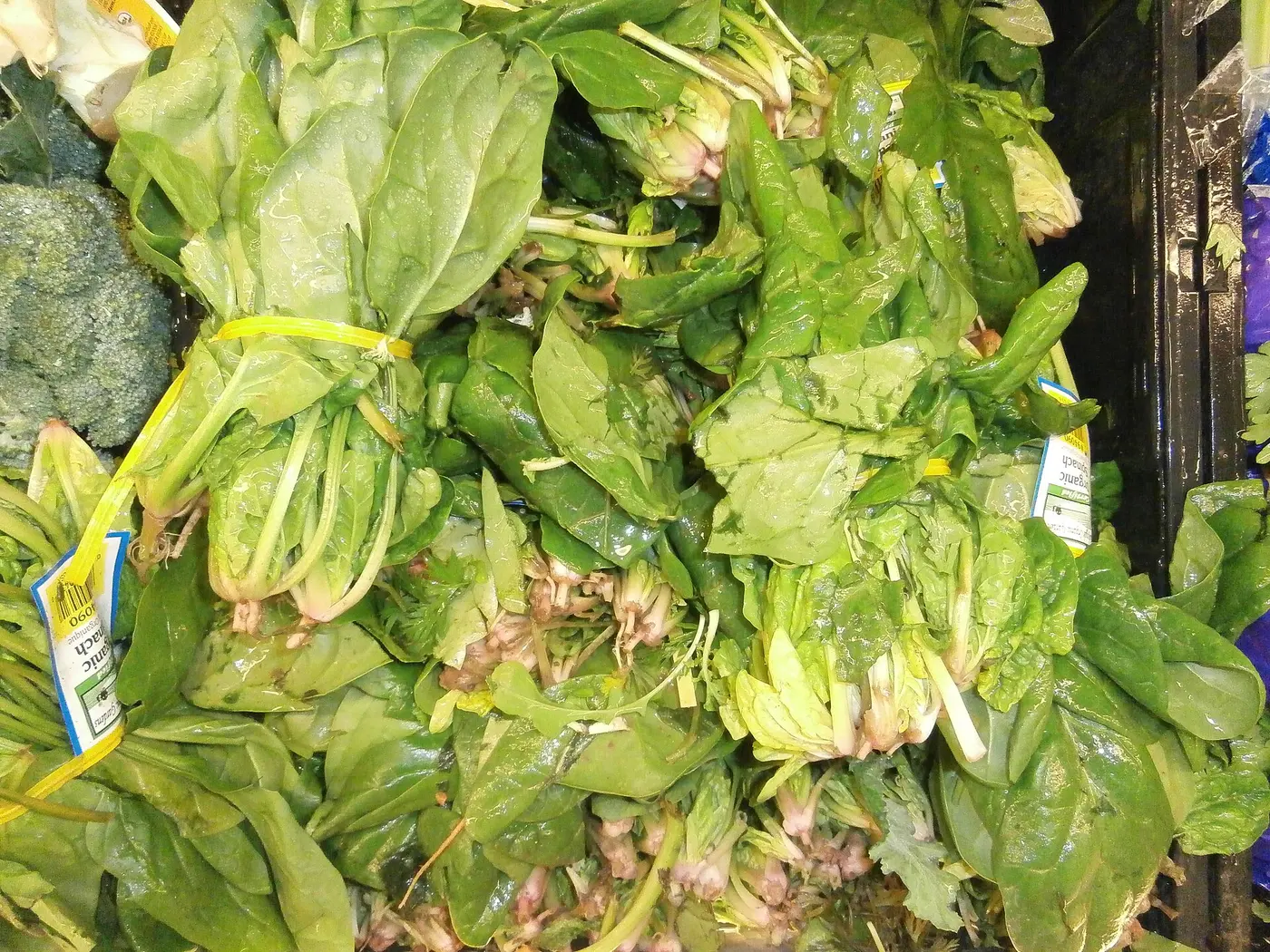

In 2018, after combing through older German and French sources, Michael Mielewczik and Janine Moll added a twist in a history of science journal. They found that in 1892, Gustav von Bunge, a physiologist at the University of Basel, had attacked a figure in a widely used table of plant analyses. One analysis there implied that 100 grams of dried spinach leaves contained half a gram of iron. “This number is 16 times too high!” Bunge wrote. So numbers that were wrong by an order of magnitude really did exist in the 19th-century literature. Mielewczik and Moll suggest that confusion between the dry weight and fresh weight of the leaves may have been one source of error. They also point to a 1934 German pharmacology textbook whose table showed some old values were more than ten times higher than others, a likely seed of the decimal-point legend.
So the wrong numbers were real. What has never been found is any record showing they were caused by a misplaced decimal point, or any paper in which German chemists of the 1930s announced such a discovery. Bunge himself, after correcting the figures, still regarded spinach as rich in iron and recommended it for feeding infants.
Popeye was after vitamin A
Popeye has been misread, too. He first appeared in 1929 as a minor character in E.C. Segar’s newspaper comic strip Thimble Theatre, and began drawing his strength from spinach in the early 1930s.
According to Sutton, in the early strips Popeye credited spinach’s power not to iron but to vitamin A. In a 1932 strip, as Canada’s McGill University notes, Popeye himself declares that the vitamin A in spinach is what makes people strong. Strictly speaking, spinach contains beta-carotene, which the body turns into vitamin A, rather than vitamin A itself.

How much iron is really there?
So how much iron does spinach contain? According to Japan’s Standard Tables of Food Composition, 100 grams of raw spinach contains 2.0 milligrams of iron, and boiled spinach 0.9 milligrams. That is high for a vegetable, but komatsuna, a Japanese leafy green, has more (2.8 milligrams raw), and neither comes close to pork liver at 13.0 milligrams.
What is more, the iron in vegetables is harder to absorb. According to e-Health Net, run by Japan’s Ministry of Health, Labour and Welfare, the heme iron in meat and fish is absorbed better than the non-heme iron found in vegetables, and non-heme iron is absorbed more readily when eaten with vitamin C or animal protein. Spinach is also rich in oxalic acid, which is known to hinder iron absorption. Spinach works best alongside meat, fish or fruit.