Can axolotls regrow their legs?
Yes. A lost leg grows back complete with bone, muscle and nerves, and axolotls can also rebuild parts of the spinal cord, heart and brain.
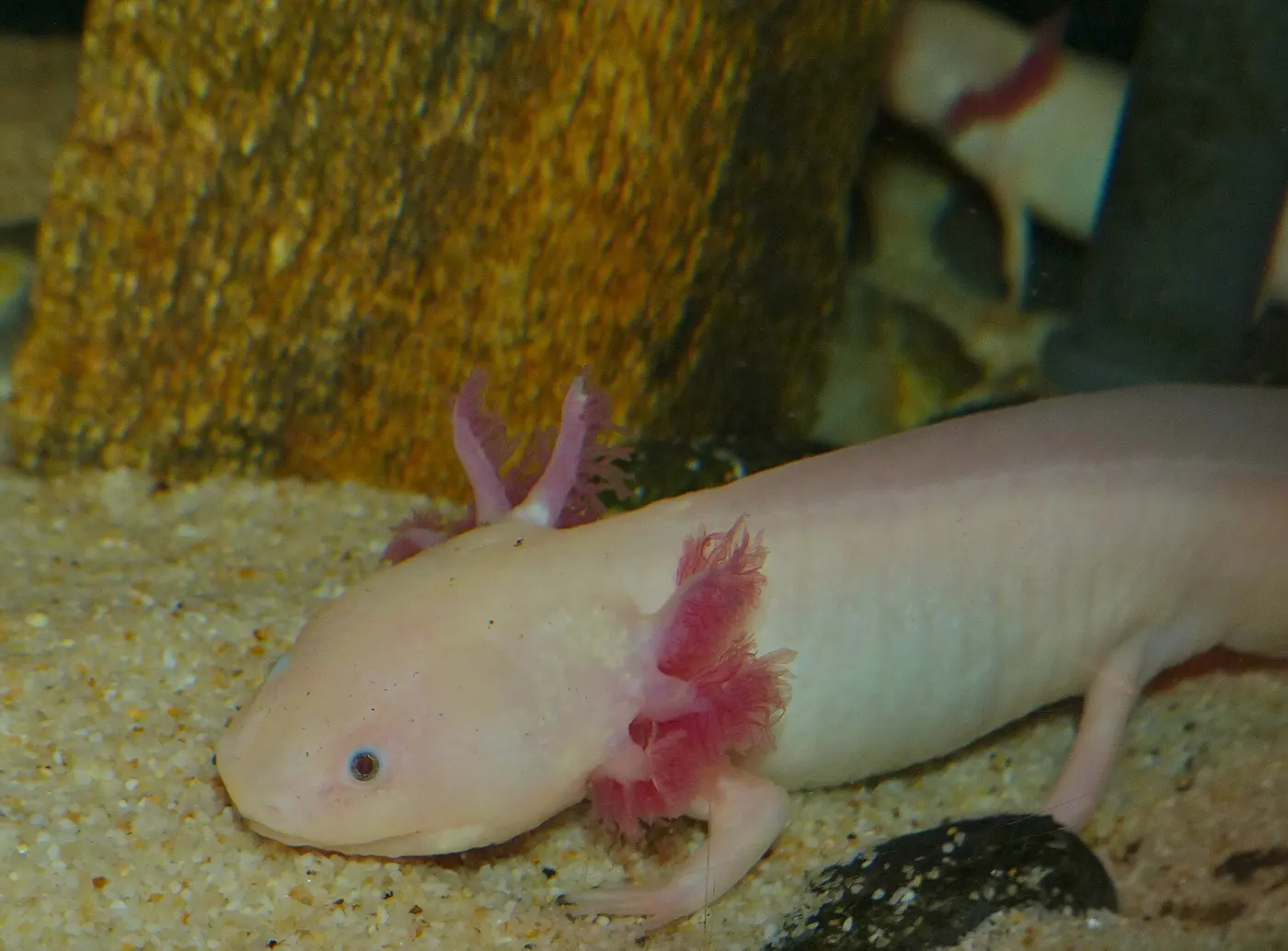
Feathery gills fan out from either side of its head, and its wide mouth seems fixed in a goofy grin. The axolotl is a salamander from Mexico, and its English name comes from the language of the Aztecs. In Japan, where it is a popular pet, it goes by a very different name: wooper looper.
Behind that comical face lies a serious talent. Axolotls are kept in research labs all over the world because a leg bitten off by a tankmate grows back, complete with bone, muscle and nerves.
A name made in Japan
“Wooper looper” (ūpā rūpā) is a name used only in Japan. In 1985 the animal appeared under that name in a TV commercial for U.F.O., a brand of instant fried noodles (yakisoba) made by Nissin Foods, and a nationwide craze followed. The name is said to have been invented for the commercial and to have been a trademark, but exactly who coined it, and how, is not clear.
The name “axolotl,” by contrast, comes from Nahuatl, the language of the Aztecs. It is usually explained as combining a word for “water” with the name of the Aztec god Xolotl.
Grown up, but still a larva
Most salamanders spend their larval stage in water and then go through metamorphosis, losing their gills and moving onto land. Axolotls normally skip this step. They grow up, mate and lay eggs while keeping the features of a larva, including external gills and a fin that runs along the back to the tail. Biologists call this neoteny.

Europeans first ran into this puzzle in the 1860s. According to historians of science, 34 live axolotls were shipped from Mexico City to Paris in 1864. Auguste Duméril, a zoologist at the Muséum national d’Histoire naturelle, took six of them. When they bred in his tanks while still looking like larvae, he concluded that this must be their adult form. Then some of their offspring lost their gills and turned into land-dwelling salamanders.
We now know that axolotls can be made to metamorphose by giving them thyroid hormone, the hormone that triggers the change in other amphibians. The Paris animals were handed out to researchers across Europe, and until at least 1914, every axolotl in Europe descended from them.
Bone, muscle and nerves, all rebuilt
When an axolotl loses a leg, a thin layer of skin first closes over the wound. Beneath it forms a blastema, a bud of cells that rebuilds bone, muscle, nerves and skin in the right order until a complete leg has grown back, down to the fingers. A 2022 review by researchers in the United States lists the many parts axolotls have been shown to regenerate: besides limbs and tails, these include the spinal cord, the heart, parts of the brain, the retina, and the jaw and teeth.
There are limits, though. In a study published in 2017, a team from Harvard and other institutions cut the forelimbs of 16 young axolotls at the same spot, let them regrow, and repeated the process up to five times. After the first amputation, every limb grew back to the fingers. After the fifth, only 25 percent did, and more than half barely grew past the cut at all. Axolotls that have been made to metamorphose also regenerate more slowly.
In 2018, a team led by researchers in Germany and Austria sequenced the axolotl genome. At about 32 billion base pairs, it is more than ten times the size of ours. Scientists are combing it for clues to how regeneration works.
Common in the lab, nearly gone in the wild
In its homeland, however, the axolotl is vanishing. Wild axolotls are now found mainly in the canals and lakes of Xochimilco, on the southern edge of Mexico City. According to a 2015 paper by researchers from the United States and Mexico, the axolotl population there fell from 6,000 per square kilometer in 1998 to 100 in 2008, and later surveys found fewer than 35. Urban growth and poor water quality are to blame, along with introduced fish that eat axolotl eggs and young.
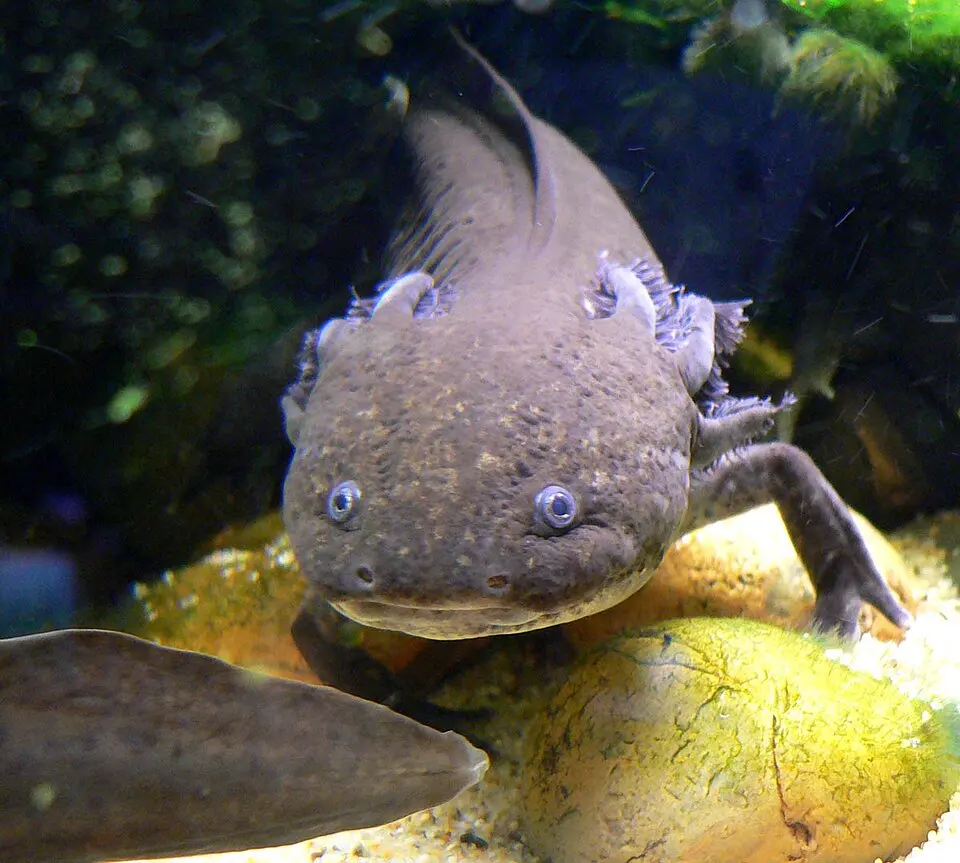

The International Union for Conservation of Nature (IUCN) lists the axolotl as Critically Endangered, its highest category of threat. It is an odd situation: an animal thriving in labs and pet shops all over the world is on the brink of disappearing from its natural home.