How do astronauts sleep in space?
In sleeping bags fixed to the wall. With no up or down, they can sleep just as well “standing up” or upside down.
6hours
At the end of the day we lie down, rest our heads on a pillow and close our eyes. In space, that everyday act is impossible. Without gravity, there is no such thing as lying down.
Astronauts still need to sleep every night, of course. So how do they manage it aboard the International Space Station (ISS), which circles the Earth about 400 kilometers (250 miles) up?
A bedroom the size of a phone booth
The ISS has private crew quarters, one per astronaut: two in the Russian module Zvezda and four in the US segment and elsewhere, enough for six people. Each is roughly the size of a phone booth, fitted with lighting, air conditioning and an alarm system for emergencies, and doubles as storage for personal belongings.
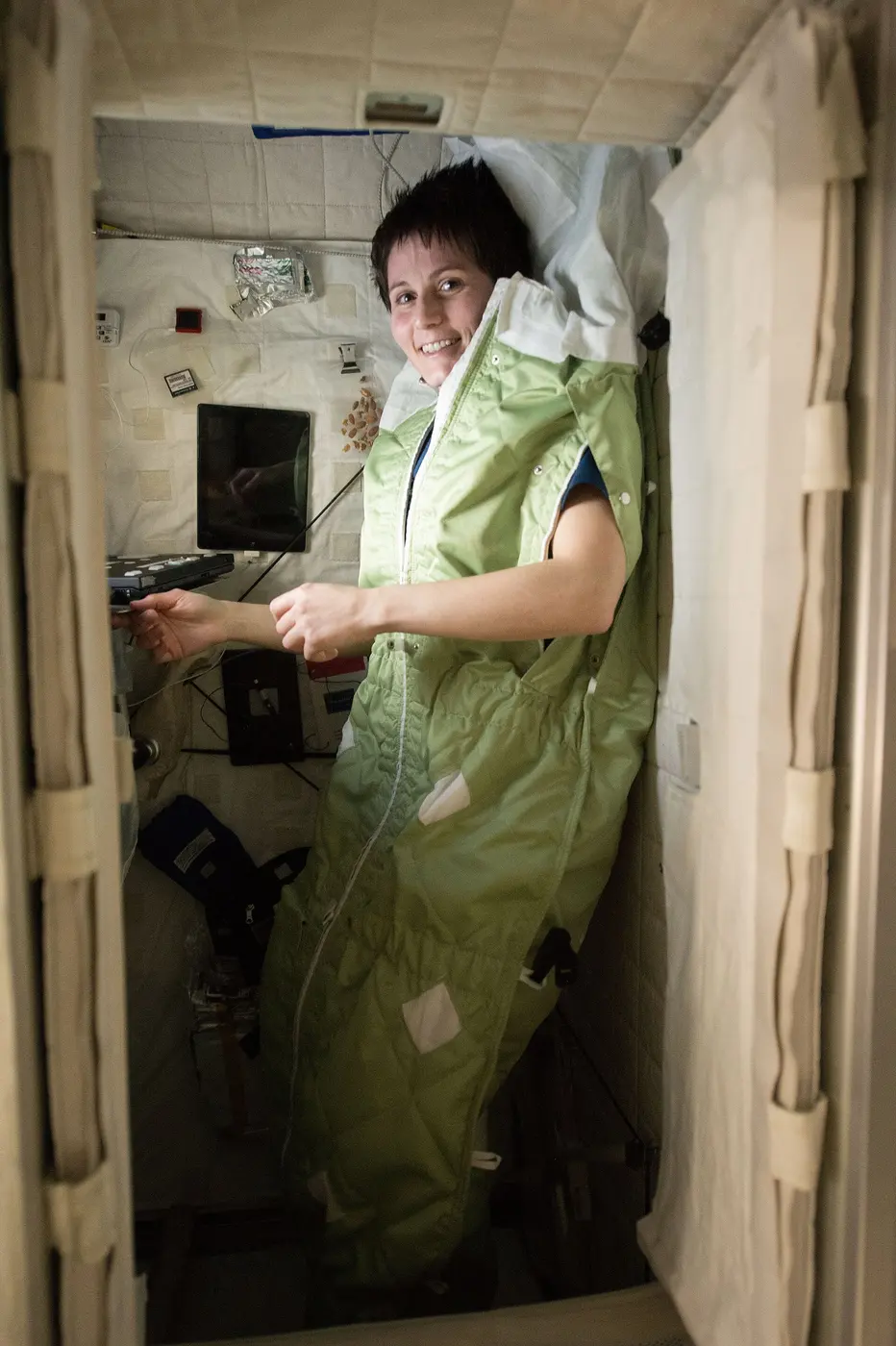

Instead of a bed, there is a sleeping bag. It is attached to the wall, and the astronaut slips inside to sleep. Otherwise, a sleeping body would drift around and might bump into something. When the station is temporarily more crowded than usual, astronauts simply fix a sleeping bag wherever there is room. On the Space Shuttle, crews slept in four-tier bunks or sleeping bags on the wall, and some dozed off in the commander’s or pilot’s seat.
Breath that pools around your face
One thing no space bedroom can do without is a fan. On Earth, warm air rises and cool air sinks, so air mixes on its own. In weightlessness that convection does not happen. Without a breeze, the carbon dioxide you breathe out lingers around your face and can cause headaches. So each sleeping area has a fan that blows air from the head toward the feet.
The fans and machinery, however, hum around the clock. Eye masks and earplugs are provided so the noise does not keep anyone awake. The temperature on board is kept between about 18 and 27°C (64 to 81°F), with humidity of around 30 to 65 percent.
A bedroom with no up or down
No gravity means no up and no down. Whether you seem to be standing against a wall or hanging upside down from the ceiling, it feels exactly the same. In fact, the crew quarters on the ISS face every which way, set into the floor, ceiling and side walls of a passageway.
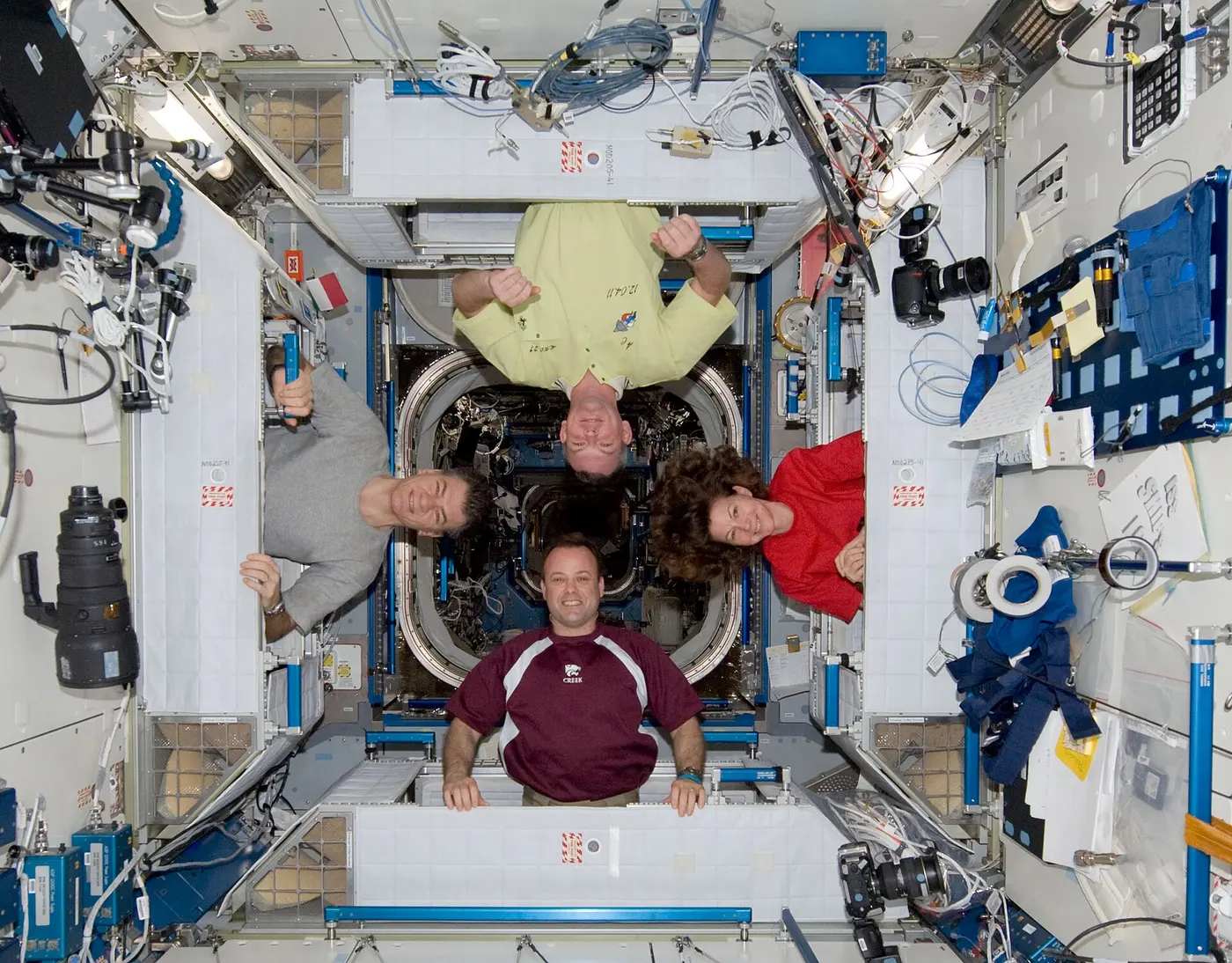

Still, it can be unsettling not to feel anything against your body. One astronaut is quoted in NASA material as saying:
Every time that I got into it and closed my eyes I feel like falling. Now I have learned that I string out my sleeping bags like a hammock and make it as tight as I can and then I get in it and zip it up and use those Velcro straps and make it as tight as I can. I need to feel like I am tied down to something touching something, or I feel like I am falling and it will wake me up.
Eight and a half hours planned, about six slept
NASA schedules 8.5 hours of sleep a night for astronauts. But a study published in 2014, which tracked the sleep of 64 Space Shuttle astronauts and 21 ISS crew members, found that in space they actually slept only about six hours on average. Three quarters of the ISS crew members had used sleeping pills during their stay.
Astronauts blame noise, being too hot or too cold, physical discomfort and the demands of their work, among other things. On Apollo 11, inside the lunar module on the Moon, there were no hammocks, so the astronauts tried to sleep on the floor. Their suits were uncomfortable, the cabin was cold, a pump was noisy and sunlight leaked in around the window shades. Getting a good night’s sleep in space has never been easy.