Why are soccer balls made of pentagons and hexagons?
Combining 12 pentagons and 20 hexagons lets you build something close to a sphere out of flat leather.
32panels
Ask people to draw a soccer ball, and most will sketch a black-and-white patchwork: black pentagons, each ringed by white hexagons. It is the same pattern we know from emoji and road signs.
But why pentagons and hexagons? Couldn’t you use just one shape? Would any number of panels do? Start thinking about it, and this familiar pattern turns out to hide some surprisingly deep reasons.
The trouble with making a sphere from flat leather
A ball has to be round. But the leather or synthetic sheets it is made from are flat. Stitching together many flat pieces to get as close to a sphere as possible has long been a puzzle for ballmakers.
If you lay out nothing but hexagons, you just get a flat surface that goes on forever; it never curves into a ball. Picture a honeycomb and you’ll see why. Slip pentagons in among the hexagons, however, and the surface bends a little at each one, until the whole thing closes up into a solid shape.
This is where the math gets interesting. Build a solid using only pentagons and hexagons, with exactly three faces meeting at every corner, and Euler’s polyhedron formula shows that no matter how many hexagons you use, there must always be exactly 12 pentagons. The combination of 12 pentagons and 20 hexagons is one that produces a well-balanced, nearly spherical shape, known in mathematics as a truncated icosahedron. Pump in air, and the flat panels bulge outward into an almost perfectly round ball.
Black and white, for television
The 32-panel truncated-icosahedron ball is said to have first been sold by a Danish ballmaker in 1962. Before that, soccer balls were usually made of long strips of leather stitched together, looking rather like a modern volleyball.
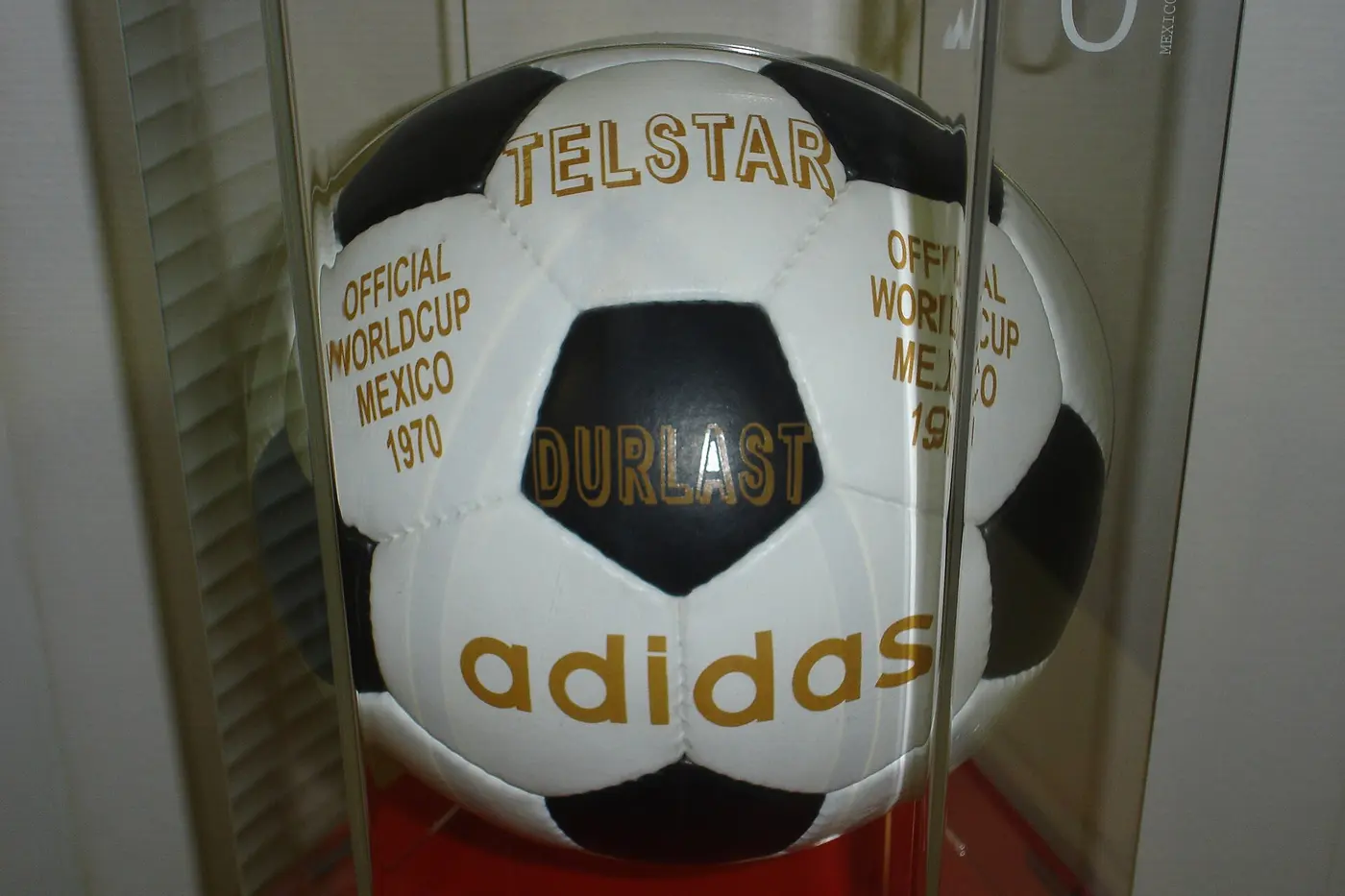

What stamped this shape on the world’s imagination was the Telstar, the official ball of the 1970 World Cup in Mexico. Its pentagons were colored black and its hexagons white so that the ball’s movement would be easy to follow on black-and-white television. Color TV was still rare around the world back then, and many people watched the matches on black-and-white screens. The black-and-white color scheme had been used before the Telstar, but it was the grand stage of the World Cup that made it the face of the soccer ball.
Chemists were amazed by a soccer ball, too
The same shape turns up in unexpected places. In 1985, Harold Kroto of Britain and Robert Curl and Richard Smalley of the United States, along with their colleagues, discovered a molecule made of 60 carbon atoms sitting at the corners of a truncated icosahedron: a molecule shaped exactly like a soccer ball.
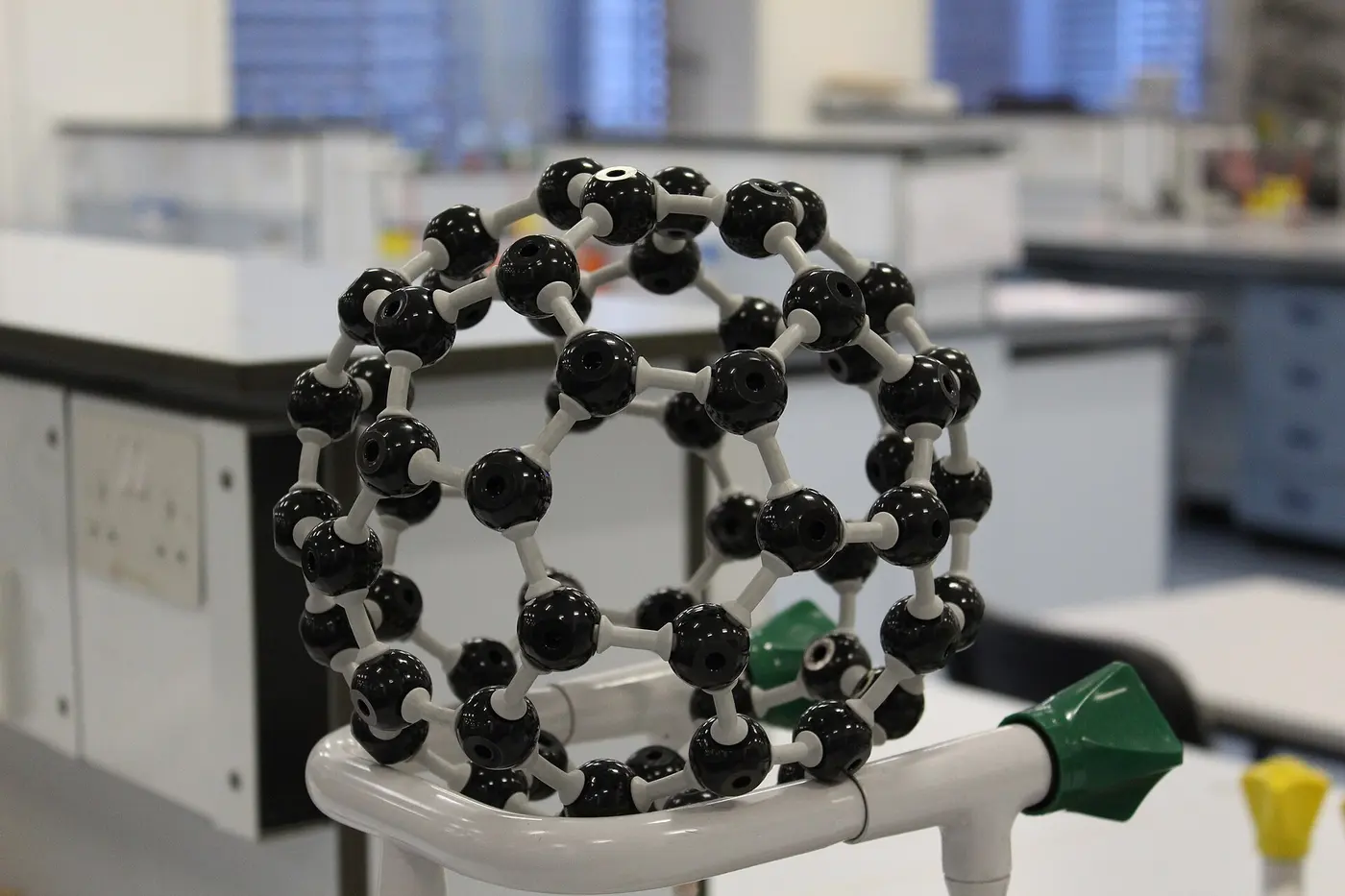

The molecule was named “fullerene” after the architect Buckminster Fuller, who designed domes of a similar shape, and its discoverers won the Nobel Prize in Chemistry in 1996. It is also known that, years earlier, in 1970, the Japanese chemist Eiji Osawa had theoretically predicted that such a molecule could exist.
The craftsmen making balls and the chemists studying molecules had arrived at the same shape.
Fewer and fewer panels
The latest soccer balls, though, are not necessarily made of 32 panels anymore. As technology for bonding panels with heat instead of stitching them improved, the number of panels in official World Cup balls dropped sharply: 14 in 2006, 8 in 2010, and just 6 in 2014. The thinking was that fewer seams would make a ball closer to a true sphere and more consistent in how it behaves when kicked.
Even so, the soccer ball we picture in our minds is still the black-and-white pattern of pentagons and hexagons. That is how powerful an image those television broadcasts of more than half a century ago left behind.