Do whales spout seawater?
Mostly not. A whale’s spout is its breath: moisture that condenses into fine droplets, mixed with mucus and some seawater that was sitting around the blowhole.
9 m
A whale breaks the surface with a loud whoosh and sends a white column into the air. For many people on a whale-watching trip, it is the moment they have been waiting for. In Japanese it is called shiofuki, literally “blowing brine,” and the great Japanese dictionary Nihon Kokugo Daijiten explains that whales are popularly said to blow brine because they send up seawater along with their breath.
But that white column is mostly the whale’s exhaled breath. A little seawater does get mixed in, yet whales are not swallowing the sea and squirting it out like a fountain.
Even Moby-Dick couldn’t decide
The nature of the spout stayed a puzzle for a surprisingly long time. Herman Melville took up the question in chapter 85 of Moby-Dick, published in 1851. His narrator, Ishmael, points out that whales have been spouting all over the sea for thousands of years, and whalemen have watched them up close for centuries, and yet “down to this blessed minute (fifteen and a quarter minutes past one o’clock P.M. of this sixteenth day of December, A.D. 1851), it should still remain a problem, whether these spoutings are, after all, really water, or nothing but vapor.”
The trouble, Ishmael explains, is that whenever you are close enough to see a spout clearly, the whale is in a “prodigious commotion” with water cascading all around it. Even if you see drops, you cannot tell whether they condensed from vapor or were lodged in the hollow of the blowhole. Whalemen, he adds, considered the spout poisonous, since touching it made the skin smart. In the end Ishmael settles on the hypothesis that the spout is nothing but mist, backing it with the tongue-in-cheek argument that deep thinkers always give off a little steam.
What the white column really is
Sixty years later, the 1911 Encyclopædia Britannica was blunt. “Of numerous erroneous ideas connected with natural history,” it said, “few are so widespread as that whales spout through their blow-holes water taken in at the mouth.” Spouting is simply breathing out. The whale forcibly expels air laden with water vapor, which condenses in the cool air into a column of steam or spray. When the sea is rough, the whale may start to exhale before its blowhole has cleared the surface, blowing up some water too, which completes the illusion.
The U.S. National Oceanic and Atmospheric Administration (NOAA) gives the same explanation today. Whales don’t have water in their lungs, and their blowholes work like nostrils. Some of the spray may be water that was lying on top of the whale’s head when it surfaced, and some is mucus, “just like when you blow your nose.” The rest is moisture from the warm air in the whale’s lungs, condensing as it meets the cooler air outside.
There is also evidence that the spout comes from the lungs. In 2017, a team including scientists from the Woods Hole Oceanographic Institution used a drone to collect the blow of humpback whales and found that the bacteria in it were clearly different from those in the surrounding seawater.

Telling whales apart by their blows
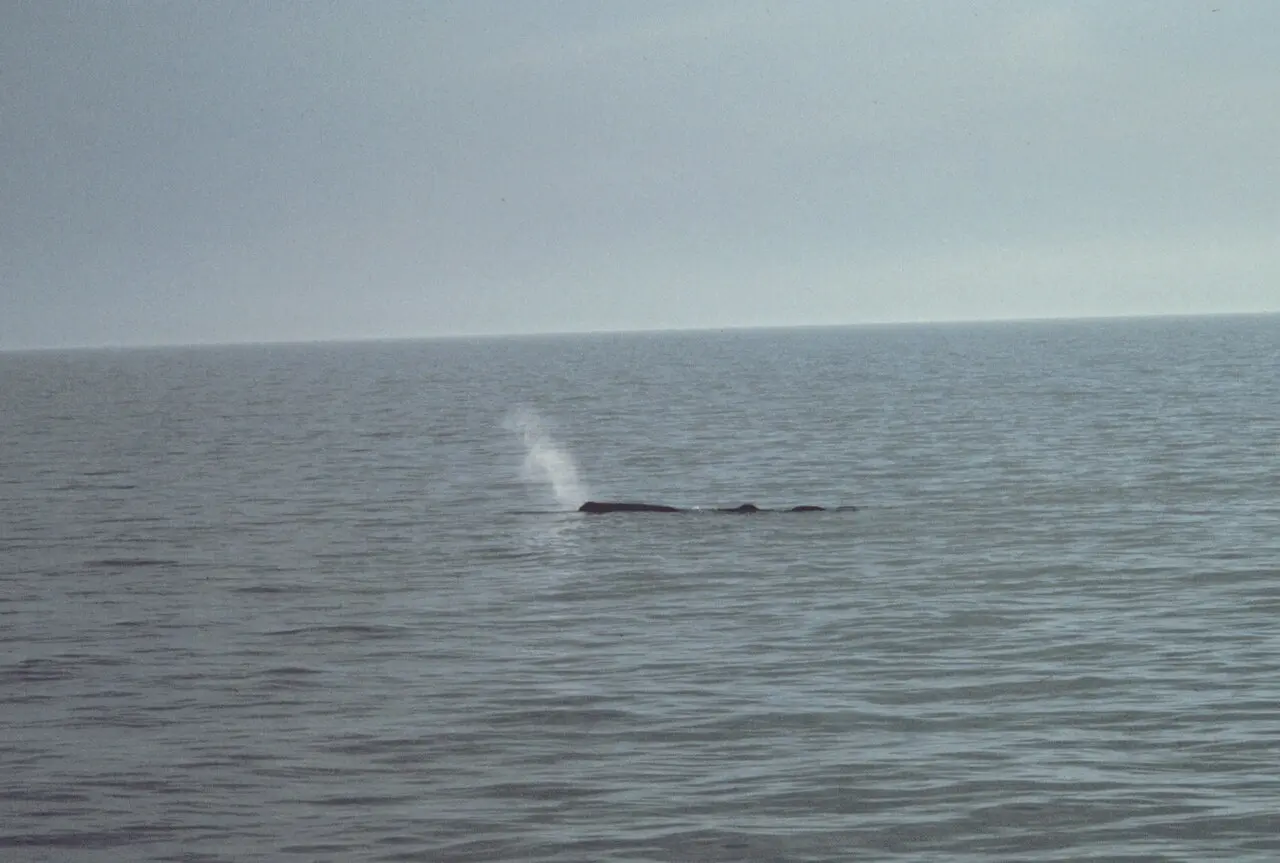
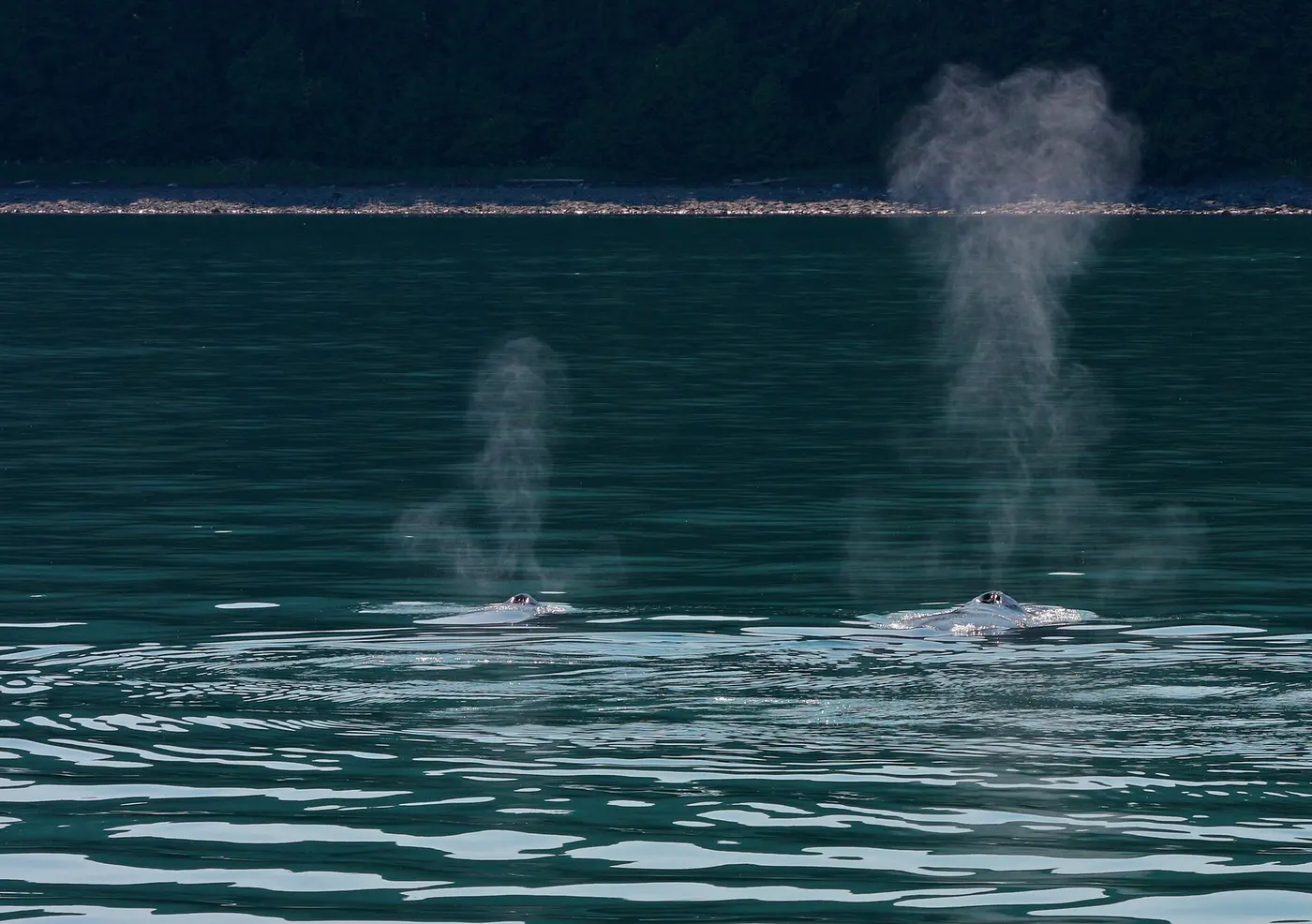
The blowholes sit on top of the head: baleen whales have two and toothed whales have one. Their number and position give each species a characteristic blow. According to a 1993 identification guide to marine mammals published by the Food and Agriculture Organization of the United Nations (FAO), right whales, with their widely separated blowholes, produce a V-shaped blow up to 5 m (16 feet) high. The blue whale’s blow is tall and slender, reaching 9 m (30 feet) or more. NOAA’s Stellwagen Bank National Marine Sanctuary describes the humpback’s blow as bushy and 10 to 16 feet (3 to 5 m) high, while a minke whale’s blow is barely visible.
The oddest is the sperm whale’s. Its single blowhole sits at the front of the head and off to the left, so its bushy blow shoots forward and to the left at an angle. On a windless day, the guide says, that angled blow alone is enough to identify the species.