When did players start wearing numbers on their backs?
In the major leagues, numbers on the back caught on in 1929. The Yankees handed them out by batting order, so Babe Ruth, who batted third, wore No. 3.
1929
Say “Yankees No. 3” to a baseball fan and they will think of Babe Ruth; say “Dodgers No. 42” and they will think of Jackie Robinson. The National Baseball Hall of Fame has written that, short of being elected to the Hall itself, having one’s number retired may be the greatest honor a ballplayer can receive.
Yet big league players did not wear numbers as a matter of course until more than 50 years after the National League was founded in 1876.
First on the sleeve
According to the Hall of Fame, the earliest verified attempt to number players came in 1907. Alfred Lawson, manager of the Reading Red Roses, a minor league club in Pennsylvania, decided to number his team’s uniforms so fans could tell the players apart. Whether the club ever actually took the field in them is unknown.
The first major league team to try numbers was the Cleveland Indians. Inspired by hockey and football, they took the field on June 26, 1916, with large numerals on their left sleeves. The experiment lasted only a few weeks, and after a brief trial the following year it was dropped.
In 1923, St. Louis Cardinals manager Branch Rickey put numbers on his players’ sleeves at the suggestion of a local sportswriter. It did not go well. As Rickey recalled in 1962, “Ridicule followed throughout the country,” the players were jeered from the stands and by opponents, team morale “busted up” completely, and the players “really didn’t want to show themselves on the field.” The numbers came off.
1929: numbers by batting order
The change came from the New York Yankees, the reigning World Series champions. According to MLB.com, on January 22, 1929, the Yankees announced that they would put numbers on the backs of their uniforms, assigned by each player’s place in the batting order. Babe Ruth, who batted third, got No. 3, and cleanup hitter Lou Gehrig got No. 4.
Yet the honor of being the first big league team to wear numbers on the back went elsewhere. According to the Hall of Fame, the Yankees’ home opener on April 16, where the new uniforms were to debut, was rained out. That same day, the Indians, blessed with clear skies, took the field in numbered jerseys.
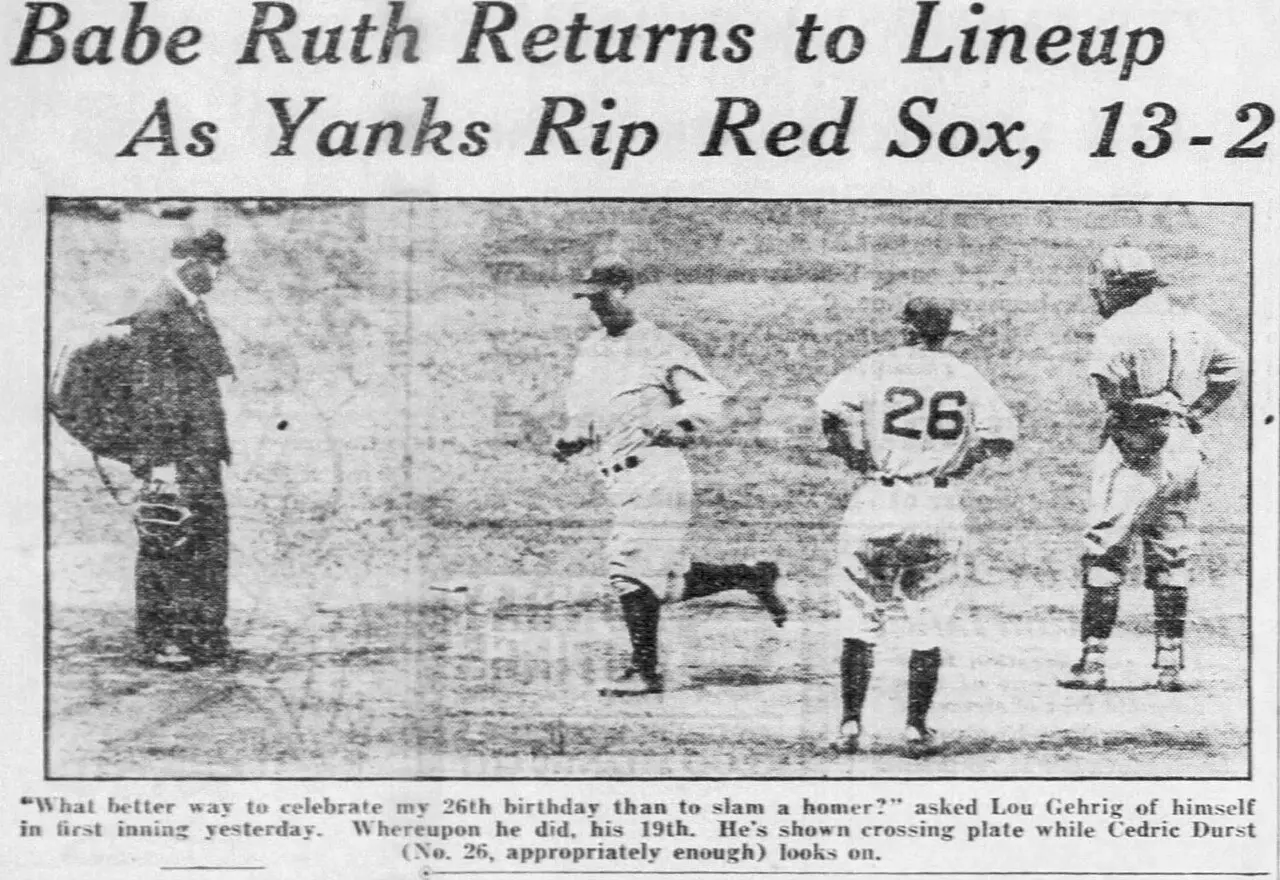

The idea spread fast. According to MLB.com, every American League team was wearing numbers by 1931, and every National League team by 1933. Still, the Philadelphia Athletics did not put numbers on their home uniforms, as well as their road ones, until 1937.
The first retired number
Once numbers stuck, they came to stand for the players themselves. In 1939 Gehrig was diagnosed with ALS (amyotrophic lateral sclerosis), a progressive and fatal disease, and his playing days were over. On July 4 the Yankees held Lou Gehrig Appreciation Day, where he told the crowd, “Today, I consider myself the luckiest man on the face of the earth.”
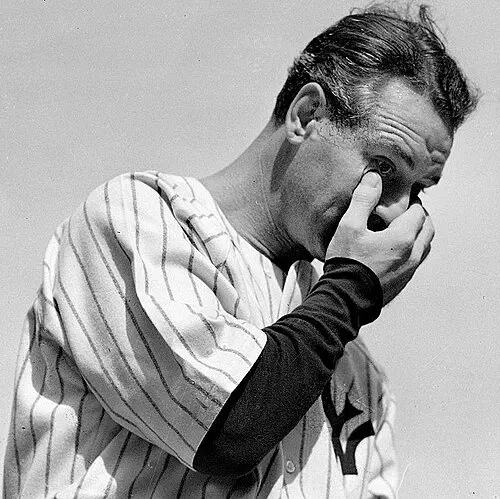

According to the Hall of Fame, about half a year later the club announced that it had retired Gehrig’s No. 4, so that no Yankee would ever wear it again. It is regarded as the first retired number in the majors, and well over 100 major league numbers have been retired since. In 1997, Jackie Robinson’s No. 42 was retired throughout the major and minor leagues, 50 years after he broke baseball’s color line.
In Japan, the first retired numbers in professional baseball came in 1947, when the Yomiuri Giants retired two: No. 14 for pitcher Eiji Sawamura, who was killed in World War II, and No. 4 for Toshio Kurosawa, a star of the team in the years right after the war. So one of Japan’s first retired numbers, too, was a 4.