Did experts once say a four-minute mile was humanly impossible?
Not really. A 1943 paper in Science called it an “imminent possibility.” The story that doctors warned it could kill a runner is a later retelling with no clear source.
1.4seconds
On the evening of May 6, 1954, at Oxford University’s Iffley Road track, a 25-year-old medical student named Roger Bannister ran a mile (about 1,609 m) in 3 minutes 59.4 seconds. For the first time, a human being had run a mile in under four minutes.
The story almost always comes with a preface. Doctors and scientists of the day, it goes, insisted that a four-minute mile was beyond the human body and that anyone who tried might die. Then, once Bannister broke through, others came pouring after him. It has become a favorite parable about mental barriers, repeated in countless speeches and self-help books. The records from the time, though, tell a quieter story, and in some ways a more interesting one.
The clock that stopped for almost nine years
Four minutes came to be seen as a “barrier” largely because the record stalled just short of it for so long. During World War II, two runners in neutral Sweden, Gunder Hägg and Arne Andersson, chipped away at the mile record race after race. Andersson ran 4:01.6 in 1944, and in July 1945 Hägg lowered it to 4:01.4. Then, in 1946, both were declared professionals for accepting payment for running and were banned from competition. With athletics in many countries still disrupted by the war, the world record sat untouched for almost nine years.
After the war, the men chasing those last 1.4 seconds were Bannister and the Australian John Landy. Landy ran in the 4:02 range again and again but could not get any further. As Bannister later recalled, Landy said it was “like a wall.”
Who said it was impossible?
So did doctors and scientists really call it impossible? Guinness World Records quotes Bannister himself, looking back years later, as saying that doctors and scientists had said it was impossible and that one would die in the attempt. But it does not say which doctor said so, or when.
What did make it into print at the time points the other way. In October 1943, the American journal Science published a short paper by Alfred W. Francis, who had plotted the world records for different distances on a single curve. By that measure, he wrote, even the hypothetical “four minute mile” fell short of the curve, and was “therefore an imminent possibility.”
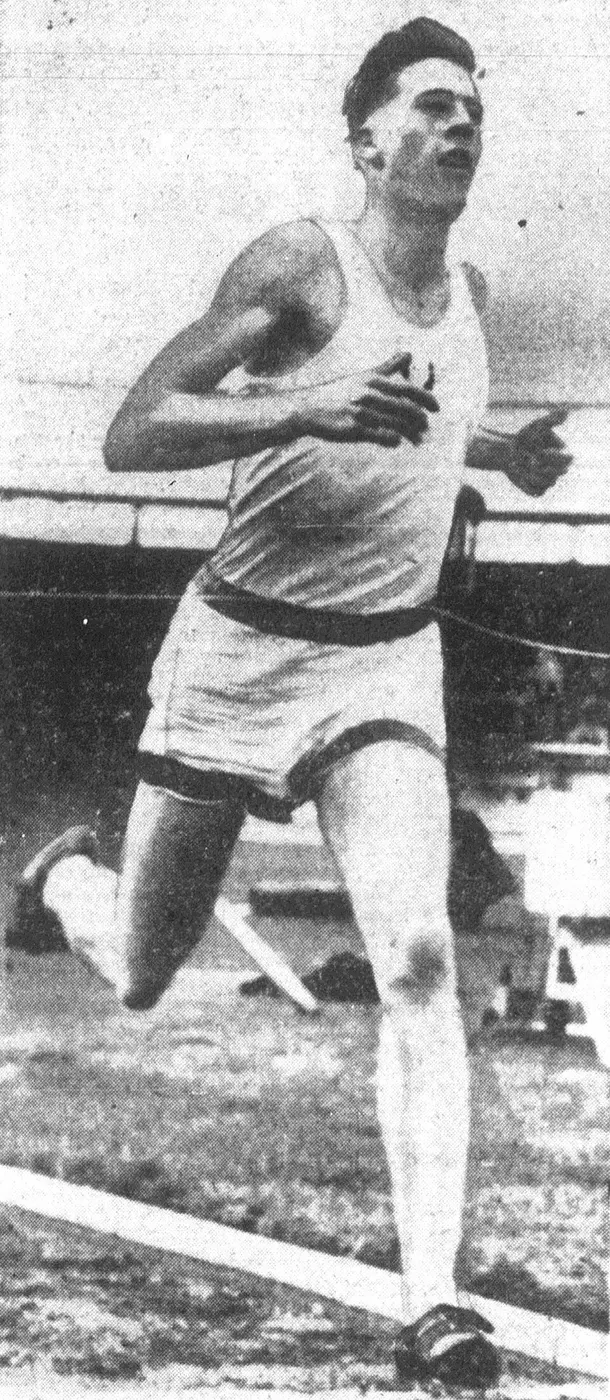

That is not to say nobody ever proposed a limit. According to Neal Bascomb’s book The Perfect Mile, the respected American coach Brutus Hamilton drew up a list of the ultimate performances humans could achieve in the 1930s, and put the fastest possible mile at 4:01.6. Andersson matched that figure, and Hägg beat it, within a few years. And in May 1954, the same month Bannister made history, Hamilton himself published an article in the journal of the American Association for Health, Physical Education, and Recreation titled “A Four-Flat Mile in ’54?”
Bannister, for his part, said in a 2002 interview that as someone trained in physiology, he could not see any logical reason why a man who could run a mile in 4:02 could not run one in 4:00. The barrier, in his view, was not physical, though it had become to some extent psychological.
Broken again in 46 days
The day of the attempt brought rain and strong winds, and Bannister considered calling it off. About 20 minutes before the race, the weather improved, and he decided to go. His friend Chris Brasher led the first two laps, Chris Chataway took the third, and Bannister went past with a little over half a lap to go.
The idea that others poured through the moment the barrier fell is only half true. Just 46 days later, on June 21, Landy ran 3:57.9 in Turku, Finland, taking the record. But they were the only two men to break four minutes in 1954. In August, at the British Empire and Commonwealth Games in Vancouver, Canada, they finally met head to head, and both went under four minutes: Bannister won in 3:58.8, with Landy second in 3:59.6.
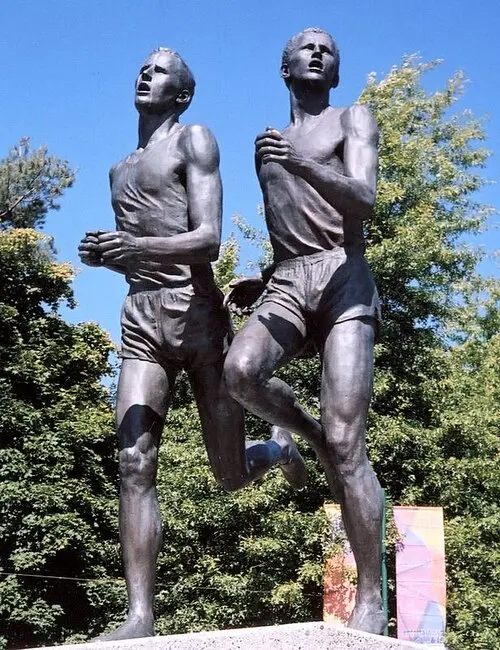

Bannister retired from racing before the year was out and became a neurologist, researching the autonomic nervous system. Today’s mile world record is 3:43.13, set by Morocco’s Hicham El Guerrouj in Rome in 1999, more than 16 seconds faster than Bannister. Even so, four minutes is still the round number every serious middle-distance runner wants to beat.