Do green tea and black tea come from the same plant?
Yes. Both are made from the leaves of Camellia sinensis. Heat the leaves right after picking and you get green tea; let their own enzymes oxidize them and you get black tea.
Japanese green tea, black tea with milk, a glass of oolong at a Chinese restaurant. They differ so much in color, aroma and flavor that it would be easy to assume they come from three different plants.
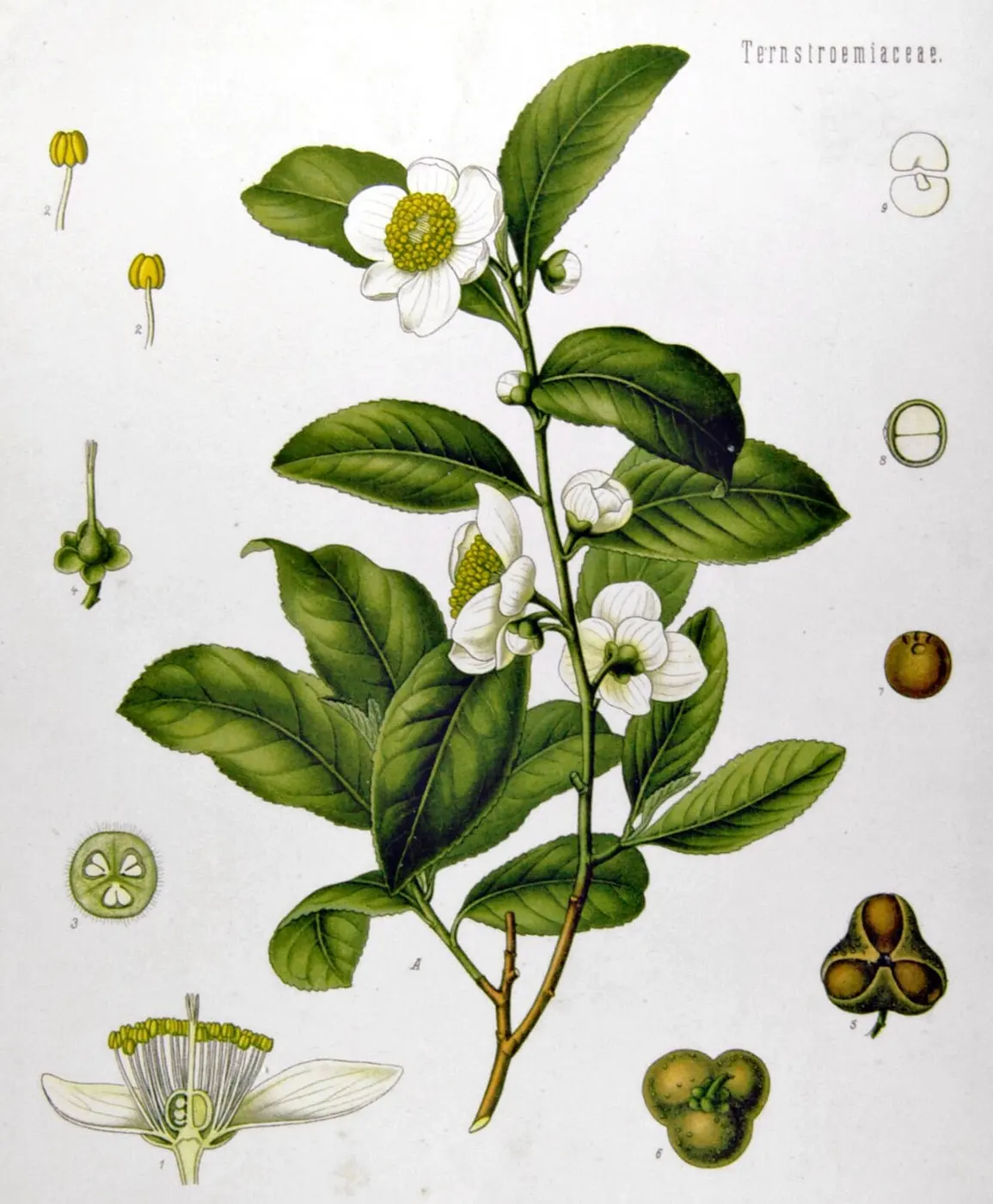
In fact, all of them are made from the leaves of a single species, Camellia sinensis, the tea plant, a relative of the garden camellia. As a Japanese dictionary of nutrition and biochemistry puts it, black tea, oolong and green tea are all made from the same species of tree. What makes the difference is not so much the leaf as what happens to it after it is picked.
Linnaeus thought there were two
In 18th-century Europe, it was widely believed that green and black tea came from different plants. Even Carl Linnaeus, the Swedish naturalist who established the modern system of scientific names, divided the tea plant into two species in the 1762 second edition of his Species Plantarum: Thea bohea and Thea viridis. Bohea was the English name for the Wuyi hills in China’s Fujian Province, famous for black tea, while viridis is Latin for green. Black tea was thought to come from the first, green tea from the second.
The Scottish plant hunter Robert Fortune helped put that idea to rest. Traveling through China’s tea districts in the 1840s, he visited the tea hills near Fuzhou in Fujian, in the heart of black tea country, expecting to find Thea bohea. “Great was my surprise,” he wrote, to find that every plant there was exactly the same as those in the green tea districts farther north. And the local people were busy turning those leaves into black tea.
In a book published in 1847, Fortune reported that most of the black and green tea shipped every year from China to Europe and America came from the same species. He had pressed specimens himself and deposited them in the herbarium of the Horticultural Society of London, “so that there can be no longer any doubt upon the subject.”

It’s all about oxidation
So how can one leaf produce such different drinks? The key lies in enzymes inside the leaf itself.
Once tea leaves are picked, enzymes in the leaf begin to oxidize compounds called catechins, and the leaves gradually turn reddish brown. To make green tea, producers heat the leaves soon after picking to stop those enzymes in their tracks. According to Saitama Prefecture, a tea-growing region near Tokyo, the Japanese method is to steam the leaves, while the Chinese method is to roast them in a pan.
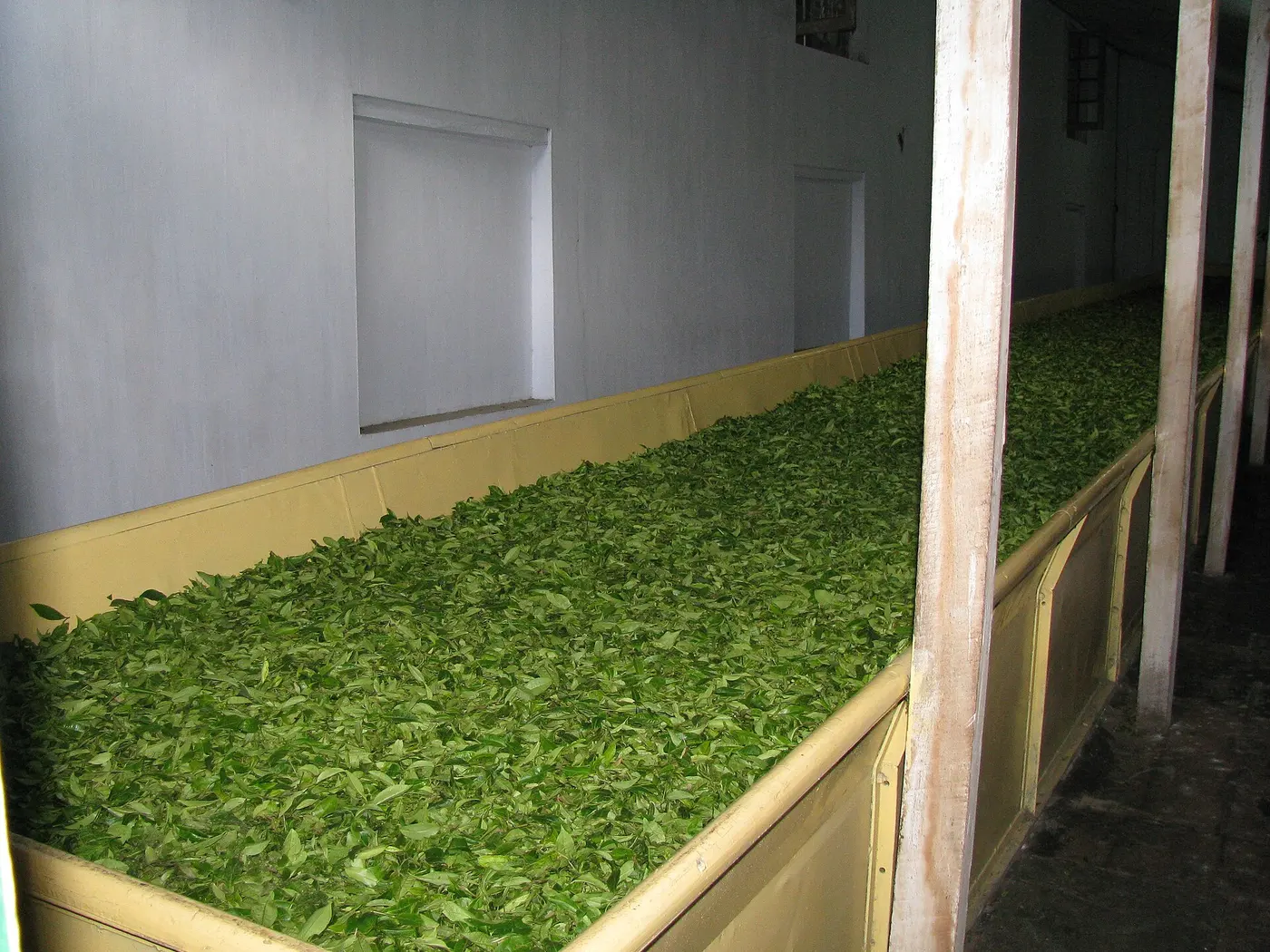
Black tea takes the opposite approach and makes the most of the enzymes. The leaves are first left to wilt, a step known as withering, then rolled to break open their cells, allowed to oxidize thoroughly and finally dried. Along the way, catechins link up to form pigments such as theaflavins, which give black tea its reddish color. Oolong sits in between: oxidation is allowed to start and then stopped partway.
Tea makers have long called this process “fermentation,” and in Japan green tea, oolong and black tea are classed as unfermented, semi-fermented and fermented teas. But as a guide from the Japan Tourism Agency explains, the process is properly called oxidation, even though it is commonly referred to as fermentation. Unlike miso or yogurt, no microbes are involved. The work is done by the leaf’s own enzymes.

Chinese and Assam varieties
That is not to say every tea plant is the same. Botanists recognize two main varieties. The China type, var. sinensis, has smaller leaves and copes relatively well with cold, and it is the type mainly grown in Japan. The Assam type, var. assamica, has larger leaves, is far more sensitive to cold and thrives in hot climates; it is widely grown on the tea estates of India and Sri Lanka. According to the Japanese encyclopedia Nipponica, wild tea plants were found in Assam, in northeastern India, in 1823.
Each variety is better suited to some kinds of tea, but no leaf is destined for one kind only. A neat example is Benifuuki, a Japanese cultivar bred from Benihomare, an Assam hybrid grown for black tea, and a Darjeeling-type plant. It was named in 1993 as a cultivar for black and oolong-style tea.
Researchers later found that Benifuuki is rich in methylated catechins, compounds studied for their potential to ease allergy symptoms such as hay fever. These compounds disappear when the leaves are fermented into black tea, so Japan’s National Agriculture and Food Research Organization advises that to make use of them, the leaves should be processed as green tea or as a lightly withered oolong-style tea. A variety bred for black tea is now sold as green tea, too.