Why is taiyaki shaped like a fish?
The sea bream, or tai, is a symbol of good luck in Japan and was once a luxury most people rarely ate. A Tokyo confectioner is said to have recast an older bean-filled cake in its shape.
1909
A crisp golden shell, packed with sweet red bean paste right to the tip of the tail. On a cold day, a taiyaki fresh off the griddle warms your hands before it warms the rest of you.
Everyone knows taiyaki are shaped like a fish. Think about it for a moment, though, and it’s a strange choice. There is no fish inside, only sweet anko, or bean paste. So why a fish? And why a tai, the red sea bream? The trail leads to a Tokyo shop and a confectioner who got it right on his third try.
The cake that came first
Taiyaki descend from imagawayaki, round cakes of batter filled with bean paste. According to the Heibonsha World Encyclopedia, imagawayaki take their name from Imagawa Bridge in the Kanda district of Edo (now Tokyo), near where they were first sold. A guide published in 1777 already lists a maker in the Honjo neighborhood, Yahei of Nasuya.
Imagawayaki were popular because they could be made quickly on the street and eaten hot. The same encyclopedia adds that depending on the shape and pattern of the mold, the cakes went by other names, including tomoeyaki, obanyaki and taiyaki. By the dictionary’s reckoning, in other words, taiyaki are simply imagawayaki in fish form.
A lucky fish in Azabu-Juban
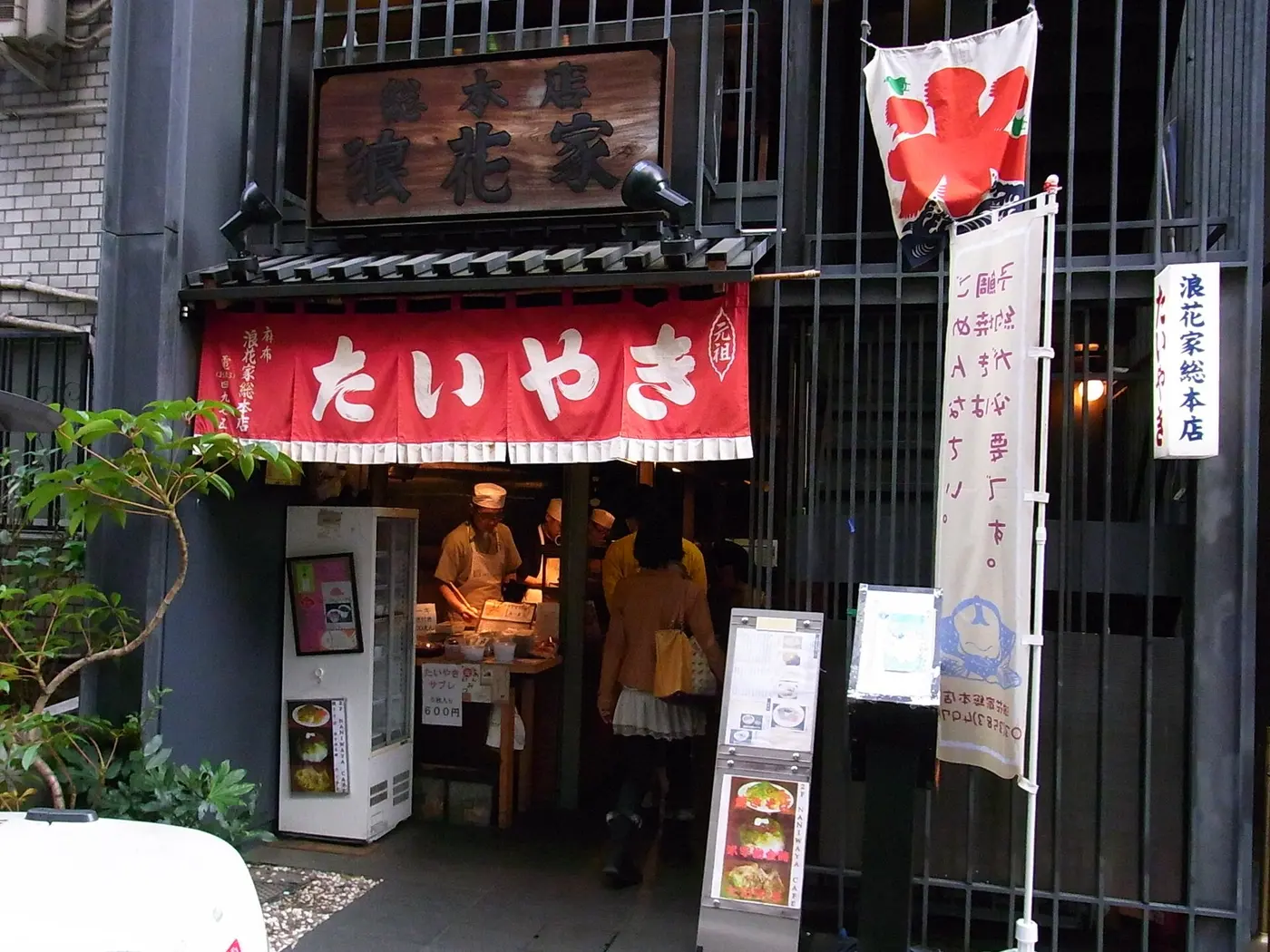
So who made the first fish-shaped mold? The usual answer is Naniwaya Sohonten, a shop that now stands in Tokyo’s Azabu-Juban district.
The National Diet Library’s reference database, which answers questions sent to Japanese libraries, has an entry on exactly this. It cites Tetsu Okada’s Tabemono Kigen Jiten (Dictionary of Food Origins, 2003), which credits Seijiro Kanbe, who founded Naniwaya in 1909, late in the Meiji era (1868–1912). Kanbe started out selling imagawayaki, which did not sell. A turtle-shaped version, kameyaki, flopped too. Then he tried the shape of an auspicious sea bream, and the cakes sold like hot cakes.

Why a sea bream? Another book cited in the same entry, Tokyo Taiyaki Meguri (2007), gives two reasons. The tai is a lucky fish, because its name echoes medetai, the Japanese word for “auspicious,” and it is served at celebrations. And real sea bream was a luxury that ordinary people seldom got to eat. If you couldn’t afford the fish, you could at least have its shape.
Fish cakes at the night market
Whether Naniwaya was truly the first is harder to say. Less than two years after the shop opened, the novelist Kyoka Izumi published Hoshimise (Night Stalls), a story dated February 1911 that describes the food stalls of a Tokyo night market. Alongside stalls selling candy and imagawayaki, one advertises “Edo-style fish cakes, fresh from the bay,” while another bills its wares as “sea bream cakes, a full eight sun from eye to tail,” borrowing the language fishmongers use for a prize catch (a sun is about 3 cm, or 1.2 inches). Fish-shaped cakes, it seems, were already common enough for rival stalls to compete over them.
Did Naniwaya’s mold get copied that quickly, or did someone else have the same idea? We can’t tell. What is certain is that by the end of the Meiji era, fish-shaped cakes were a hit in Tokyo.
“Wild” and “farmed”
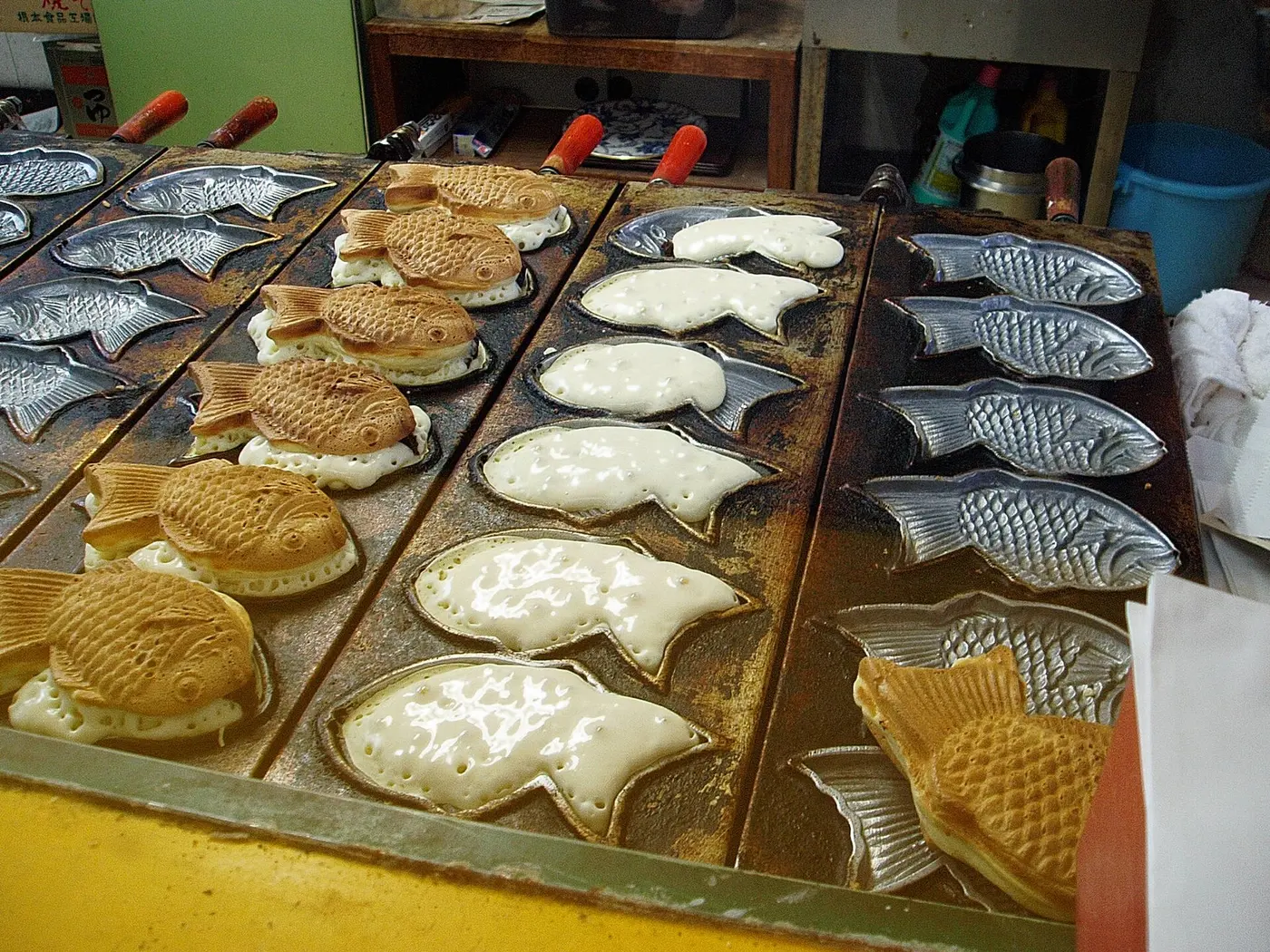
Taiyaki molds come in two main types. One is a single-fish iron mold on a long handle, turned by hand over the flame. The other is a large griddle with rows of fish-shaped hollows that bakes many at once. Taiyaki fans sometimes call the first kind tennen-mono, “wild-caught,” and the second yoshoku-mono, “farm-raised.” A 2002 guidebook by Yasuhiko Miyajima is titled Taiyaki no Gyotaku (Fish Prints of Taiyaki), with the subtitle “37 ‘wild’ taiyaki on the verge of extinction.” The slow, one-at-a-time molds have become a rarity.

Taiyaki’s biggest moment in the spotlight may have come in 1975. On December 25 that year, the singer Masato Shimon released “Oyoge! Taiyaki-kun” (Swim! Little Taiyaki), a song from the Fuji TV children’s show Hirake! Ponkikki. In an all-time singles ranking published in 2016, the Oricon chart put its sales at 4.577 million copies, the most of any single in the chart’s history.