Why do sumo wrestlers throw salt?
Because sumo has its roots in Shinto ritual, wrestlers scatter salt to purify the ring.
45kg
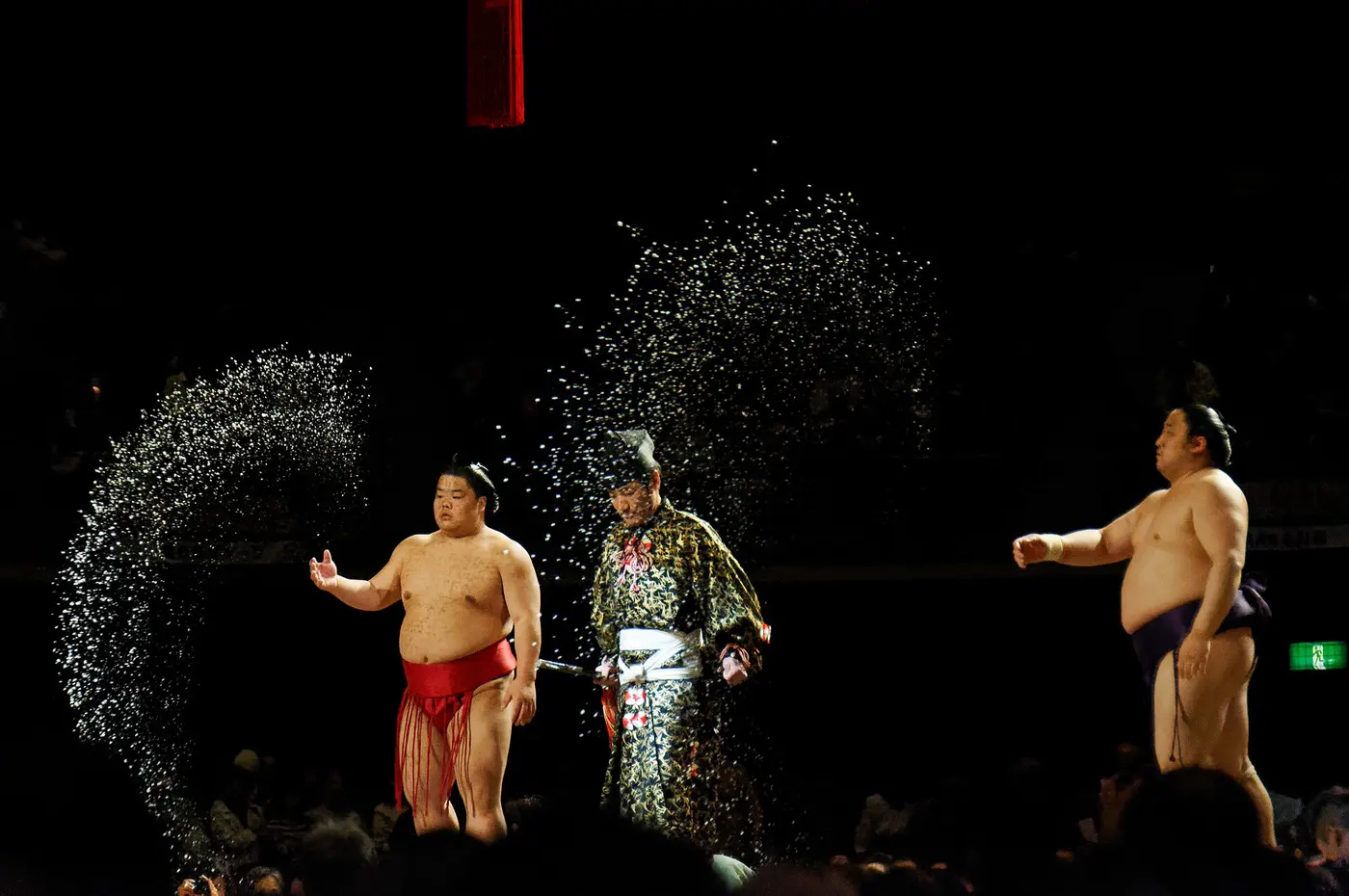
A wrestler finishes his crouching face-off, reaches into a salt basket and tosses a handful high over the ring. As the white grains arc through the spotlights, the arena erupts. Anyone who has watched sumo on television has seen it countless times.
What is that salt for? You may have heard that it’s “to disinfect injuries.” But the main meaning of the salt throw goes back much further than that.
A handful to purify the ring
Sumo is said to have begun as a Shinto ritual offered to the gods. In ancient times, matches were held at shrine festivals to divine the harvest or give thanks to the deities. The place where they were held had to be sacred. Salt, it is thought, came to be scattered to drive evil from the ring, or dohyō, and purify it.
The idea of cleansing with salt runs deep in Japanese life, well beyond sumo. Shops place small cones of salt at their entrances, and people sprinkle salt on themselves on returning from a funeral. In Japanese mythology, the god Izanagi purified himself in seawater after returning from the land of the dead, and this story is sometimes linked to the origins of purification with salt.
Other parts of a wrestler’s routine also have to do with purification. Below the ring, he receives “power water” (chikara-mizu) to rinse his mouth and wipes his lips with “power paper” (chikara-gami), both said to cleanse the body. Within this series of rituals, the salt throw has the job of purifying the ring itself.
Only senior wrestlers throw salt
Not every wrestler gets to throw salt, though. As a rule, it is done by sekitori—wrestlers in the top two divisions, jūryō and above. In bouts below that level, matches usually go ahead without salt unless there is time to spare. For young wrestlers, being allowed to throw salt is said to be a goal in itself.
In sekitori bouts, wrestlers go through the face-off several times after stepping into the ring, throwing salt each time. This face-off has a time limit, introduced in the January tournament of 1928 to coincide with the start of sumo radio broadcasts. Since the September tournament of 1950, the limit has been four minutes for the top makuuchi division and three minutes for jūryō. The last throw, once the wrestlers are told time is up, tends to be the most fired-up of all.

About 45 kilograms a day
It may be one handful at a time, but it adds up. At tournaments held at the Ryōgoku Kokugikan arena in Tokyo, about 45 kilograms (roughly 100 pounds) of salt is said to be prepared each day, and around 650 kilograms over a 15-day tournament. The bamboo baskets beside the ring each hold about 5 kilograms and are topped up whenever they run low.
The salt used at Tokyo tournaments is Hakata no Shio, made by Hakata Salt in Ehime Prefecture, and it is said to have been in use since the May tournament of 1987. Its large, slightly moist grains, which retain bittern (the mineral-rich liquid left after salt crystallizes), are easy to grab and fly a long way when thrown with gusto.
The “disinfectant” theory and the big throwers
What about the idea, mentioned at the start, that salt is there as a disinfectant? You still often hear that salt helps sterilize scrapes when a wrestler falls in the ring. But the origin of the salt throw lies in purification, and the disinfection story is generally seen as a rationale added later.
At the same time, the salt throw has become part of the show. Former sekiwake Mitoizumi was known for flinging around 600 grams of salt at a time, and at sumo’s London tour he was reportedly introduced as the “Salt Shaker.” Kitazakura is said to have inherited the style from Mitoizumi after his retirement, and his huge throws of salt at the end of the time limit brought the house down.
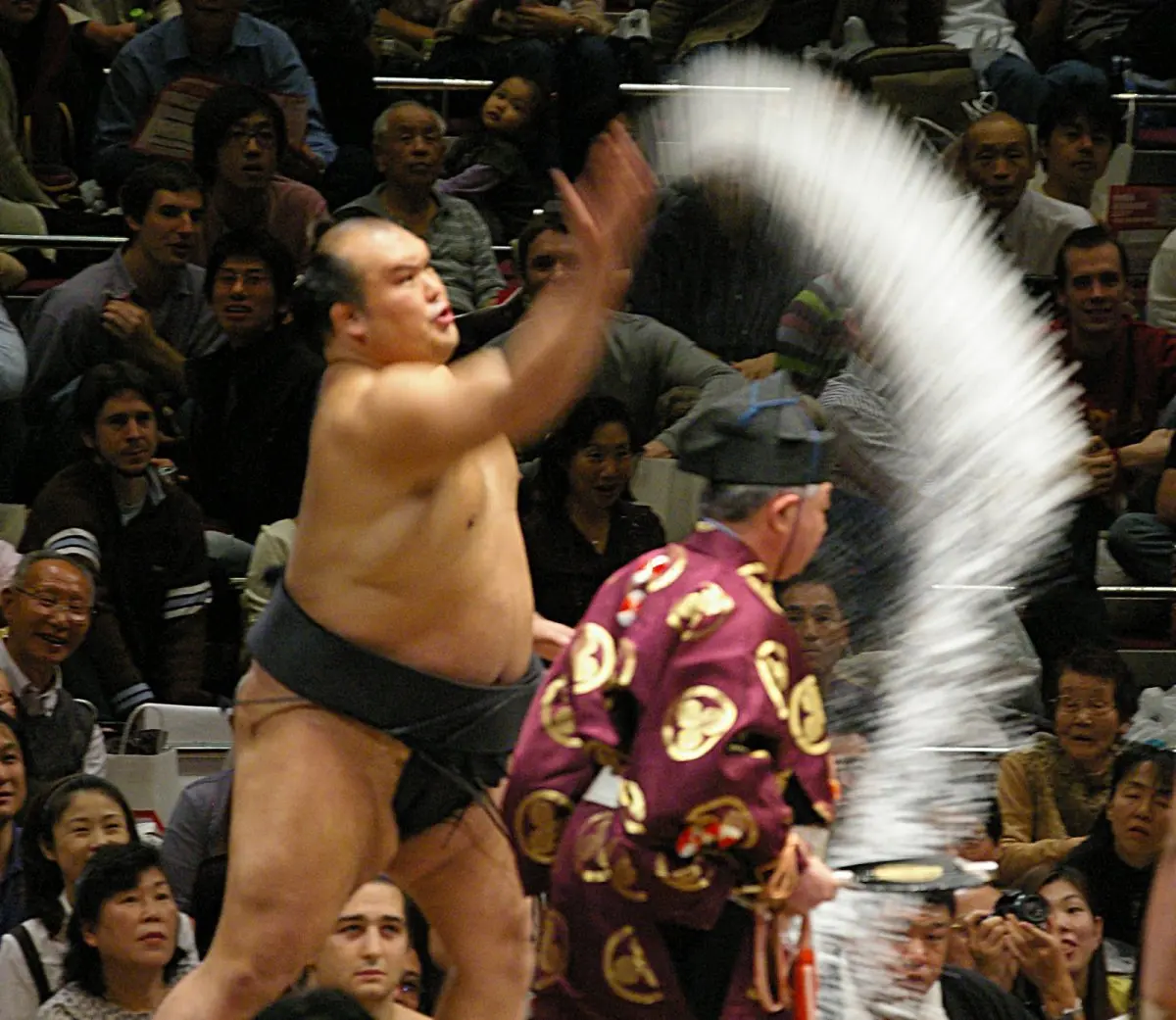

A ritual that purifies a sacred space, and a crowd-pleasing moment of theater: in that single handful of salt, sumo’s two faces overlap.