Where does beach sand come from?
Mostly from bits of rock that rivers carry down from the mountains. On coral islands it comes from shells and skeletons, and on volcanic islands from shattered lava.
160ha
Scoop up a handful of beach sand and let it run through your fingers. What was it before it became sand?
The answer depends on the beach. The US National Oceanic and Atmospheric Administration (NOAA) describes sand as the end product of many things, from decomposed rocks to the by-products of living things, and even parrotfish poop.
Rock from the mountains
According to NOAA, most sand forms as rocks break down through weathering and erosion over thousands or even millions of years. Two minerals, quartz and feldspar, are especially slow to decompose, so they survive the longest. The fragments break down further as rivers carry them to the sea, where waves and tides keep grinding them. The tan color of most sandy beaches, NOAA explains, comes from iron oxide tinting the quartz and from feldspar, which is naturally brown to tan.
That means a beach takes on the character of the mountains behind it. Geologists at Japan’s National Institute of Advanced Industrial Science and Technology have written that the coarseness of beach sand and the kinds of grains in it are closely tied to local geology and wave strength.
On the Enshu-nada coast of Shizuoka Prefecture, high school students put this to the test. In a study presented at the 2009 meeting of the Japan Geoscience Union, students from Iwata Minami High School found that the sand near the mouth of the Tenryu River was whitish, while the sand near the Oi and Abe rivers to the east was almost black. They attributed this to quartz- and feldspar-rich rocks such as granite in the Tenryu basin, and to rocks shedding dark minerals in the Oi and Abe basins. The students also found pink and orange grains of garnet that were most common near the Tenryu and became scarcer with distance, and they traced the garnet back to that river.
Sand from living things
The white beaches of coral islands are made not of rock but of living things: fragments of coral skeleton, broken shells and, in Okinawa, the famous “star sand.”
According to the Akajima Marine Science Laboratory in Okinawa, star sand consists of the shells of foraminifera, single-celled organisms related to amoebas. Some have pointed spines; others, known in Japanese as “sun sand,” have rounded tips. Living foraminifera cling to dead coral, rocks and seaweed in shallow reef waters. When they die, their limy shells are left behind and eventually become sand.
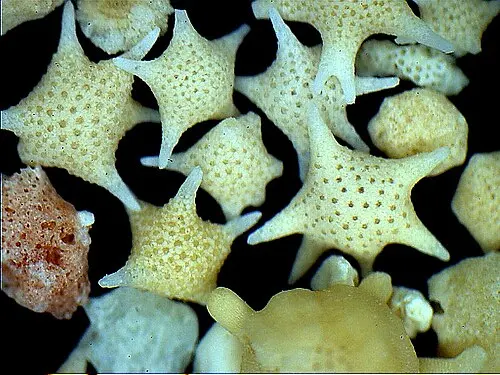

Perfect stars are rarer on the beach than you might think. In a 1986 article in Chishitsu News, a magazine of the Geological Survey of Japan, a survey geologist noted that star sand gets worn down on the beach, so neat stars are relatively few. The souvenir star sand of the time, he wrote, was fossil sand dug from old deposits on Taketomi Island.
In tropical waters, fish make sand too. According to NOAA, parrotfish scrape algae off coral and rocks with their beaklike teeth, grinding up the coral skeleton in the process and excreting the indigestible part as white sand, hundreds of pounds of it a year. NOAA notes that the famous white-sand beaches of Hawaii actually come from parrotfish poop.
Black beaches and green beaches
Volcanic islands produce beaches of other colors. According to the US Geological Survey (USGS), Hawaii’s black sand forms when hot lava flows into the cold ocean and shatters into tiny shards of black glass, which the waves then gather into beaches.
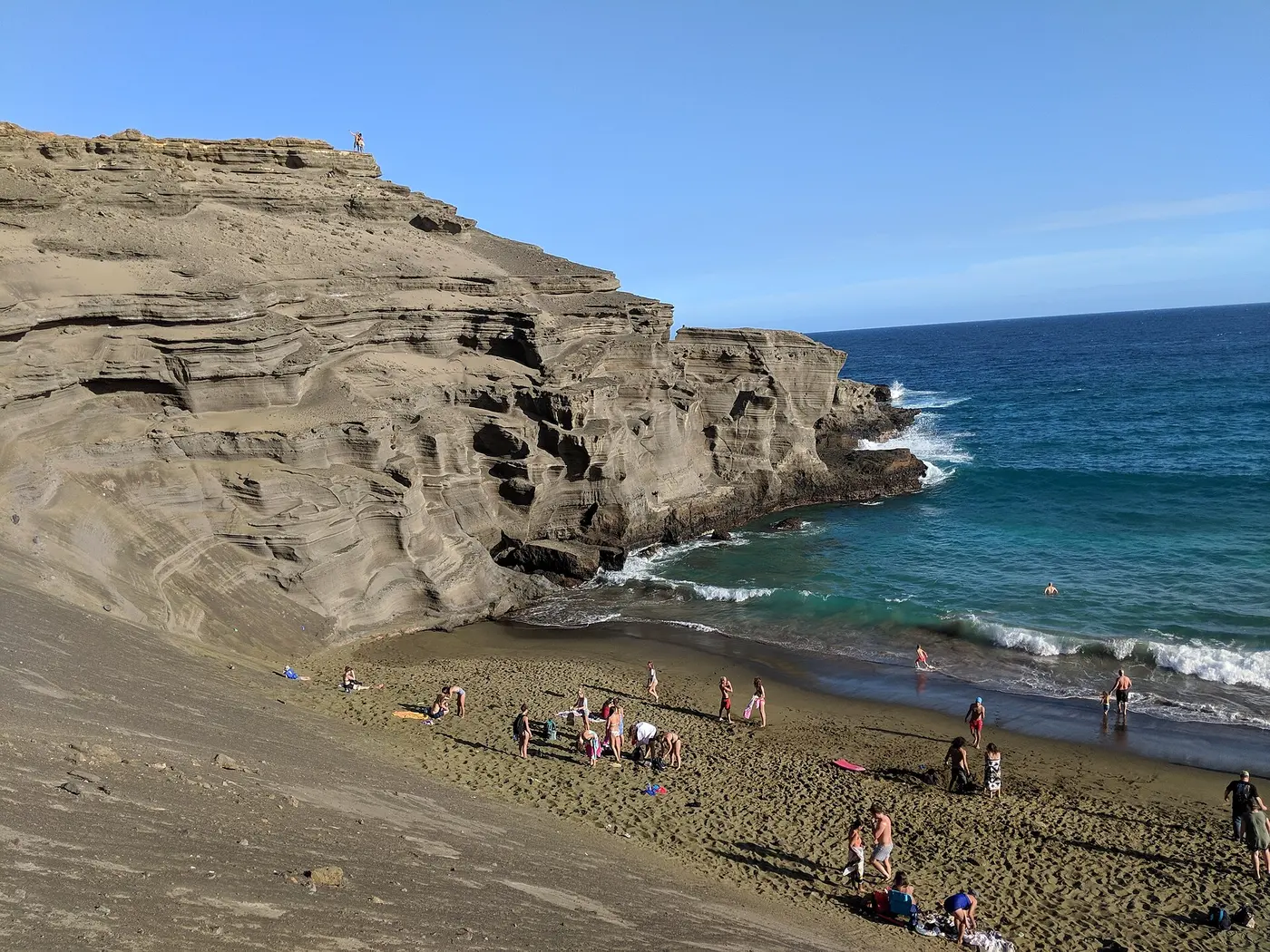
Papakōlea Beach, near the southern tip of the Island of Hawaii, is green. The color comes from grains of olivine, a mineral. According to the USGS, Puʻu Mahana, the volcanic cone behind the beach, was built from olivine-rich magma, and as waves eat away at the cone, olivine is released. Because olivine is heavier than other grains, it stays on the beach while the waves carry the lighter ones out to sea. Once the cone has completely eroded, the USGS writes, the beach will eventually look like any other.

When the journey is cut short
A beach is a balance between sand arriving and sand carried away by waves. If less arrives, the beach shrinks.
According to Japan’s Ministry of Land, Infrastructure, Transport and Tourism (MLIT), a study comparing topographic maps found that from the late 19th century to 1978, Japan lost an average of 72 hectares (180 acres) of beach a year. From 1978 to 1992, that rose to 160 hectares (400 acres) a year. Among the main causes, the ministry cites dams and gravel mining, which cut the sand rivers deliver, and breakwaters and other structures that block sand drifting along the coast.
Along Enshu-nada, where sandy beaches stretch for about 117 kilometers (73 miles) on either side of the Tenryu River, Shizuoka Prefecture says dams and gravel mining have cut the supply of river sand while coastal structures have interrupted its flow, leaving once-grand dunes threatened by erosion. A projection cited by Japan’s National Institute for Environmental Studies suggests that rising seas could wipe out 60 to 70 percent of Japan’s sandy beaches by the end of this century.