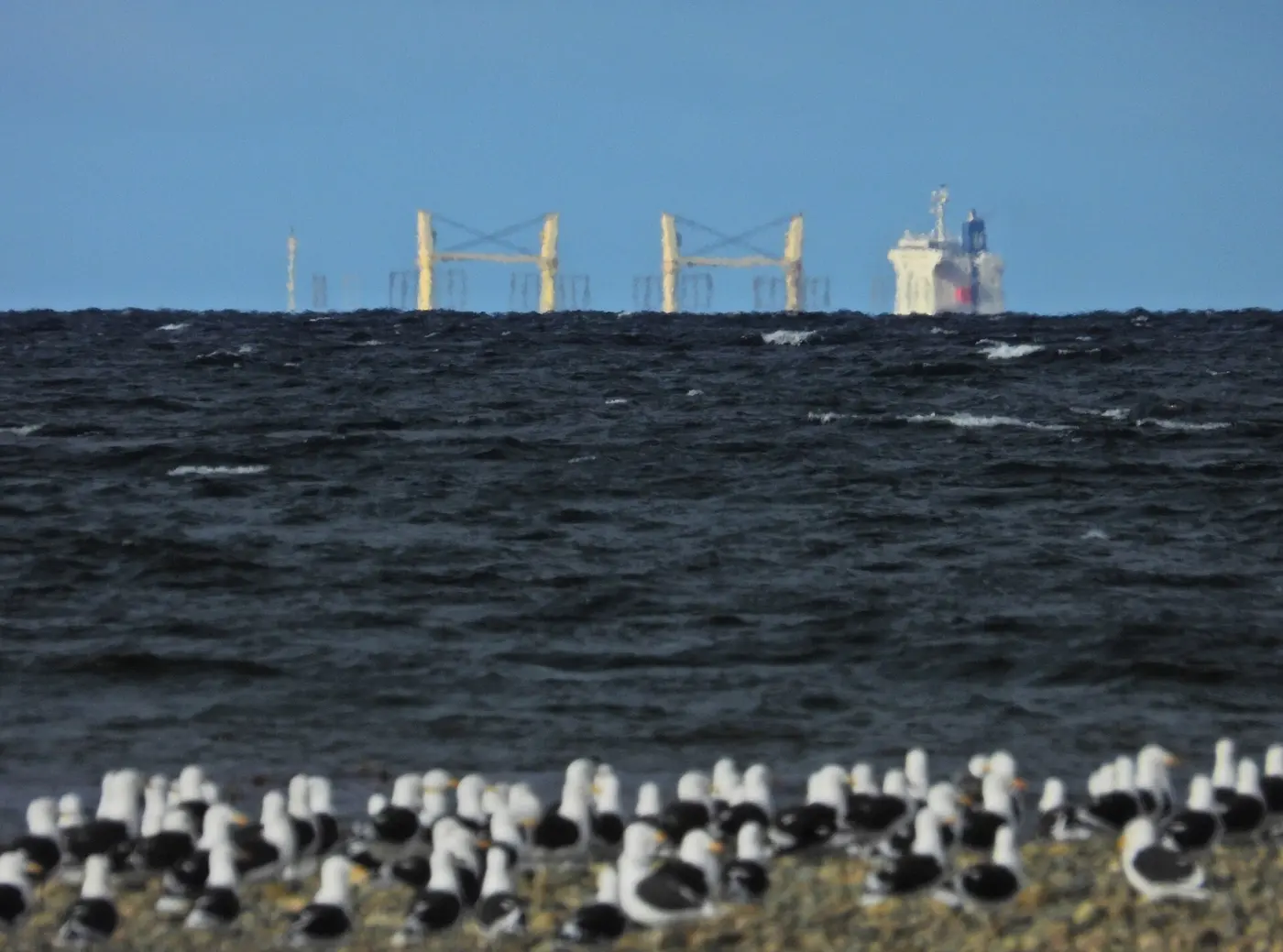
How far away is the horizon?
From an eye height of 1.6 meters, about 4.5 kilometers (2.8 miles). Because the atmosphere bends light slightly, you can actually see a little farther, close to 5 kilometers.
4.5km
Stand on a beach and look out to sea, and the line where the water meets the sky stretches straight across your view. The horizon seems to lie unimaginably far away.
Do the math, though, and it is only about 4.5 kilometers (2.8 miles) off, roughly an hour’s walk. The horizon is so close because we are standing on a round planet.
Pythagoras does the work
If the sea were perfectly flat, the horizon would recede until haze swallowed it. But Earth’s surface curves away from us. Your line of sight skims the sea at some point, and beyond it the water drops out of view behind the bulge of the planet. That point of contact is the horizon.
At the horizon, your line of sight meets Earth’s radius at a right angle, so the Pythagorean theorem, applied to the triangle formed by Earth’s center, your eye and the horizon, gives the distance. Taking Earth’s radius as 6,371 kilometers, it boils down to this: with your eye h meters above the water, the horizon is about 3.57 × √h kilometers away.
For an adult whose eyes are 1.6 meters (5.2 feet) above the sand, 3.57 × √1.6 comes to about 4.5 kilometers. For a child with eyes 1 meter up, it is about 3.6 kilometers. Lie down on the beach with your eyes 30 centimeters (1 foot) above the ground, and the horizon is less than 2 kilometers away.

Here is the curious part: doubling your eye height does not double the distance you can see. Because the distance grows with the square root of the height, you have to climb four times as high to see twice as far.
Bent light buys a little extra
All of this assumes that light travels in straight lines. In reality, the air near the ground or sea is denser than the air higher up, so light from far away bends slightly downward, following the curve of the Earth a little. The horizon ends up a bit farther away than the geometry says.
The Japan Coast Guard takes this into account when it works out how far a lighthouse can be seen. According to its guidelines, a light’s geographical range depends on the height of the light, the height of the observer’s eye, the curvature of the Earth and atmospheric refraction. The figures in the Coast Guard’s table are calculated as though you can see about 8 percent farther than you could if light traveled in straight lines. On that basis, the horizon from an eye height of 1.6 meters is about 4.9 kilometers (3 miles) away.
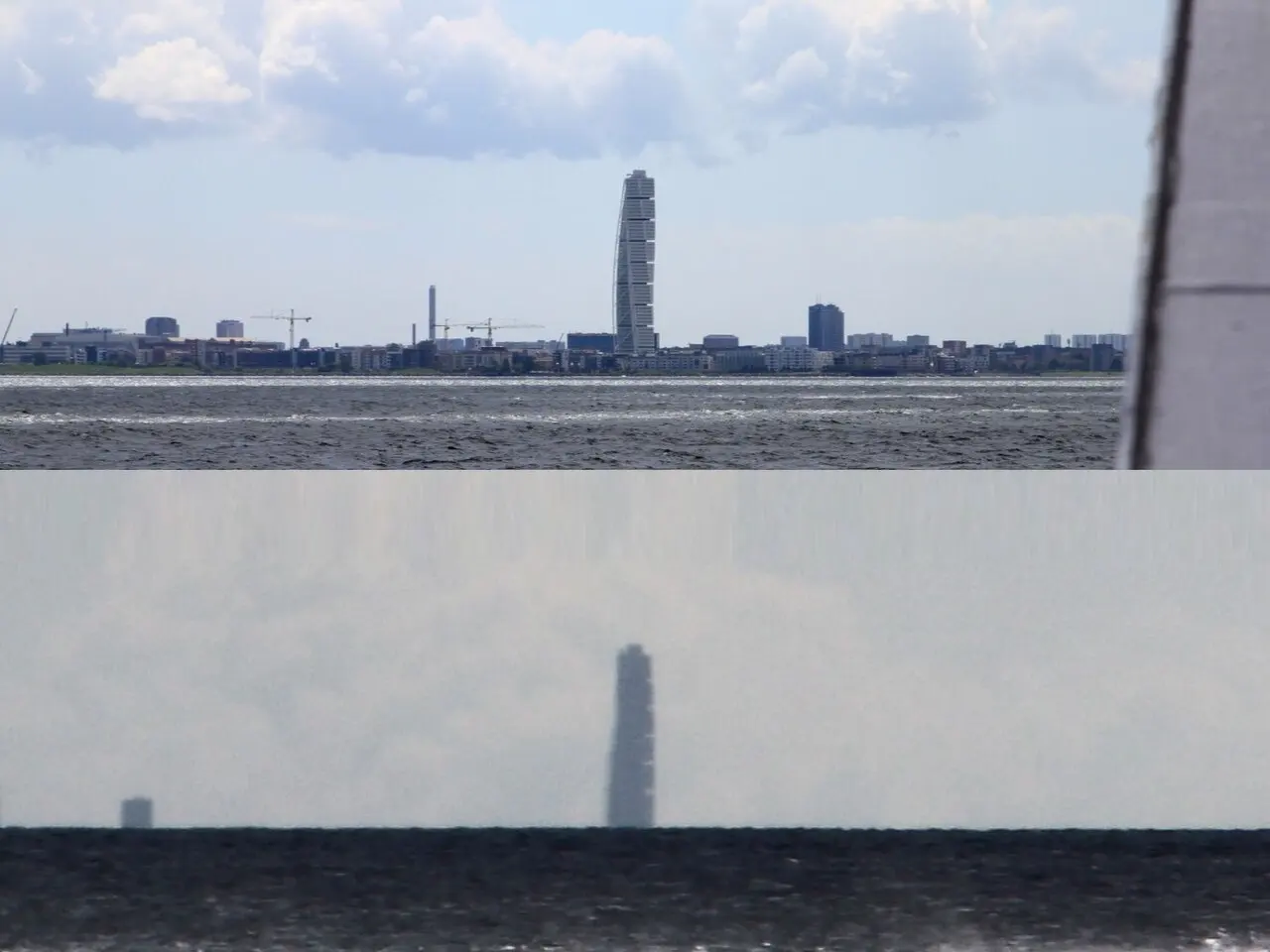
The amount of bending changes from day to day, though, with the temperature of the air. Under some conditions, mirages even lift normally hidden islands or ships into view. The distance to the horizon is never fixed to the meter.
From high places, toward high peaks
Climb higher, and the horizon moves dramatically farther away. The upper observation deck of Tokyo Skytree, the Tembo Galleria, is about 450 meters (1,480 feet) up, and even ignoring refraction you can see about 76 kilometers (47 miles) from there. From the summit of Mount Fuji, 3,776 meters (12,388 feet) high, the horizon is about 220 kilometers (137 miles) away.
If the thing you are looking at is tall too, you can see it from farther still, because the distance from your eye to the horizon and from the horizon to the far-off peak add together. The Coast Guard’s lighthouse calculations likewise use both the height of the light and the height of the observer’s eye.
Mount Fuji is the classic example. According to the town of Nachikatsuura in Wakayama Prefecture, the farthest place from which Fuji can be seen is the town’s Irokawa Fujimi Pass, 322.9 kilometers (200.6 miles) away, where the view was confirmed in September 2001. Before that, the record belonged to Mount Myoho in the same town, 322.6 kilometers away, from which Fuji was photographed in 1997. The height of the mountain, the height of the pass and a little help from the atmosphere together make that sightline possible.
Ships that sink below the horizon
The horizon has long shown people that Earth is round. The Greek geographer Strabo, writing in the decades around the start of the Common Era, cited sailors’ experience as proof that the surface of the sea is curved. Distant lights placed at eye level can’t be seen, he wrote, but if they are raised higher they come into view, even from farther away. And as sailors approach land, the shore seems to rise steadily into sight. Strabo even cited the scene in Homer’s Odyssey in which Odysseus, lifted on a great wave, catches sight of land in the distance.
The Roman naturalist Pliny the Elder, in his Natural History in the first century, wrote that land invisible from the deck of a ship can be seen from the masthead, and that if a bright object is fixed to the top of the mast of a departing ship, it seems to sink gradually until it disappears. A ship vanishing over the horizon was an everyday proof of a round Earth some 2,000 years ago.