Are rogue waves real?
Yes. On New Year’s Day 1995, instruments on a North Sea platform recorded a wave 25.6 meters high, more than twice the height of the waves around it.
25.6m
For centuries, sailors have told of monstrous waves that rise without warning from a stormy sea, towering over everything around them. For just as long, most scientists doubted them. As the US National Oceanic and Atmospheric Administration (NOAA) puts it, rogue waves have been part of marine folklore for centuries, but scientists have accepted them as real only in the past few decades.
What finally settled the matter was a single wave, measured in the North Sea on New Year’s Day 1995.
Forecast wave heights are averages
First, a word about what forecasters mean by wave height. According to the Japan Meteorological Agency (JMA), if you measure the waves passing a given point one by one, pick out the highest third and average their heights, you get what is called the significant wave height. This is the figure given in marine forecasts.
Real seas contain waves both higher and lower than that. According to the JMA, if you watch 100 waves, about 10 to 20 minutes’ worth, the highest will statistically be about 1.5 times the significant wave height. Watch 1,000 waves, over two or three hours, and the tallest will be close to twice as high. And when several large waves happen to pile up on one another, an unexpectedly huge wave can appear. The JMA describes such giant waves as occurring once in several thousand to several tens of thousands of waves.
Researchers generally define a rogue wave, also called a freak wave, as one more than twice the significant wave height; some use a threshold of 2.2. In other words, a rogue wave is not defined by any absolute height, but by how far it towers over the waves around it.
New Year’s Day at Draupner
The Draupner platform, part of a gas pipeline network, stands in the North Sea about 160 kilometers (100 miles) southwest of the southern tip of Norway. On January 1, 1995, a downward-pointing laser on the platform recorded an extraordinary wave. From trough to crest it measured 25.6 meters (84 feet), and its crest rose 18.5 meters (61 feet) above the calm-water level.
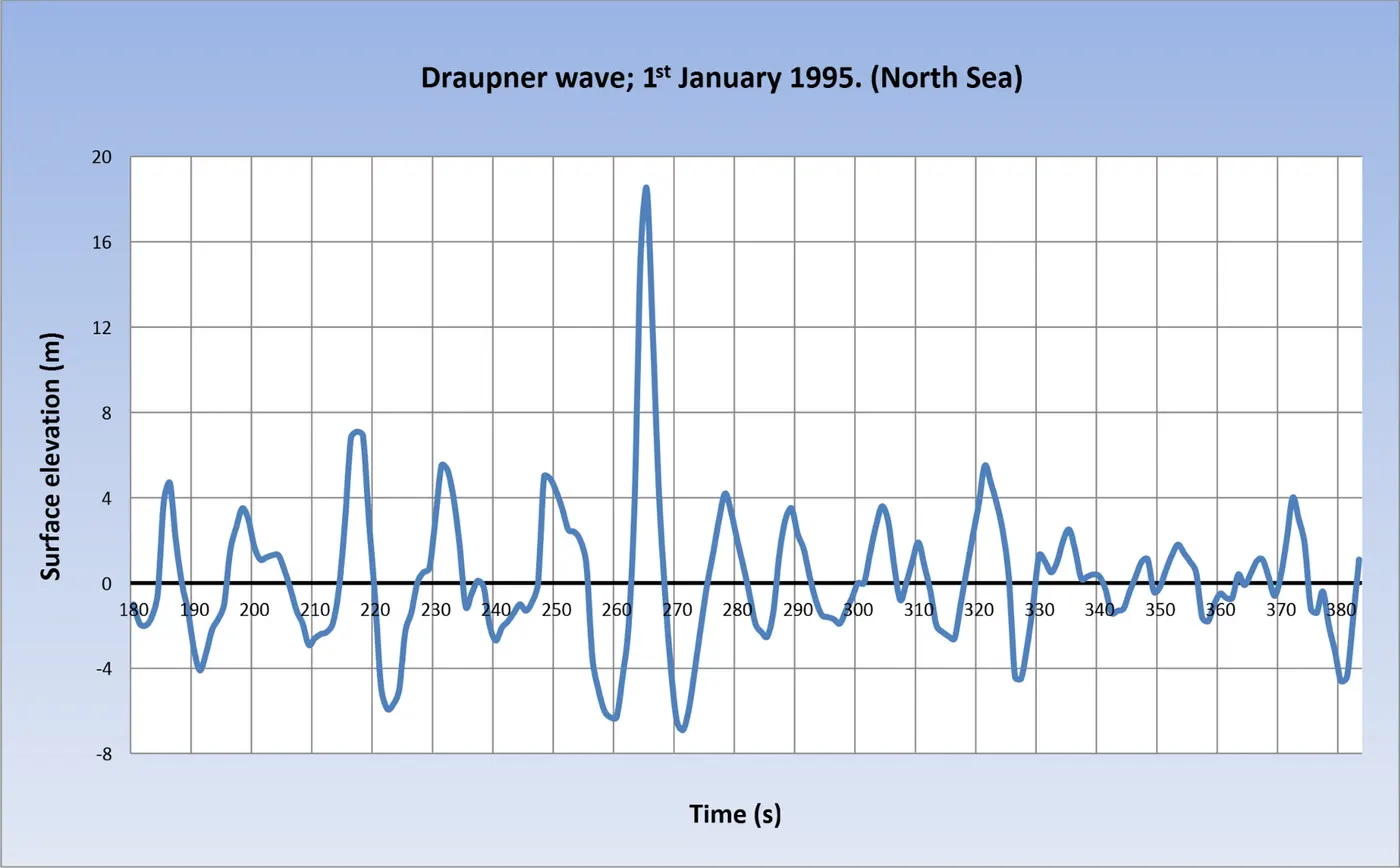

At the time, the significant wave height was about 12 meters (39 feet). It was a rough sea, but this wave was more than twice as high. The platform also suffered minor damage, which backed up the reading. The “Draupner wave” became one of the first rogue waves confirmed by instruments, and the starting point for much of the research that followed.
In 2019, a British research team reported recreating the Draupner wave at reduced scale in a large circular wave tank. They could reproduce its full height and the shape of its crest only when two groups of waves crossed at a large angle. Waves coming from a single direction broke before they could grow that tall.
Counting giants from space
Rogue waves turned out to be more than a North Sea curiosity. According to the European Space Agency (ESA), the EU-funded MaxWave project, launched in December 2000, examined about three weeks of radar images of the ocean surface from ESA’s ERS satellites, roughly 30,000 of them, and found more than ten individual waves over 25 meters (82 feet) high around the world.
Around the same time, ships were being hit. ESA reports that in February and March 2001, the cruise ships Bremen and Caledonian Star both had their bridge windows smashed by 30-meter (98-foot) rogue waves in the South Atlantic. The Bremen was left without navigation or propulsion for about two hours.
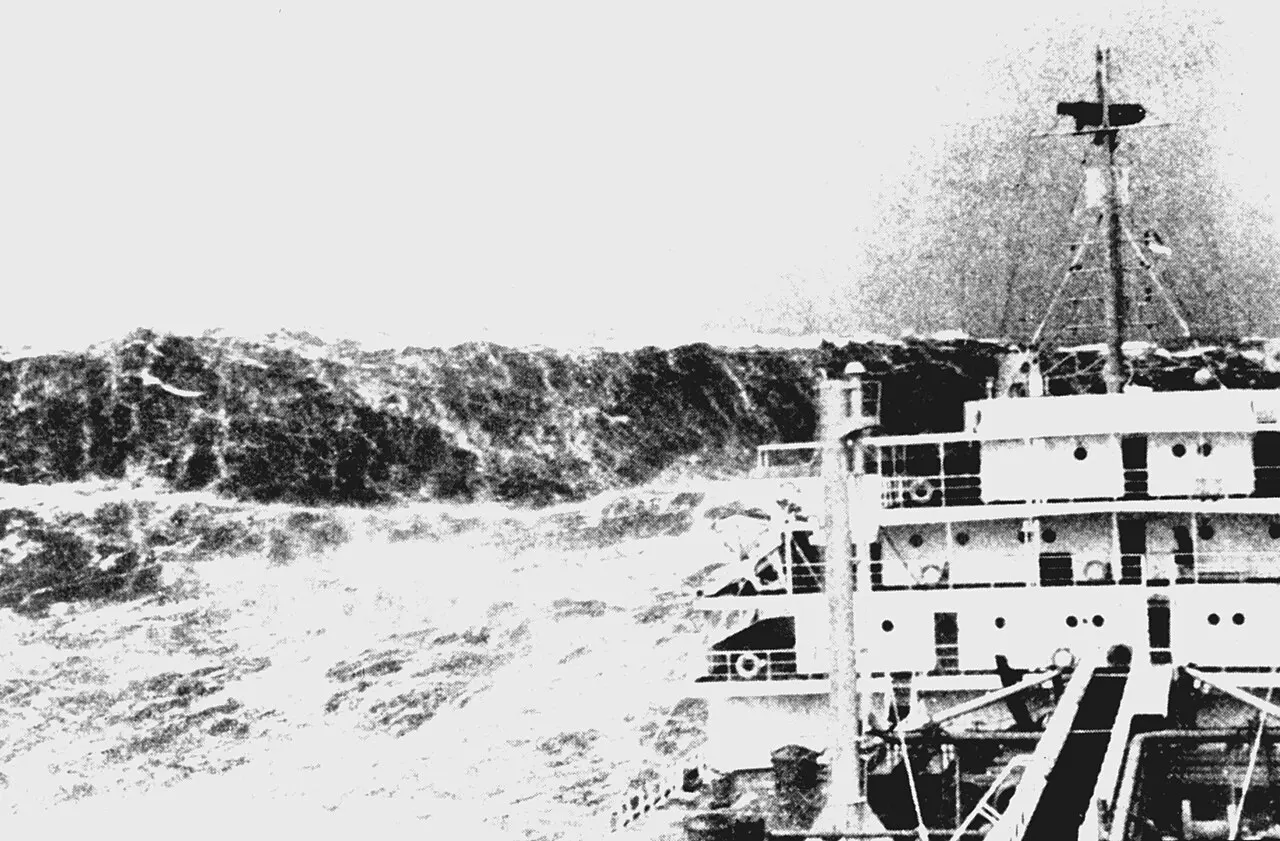

The tallest waves are not necessarily rogue waves, however. In February 2000, a British research vessel near Rockall, west of Scotland, measured individual waves up to 29.1 meters (95 feet) from crest to trough, at the time the largest waves ever recorded by scientific instruments in the open ocean. But they came in a ferocious gale, with the significant wave height reaching 18.5 meters (61 feet). Because the surrounding waves were enormous too, these giants fell short of the twice-the-neighbors threshold.