Are raindrops shaped like teardrops?
No. Small raindrops are almost perfectly round, larger ones flatten on the bottom like a hamburger bun, and the biggest ones break apart.
8.8mm
Ask someone to draw a raindrop, and chances are they will sketch a teardrop: pointed at the top, round at the bottom. Weather icons, cartoons and emoji tend to show raindrops the same way.
Real raindrops falling from the sky are not shaped like that at all. According to NASA, they look more like the top half of a hamburger bun: round on top and flat on the bottom.
Small drops are round
Two forces decide a raindrop’s shape: the surface tension of water and the push of the air it falls through.
Surface tension pulls the surface of water as tight as it can, and for a given volume, the shape with the smallest surface is a sphere. As NASA puts it, water molecules are more attracted to one another than to the air, so they cling together in a little round community. That is why the tiny droplets that form inside clouds are almost perfect spheres.
According to Nipponica, a major Japanese encyclopedia, meteorologists call it rain when the falling drops are at least 0.5 millimeters across; when most are smaller, it is drizzle. Up to a diameter of about 0.4 millimeters, raindrops stay almost spherical.
Bigger drops turn into buns
As raindrops fall, they collide and merge with other drops and grow. The bigger they get, the faster they fall. A drop 1 millimeter across falls at about 4 meters per second (9 mph), while one 5 millimeters across falls at about 9 meters per second (20 mph).
The faster a drop falls, the harder the air pushes on its underside. NASA explains that this pressure flattens the bottom of a larger drop into the shape of a hamburger bun, or even dents it inward so that it looks like a kidney bean. The top stays rounded, because there surface tension wins out over the airflow.
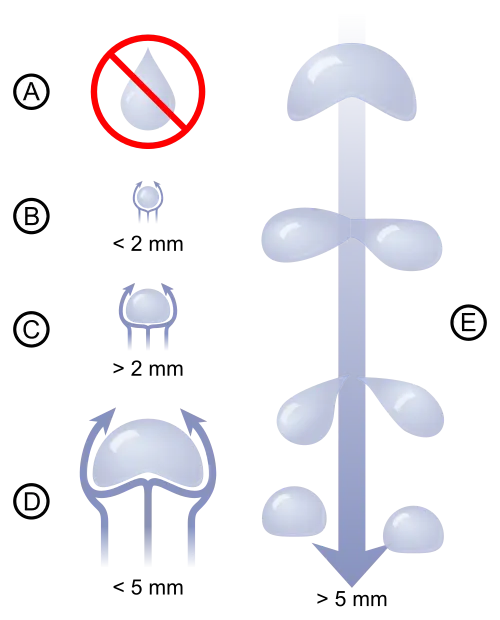

A falling raindrop never comes to a point on top. If anything, the familiar teardrop is the real shape turned upside down.
Too big to hold together
Can a raindrop keep growing forever? According to NASA, an oversized drop gets distorted into a parachute shape as it falls, and eventually it breaks up into smaller drops. Nipponica adds that large drops begin to wobble and become unstable. As a result, the raindrops we usually see are no more than 2 to 3 millimeters across, and drops larger than 5 millimeters are extremely rare.
This breakup may even explain why raindrops come in the sizes they do. In 2009, Emmanuel Villermaux and Benjamin Bossa, physicists in France, studied how a single large drop falling through air flattens, inflates into a bag, bursts and scatters into fragments of many sizes. Those fragments alone, they found, could account for the whole range of raindrop sizes seen in real rain. And the breakup is over far more quickly than the time it typically takes for drops to collide with one another.
Where the teardrop comes from
So why do we draw raindrops as teardrops? According to NASA, many of us picture tears falling from our eyes, or the stretched-out drip from a leaky faucet, and weather graphics reinforce the misconception.
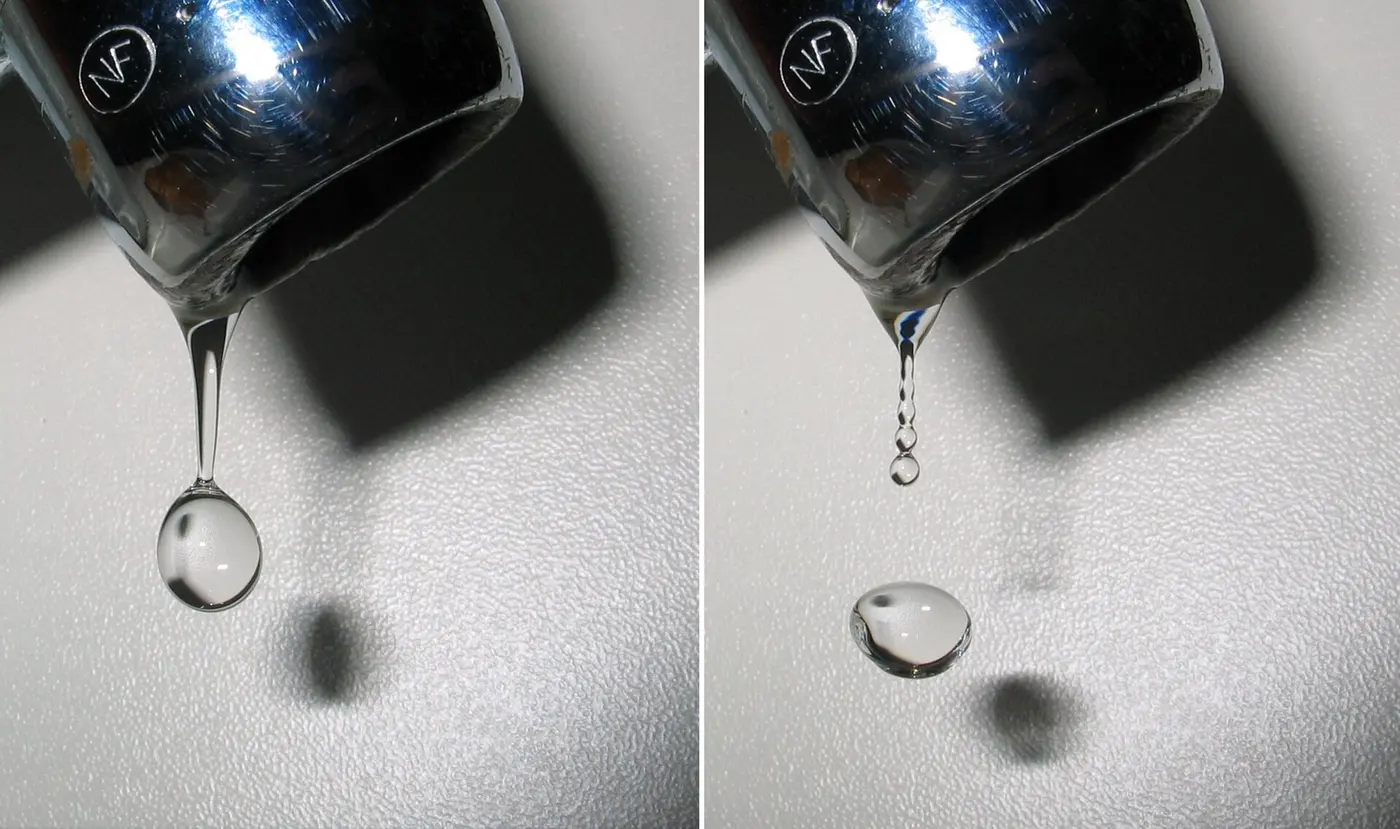

A drip from a faucet really does look like a teardrop just before it lets go, joined to the tap by a thin neck of water. But once it breaks free, the neck snaps and surface tension quickly pulls the drop into a ball. The teardrop is the shape of water that is still clinging to something. A raindrop falling freely through the air never takes that shape.