Do ostriches really bury their heads in the sand?
No. When danger threatens they run, and if they cannot get away they drop to the ground and lay their heads and necks flat to stay out of sight.
70km/h
When trouble comes, bury your head in the sand and pretend it isn’t there. The ostrich has carried that reputation for so long that in English its very name can describe a person who refuses to face an unpleasant reality.
Yet zoo experts and wildlife guides are unanimous: ostriches do not bury their heads in the sand. So where did the story come from, and what does a frightened ostrich really do?
A 2,000-year-old tale
The head-hiding story is very old. One early version appears in the Natural History, the vast encyclopedia compiled by the Roman scholar Pliny the Elder in the first century.
Pliny describes the ostrich as the largest of all birds, taller than a man on horseback. Then he turns to its supposed stupidity. For all the size of its body, he writes, the bird imagines that when it has thrust its head and neck into a bush, its whole body is hidden.
Notice the detail: Pliny wrote “bush,” not “sand.” The same passage claims that ostriches grab stones with their feet and hurl them at anyone chasing them. Ancient natural history, it seems, mixed observation with a good deal of hearsay.
Built to run
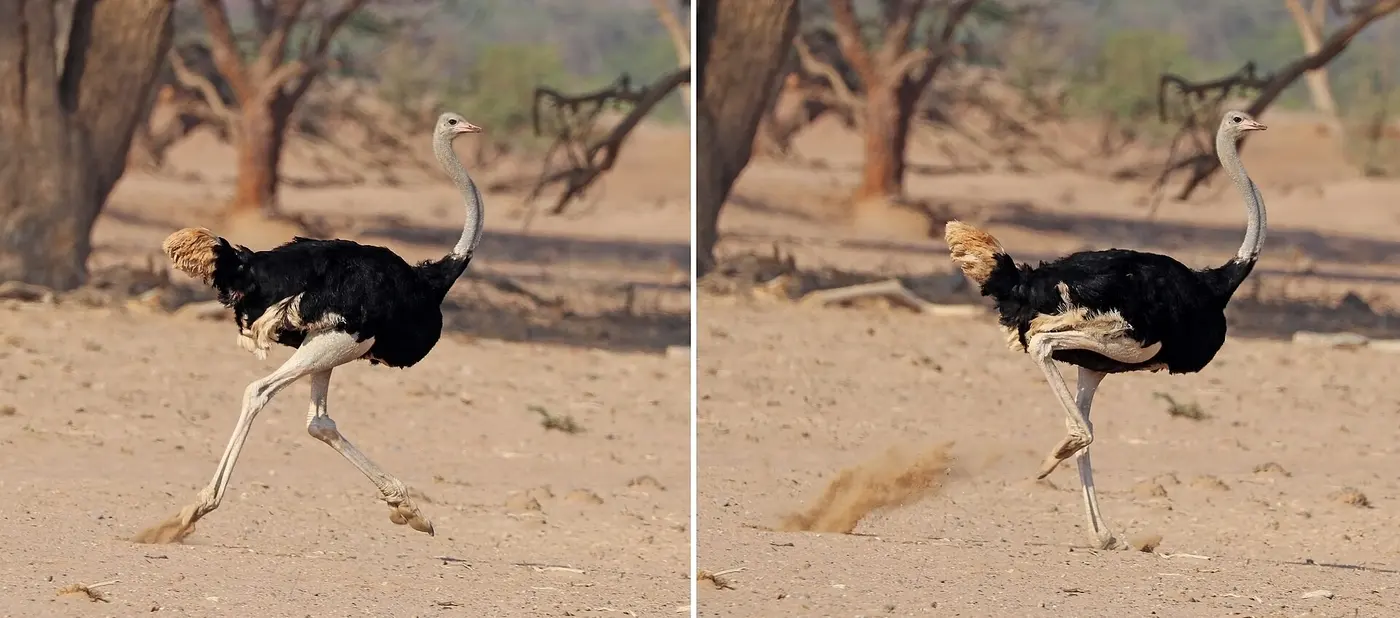
A real ostrich has a much better plan than hiding its head. It runs.
The ostrich is the largest living bird. Males stand 2.1 to 2.7 meters (7 to 9 feet) tall and weigh 100 to 130 kilograms (220 to 287 pounds). They cannot fly, but their legs more than make up for it. According to San Diego Zoo Wildlife Alliance, an ostrich can sprint in short bursts at up to 70 kilometers per hour (43 miles per hour) and keep up a steady 50 kilometers per hour (31 miles per hour) over longer distances. A single stride can cover 3 to 5 meters (10 to 16 feet). Even a month-old chick can reach nearly 56 kilometers per hour (35 miles per hour).
Each foot has only two toes, an adaptation for speed. And if an adult is cornered, its clawed kick is said to be powerful enough to kill a lion.

Lying low
What if running is not an option? San Diego Zoo Wildlife Alliance explains that a cornered ostrich flops to the ground and stays perfectly still, stretching its head and neck flat out in front of it.
An ostrich’s head and neck are pale and blend in with the soil. From a distance, the head seems to vanish, leaving only a mound of body feathers visible. In other words, it looks exactly as if the bird has buried its head. National Geographic gives the same explanation: a threatened ostrich lies low and presses its neck to the ground, and from afar it can appear to have its head in the sand.
Of course, an ostrich that really did push its head into the sand would not be able to breathe.
Tending the nest
Another likely source of the myth is the way ostriches care for their eggs.
Unable to nest in trees, ostriches lay their eggs in a shallow pit in the ground, scratched out by the male. Several females in a group lay their eggs together in the nest of the dominant hen. While the eggs are being incubated, males and females take turns rolling them with their beaks.
BBC Science Focus magazine points out that an ostrich occasionally lowers its head into the nest to turn the eggs, and from a distance this looks very much like hiding. That, the magazine says, is where the myth comes from.
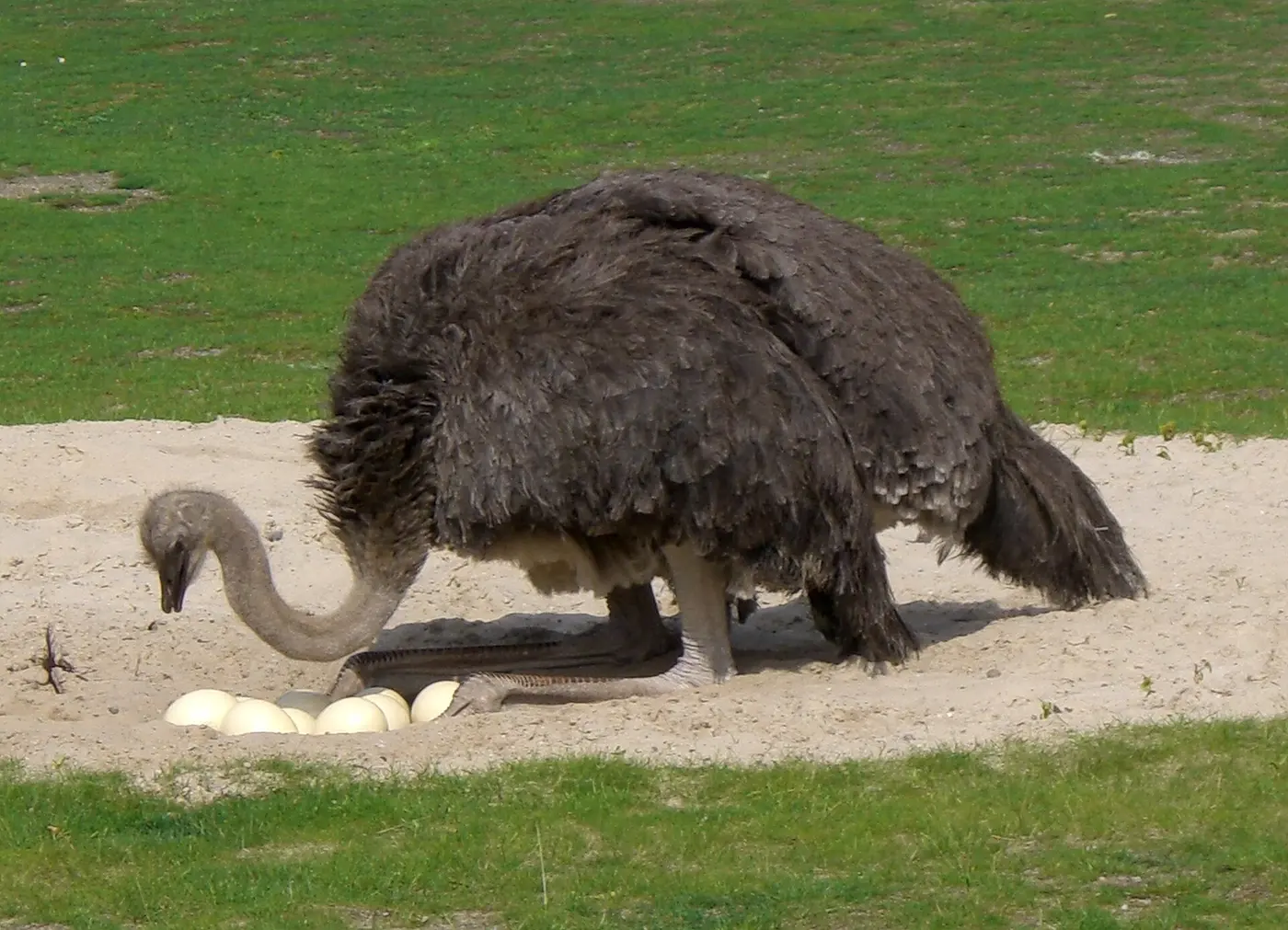

The eggs themselves are impressive. An average ostrich egg measures about 15 by 13 centimeters (6 by 5 inches) and weighs about 1.5 kilograms (3 pounds), roughly as much as two dozen chicken eggs.