Where does the Japanese word “baka” come from?
No one knows for sure. Dictionaries favor moha, a Sanskrit word for “ignorance” used by Buddhist monks.
“Baka da nā” (what an idiot), “sonna baka na” (that’s absurd), “baka-shōjiki” (honest to a fault), “oya-baka” (a doting parent). Baka (ばか), usually translated as “fool” or “idiot,” is one of the most-used words in Japanese. It turns up not only as an insult but also to express exasperation or embarrassment, or even affection.
Written in kanji, though, it is 馬鹿: “horse” plus “deer.” Why those two animals? Neither is especially foolish. Dig a little and it turns out these two characters come with a rather tangled story.
The kanji are just for sound
The first thing to know is that 馬鹿 is ateji. Ateji are kanji chosen for their sound, regardless of their meaning, to write a word.
In fact, baka has been written many ways over the years. Besides 馬鹿 there are 莫迦, 馬稼 and 破家, each of which simply spells out the sounds “ba” and “ka.” Today 馬鹿 has become by far the most common, but the horse and deer themselves carry no meaning.
The word baka itself is said to appear already in the Bunmei-bon Setsuyōshū, a dictionary from the middle of the Muromachi period (1336–1573). It has been in use for at least 500 years.
The deer that was called a horse
Even so, the kanji 馬鹿 remind many people of a Chinese tale known in Japanese as “pointing at a deer and calling it a horse.”
It is set in China in the 3rd century BCE, during the Qin dynasty. Zhao Gao, a man who had seized power at court, wanted to find out who would dare oppose him. He presented a deer to the emperor and declared, “This is a horse.” Courtiers who feared Zhao Gao went along and said “horse”; those who honestly said “deer” were later punished. The story is recorded in the Records of the Grand Historian by Sima Qian, and it has long been known in Japan too: The Tale of Genji contains a scene that alludes to it.
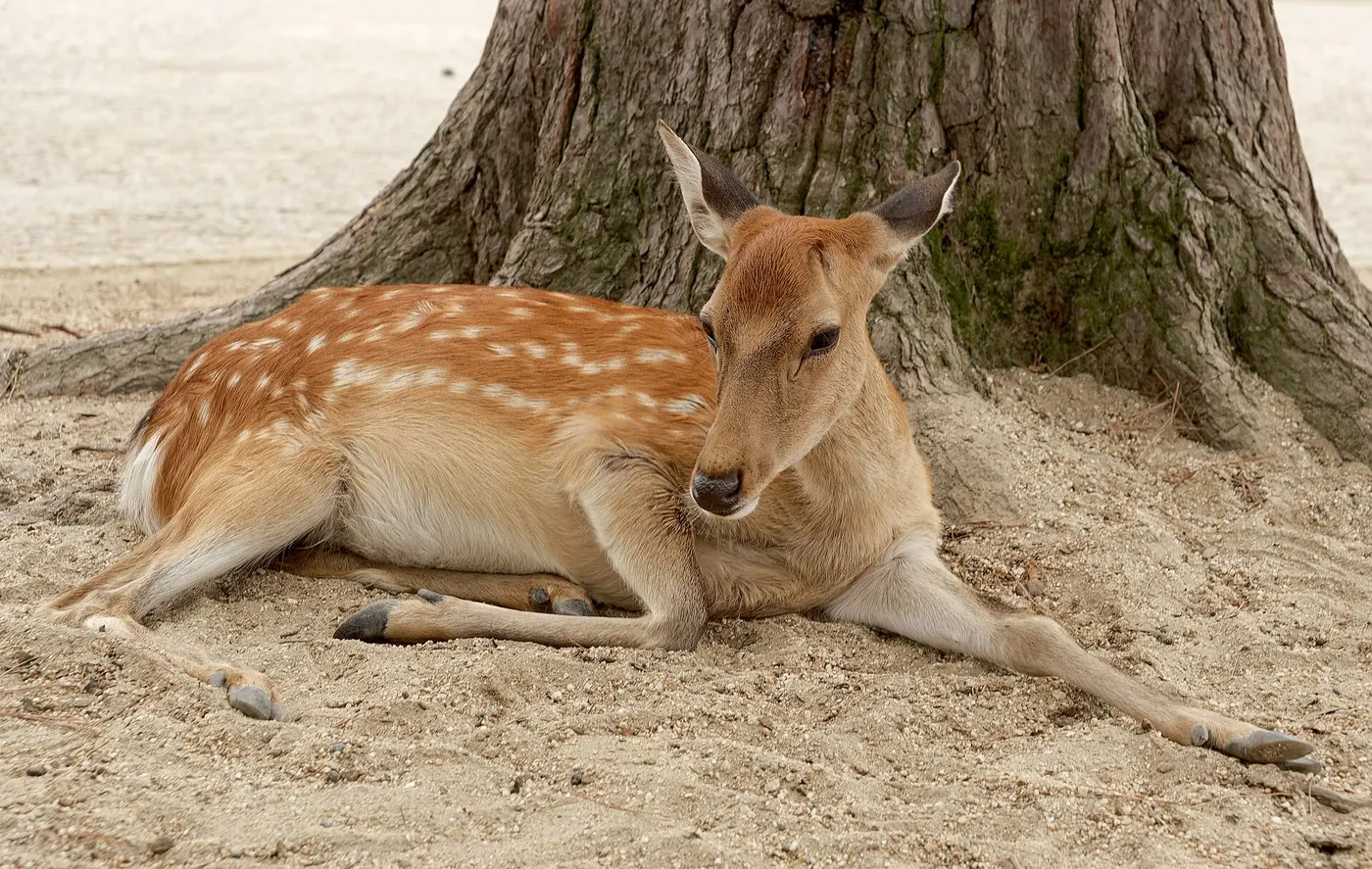

Some trace baka to this story, but specialists generally regard it as a folk etymology attached after the fact. For one thing, the tale is about a tyrant’s abuse of power, and it has no direct link to the meaning “foolish.” For another, reading 鹿 as “ka” is a native Japanese reading, not a Chinese pronunciation. It seems more natural to suppose that the spelling 馬鹿 came first and the story was associated with it afterward.
Slang among Buddhist monks?
So what is the real origin? In truth, there is still no definitive answer.
The best-known theory links it to Buddhism. Sanskrit, the classical language of ancient India, has the word moha, meaning “ignorance” or “delusion.” According to this theory, 莫迦, a way of writing moha in Chinese characters, was used as jargon among Buddhist monks and then spread to the general public. The theory was proposed by a scholar in the Edo period (1603–1868), and many major Japanese dictionaries, including the Kōjien, adopt it.
Other suggestions abound: that it comes from haka (破家), “ruining one’s household,” a term found in Zen texts; from the Ba family (馬家), who squandered their fortune in a poem by the Chinese poet Bai Juyi; or from the old adjective hakanashi, “fleeting” or “futile.”


Where “aho” ends and “baka” begins
Clues to baka’s history have also come from unexpected places. In the early 1990s, the Kansai TV program Tantei! Knight Scoop, prompted by a viewer’s request, set out to find the boundary between aho and baka, two Japanese words for “fool.”
The program sent questionnaires to the boards of education of every municipality in Japan and in 1991 completed a “national map of aho and baka.” It showed that words with the same meaning were distributed in concentric circles centered on Kyoto. This supported the “center-periphery theory” of dialects, which holds that words born in the old capital spread outward to the provinces like ripples, and linguists praised the results. Matsumoto Osamu, the program’s producer who compiled the survey, later put forward the Ba-family theory.