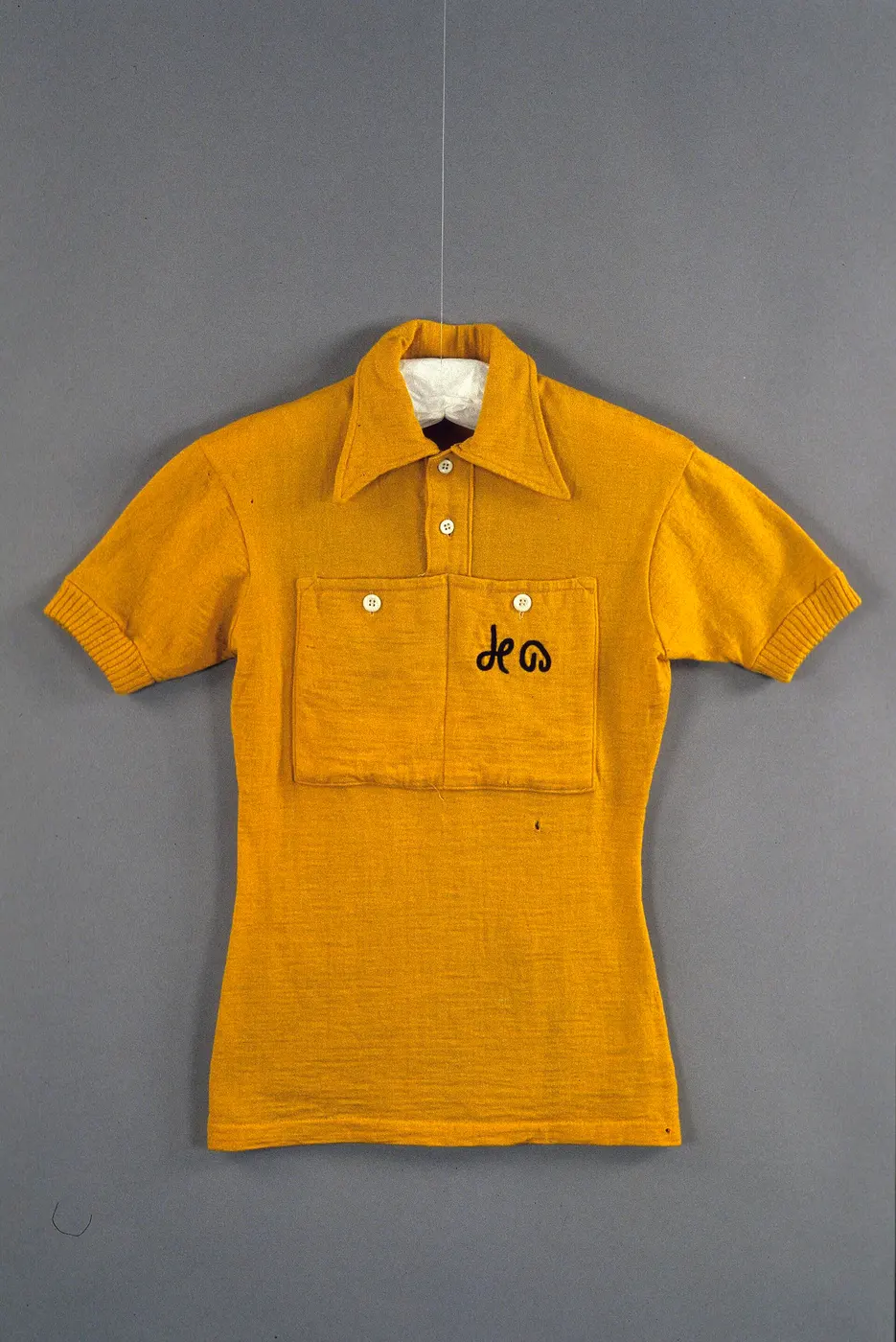
Why is the Tour de France leader’s jersey yellow?
Because L’Auto, the newspaper that ran the race, was printed on yellow paper. The jersey was introduced in 1919 so that fans could spot the leader at a glance.
1919
Every July, the Tour de France spends three weeks racing around France. Whoever leads the overall standings starts each stage in a yellow jersey, the maillot jaune. In French, maillot means jersey and jaune means yellow.
There are other special jerseys, polka dots for the best climber and green for the points leader, but yellow is the one every rider dreams of. Why yellow, though, and not red or blue?
A race run by a yellow newspaper
The Tour de France was launched in 1903 by L’Auto, a Paris sports daily. Its editor, Henri Desgrange, reasoned that a long race around the whole country would fill his pages and sell more papers.
The paper had started out in 1900 as L’Auto-Vélo, and it was printed on yellow paper. Its established rival, Le Vélo, used green paper, and the yellow is said to have been chosen to set the newcomer apart. Le Vélo sued over the similar title, and in 1903, the year of the first Tour, the paper became simply L’Auto.
Grenoble, 1919
After a break for the First World War, the Tour resumed in 1919. Riders wore similar drab jerseys, and once they were covered in mud and dust it was hard to tell who was who. So Desgrange decided to put the race leader in something distinctive.
According to France’s National Sports Museum, the yellow jersey was created so that spectators by the roadside could pick out the overall leader, even if he was unknown to the public, and its color was taken from the pages of L’Auto. Another story holds that yellow was an unpopular color, the only one that could be supplied in a hurry, but the newspaper explanation is the one most widely accepted.
The first man to wear it was Eugène Christophe of France. On July 19, 1919, before the 2 a.m. start of the 325 km (200-mile) 11th stage from Grenoble, at the foot of the Alps, to Geneva in Switzerland, the race leader was handed his yellow jersey with no particular ceremony. That day, Desgrange wrote in L’Auto that he had that morning handed the valiant Christophe a superb yellow jersey. Christophe himself was not thrilled to stand out, and spectators reportedly teased him by calling him a canary.
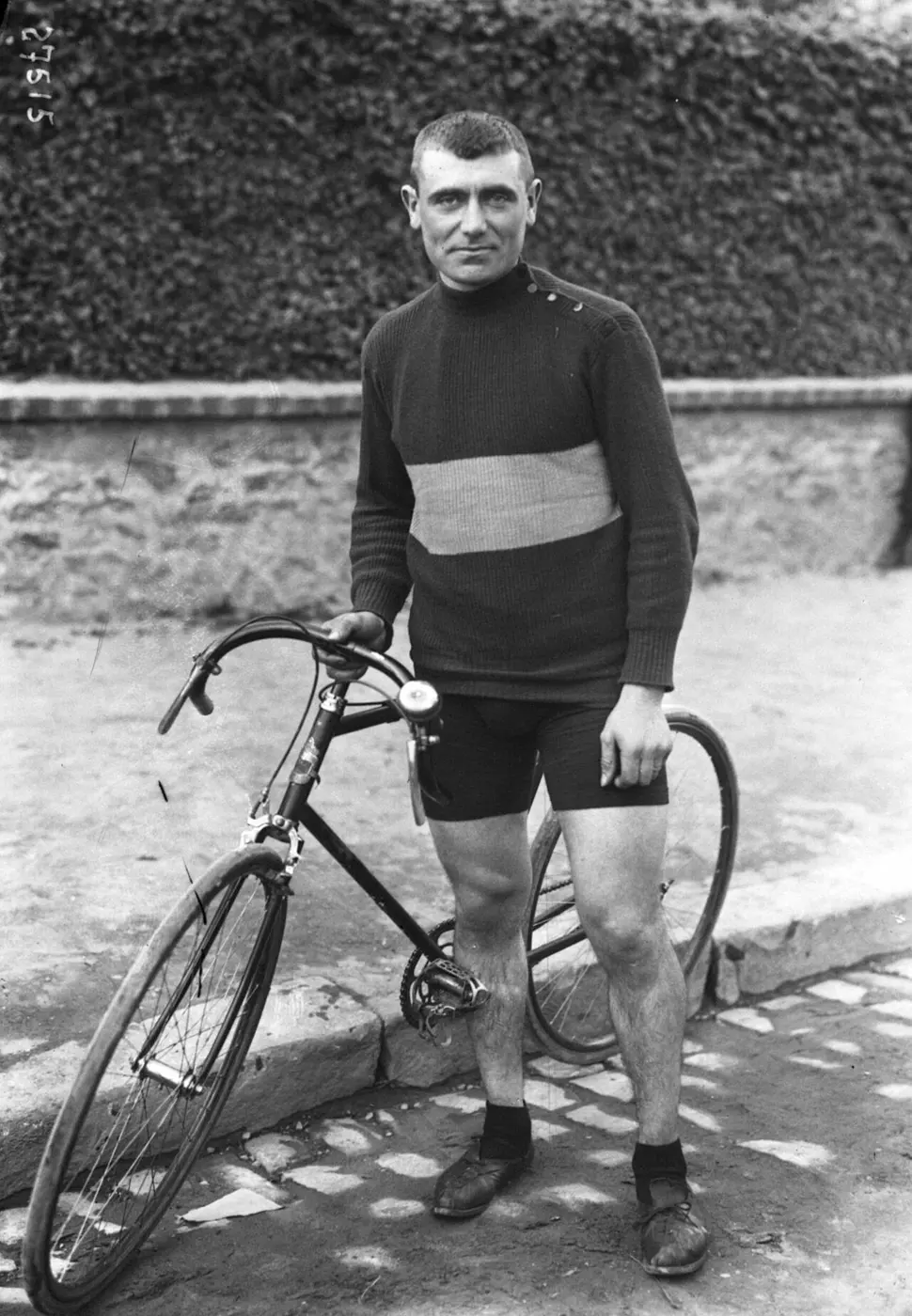

An unlucky leader
Christophe did not get to wear yellow into Paris. On July 25, during the 468 km (291-mile) 14th stage from Metz, near the German border, to Dunkirk on the North Sea, his bike’s fork, the part that holds the front wheel, snapped on the cobbles at Raismes, near the Belgian border.
Christophe had trained as a locksmith and fitter, and he repaired the fork himself and carried on. But he lost nearly two and a half hours that day, and the lead passed to Firmin Lambot of Belgium. Lambot went on to win the Tour, and Christophe finished third. It was a brutal race: of the 67 riders who started, only 11 made it to the finish. The broken fork is now in the collection of the National Sports Museum. Remarkably, Christophe had already suffered the same fate in 1913, when his fork broke on a descent in the Pyrenees and he fixed it himself at a village forge.
Yellow in 1913?
There is a rival claim to the first yellow jersey. Philippe Thys of Belgium, who won the Tour in 1913, 1914 and 1920, told a Belgian magazine when he was 67 that he had worn yellow back in 1913. Desgrange had asked him to wear a colored jersey, he said, and he refused at first, afraid it would make him a target for other riders. His team manager talked him round, and “a yellow jersey was bought in the first shop we came to.”
The Tour historian Jacques Augendre found Thys’s account believable, but noted that no newspaper mentions a yellow jersey before the war and that, without witnesses, the mystery cannot be solved. The race’s official history still credits Christophe in 1919.
After Desgrange died in 1940, his initials, “HD,” were added to the jersey. They were dropped in 1984 but returned in 2003, for the Tour’s centenary.