Does lightning never strike the same place twice?
It strikes the same place again and again. Tall buildings are especially frequent targets: the Empire State Building is hit an average of 23 times a year.
23times
“Lightning never strikes twice in the same place,” the saying goes. According to the Cambridge Dictionary, it is said to show that something bad or unusual is unlikely to happen to the same person twice.
As consolation, it isn’t bad. As a statement about lightning, it is simply wrong. The US National Weather Service lists it among the common myths about lightning and points out that lightning often strikes the same place repeatedly.
A building hit 23 times a year
According to the National Weather Service, the main things that decide where lightning strikes are height, a pointed shape and isolation. Where those come together, lightning will strike again and again. Mountains and trees are hit many times a year.
The agency’s favorite example is the Empire State Building in New York. Opened in 1931, it stands 1,250 feet (380 meters) to its highest floor and 1,454 feet (443 meters) to the tip of its antenna, and it is struck by lightning an average of 23 times a year. The building’s own website puts the figure at 25. Whichever number you prefer, the same building takes more than 20 hits every year.
The skyscraper has also served as a lightning laboratory. In the 1930s, a General Electric research team led by the engineer Karl B. McEachron photographed the strikes on the building summer after summer and measured their currents. In February 1938, Time magazine reported on the results of three summers of work. The team had caught something unexpected: in some cases the leader, the faint channel that blazes the trail for a lightning bolt, did not come down from the cloud but shot upward from the top of the building.
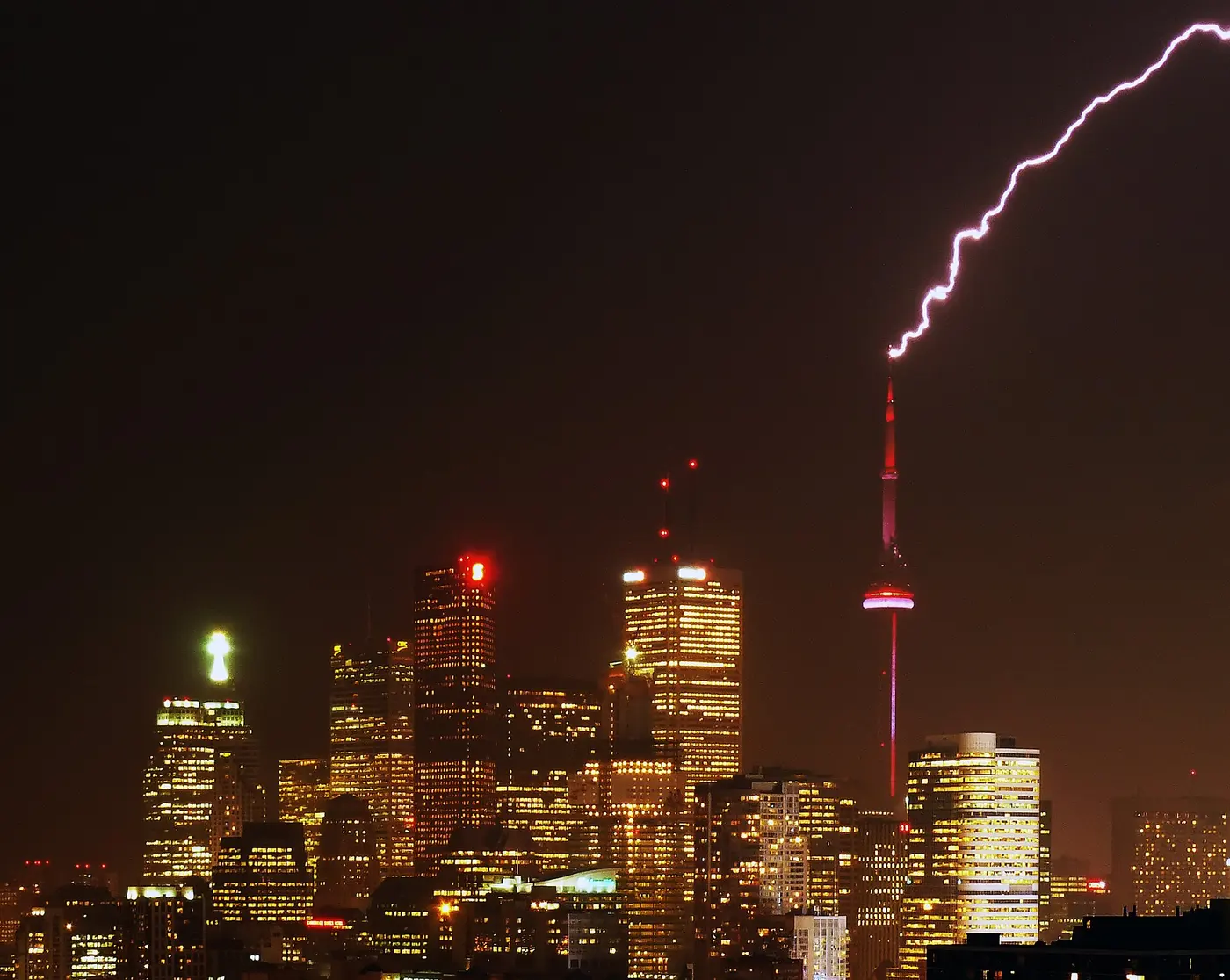

Lightning that goes up
Normally a lightning bolt works its way down from the cloud, branching as it goes. On very tall structures, though, lightning can begin at the top of the structure and climb toward the cloud. This is called upward lightning. The National Severe Storms Laboratory, part of the National Oceanic and Atmospheric Administration (NOAA), notes that very tall structures and towers can trigger lightning, which then starts at the top of the tower. Tall buildings are not just passive targets. They help set the lightning off.
In Japan, the Central Research Institute of Electric Power Industry has been recording lightning at Tokyo Skytree, a 634-meter (2,080-foot) broadcasting tower, since 2012. According to a 2017 report in the Nikkan Kogyo Shimbun, a Japanese business daily, the tower logged 62 strikes in roughly its first six years, 37 of them upward and 25 downward. The same article notes that Tokyo Tower, at 333 meters (1,093 feet), yields only about one observation a year.
Japan’s Sea of Japan coast in winter is another hot spot for upward lightning. There, lightning that hits tall structures usually starts with a discharge climbing from the structure itself, and researchers have been recording strikes on the turbines of a wind farm in Nikaho, Akita Prefecture.
The same path, many times in a split second
Repeat strikes happen even within a single flash. According to the National Severe Storms Laboratory, a common type of cloud-to-ground flash can contain anywhere from one to as many as 20 return strokes. Once the first stroke has opened a channel through the air, the following strokes race down the same path and hit the ground again. That is why lightning seems to flicker.
The laboratory also says that about half of all flashes strike the ground at more than one point. What looks like a single bolt often hits the same spot, or one very close by, several times in a fraction of a second.
The ranger struck seven times
Lightning can even strike the same person more than once. According to Guinness World Records, the record for surviving lightning strikes is seven, held by Roy C. Sullivan, a park ranger at Shenandoah National Park in Virginia, who was struck between 1942 and 1977. He lost his eyebrows, had his hair set on fire and suffered burns, but survived every time.
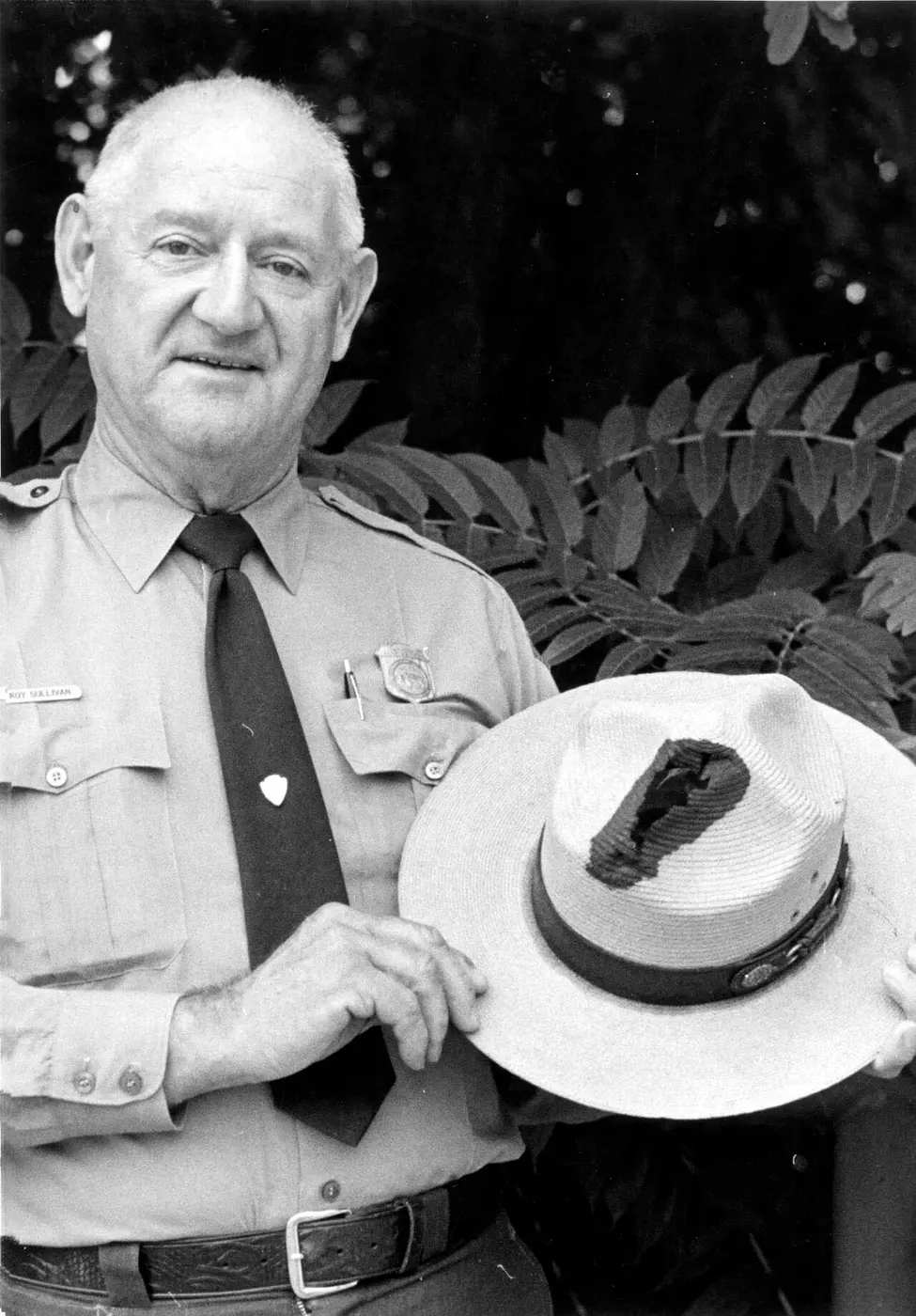

That is, of course, extraordinarily rare. The National Weather Service puts the odds of being struck by lightning over a lifetime, taken as 80 years, at about 1 in 15,300 for someone living in the United States.