Is katsuobushi the hardest food in the world?
It is often called that, but no official record or measurement backs the claim. It is extremely hard, though, because drying turns it glassy.
15%
Pick up a whole piece of katsuobushi before it is shaved and it is hard to believe it was ever a fish. It is heavy, rock-solid and dry. Knock two together and they make a sharp clack like wooden clappers. It looks and feels like a lump of wood.
Katsuobushi is dried, smoked and fermented skipjack tuna, also known as bonito, and it is one of the foundations of Japanese cooking. Shaved into paper-thin flakes, it flavors dashi stock and tops everything from tofu to okonomiyaki. And it is often said to be “the hardest food in the world.” Some even claim it holds a Guinness World Record. Is that true?
Where does “world’s hardest” come from?
Even a page on traditional foods from Japan’s Ministry of Agriculture, Forestry and Fisheries says that katsuobushi “is called the hardest food in the world.” Note the wording, though: it is “called” that.
Has anyone actually measured its hardness and compared it with every other food? We could not find any official record or published study that does. The claim that it holds a Guinness World Record is widely repeated online, but we could not find a source that confirms it as an official record. Even a 2003 paper by researchers at Tokyo University of Marine Science and Technology, who studied katsuobushi’s physical properties, only says that it “is said to be ‘the hardest food in the world.’”
“The world’s hardest food,” in other words, is best understood as a long-standing figure of speech for something very hard indeed.
Half a year of drying
Still, katsuobushi really is extraordinarily hard, and the reason lies in how painstakingly it is made.
According to the Heibonsha World Encyclopedia, the fish is cut into pieces and simmered, the bones are removed, and the pieces are smoked over a fire of hardwood such as oak. This smoke-drying is repeated again and again, with rest periods for cooling in between, until the result is a dark, rough block called arabushi. Its surface is then scraped smooth, and the block is inoculated with mold and left to ferment, then sunned and brushed off, and molded again. Repeated about four times, this produces honkarebushi, considered the finest grade. The whole process takes close to six months.
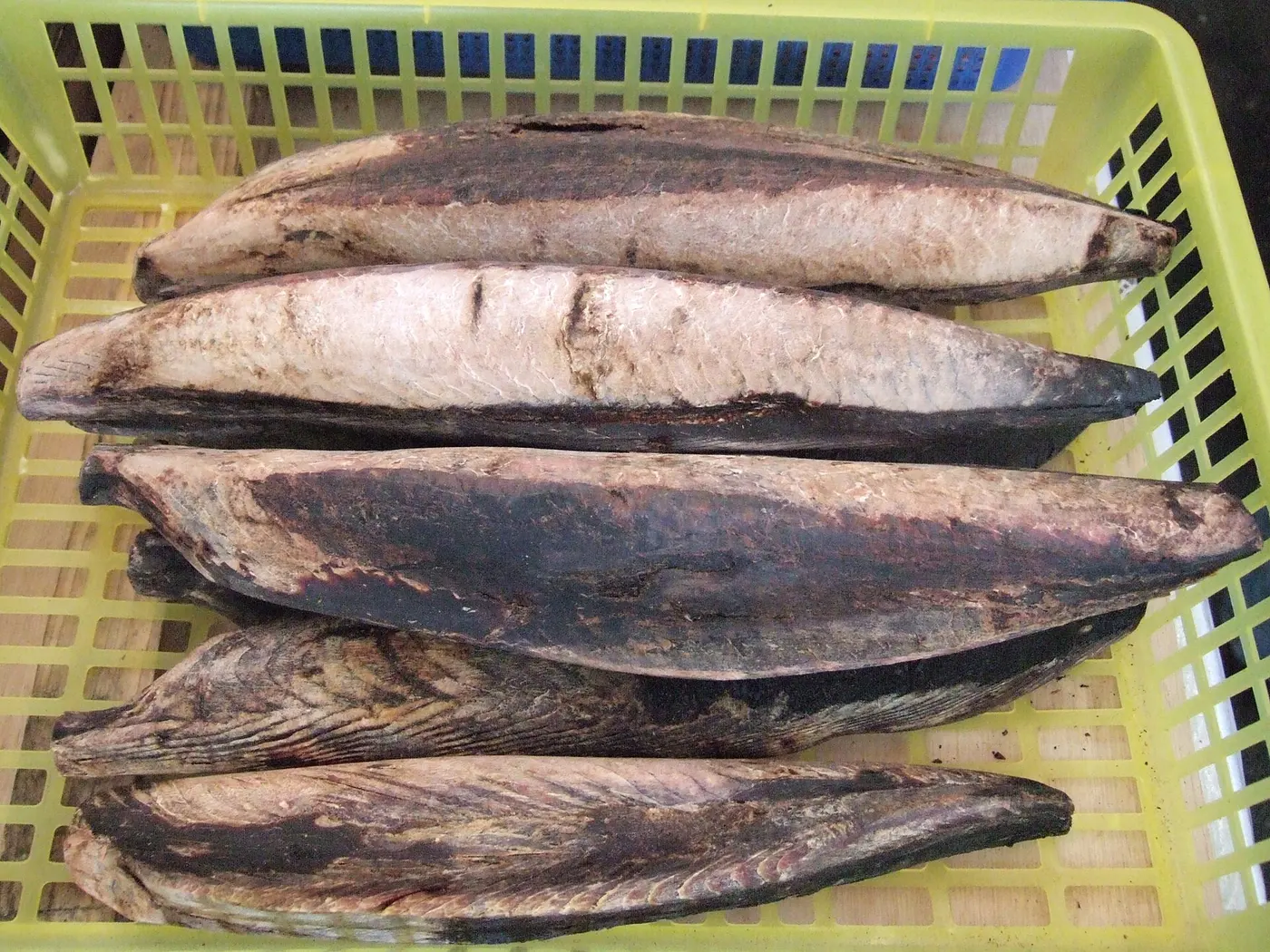

The mold is mainly of the genus Aspergillus, and it breaks down fat while improving the aroma and color. Japan’s agriculture ministry explains that repeated smoking and molding dry the fish to the point where microbes can no longer grow, which is why katsuobushi keeps so well.
The Standard Tables of Food Composition in Japan, published by the Ministry of Education, put numbers to it. Raw spring-caught skipjack contains 72.2 grams of water per 100 grams. In katsuobushi, that falls to 15.2 grams.
The secret is glass
Why does losing water make it so hard? The Tokyo University of Marine Science and Technology study offers one answer.
The researchers measured how katsuobushi behaves as its temperature changes and showed that it is in a “glassy” state. In a glass, molecules are frozen in place without forming an orderly crystal and can barely move, which makes the material hard and brittle. Window glass and hard candy are familiar examples. The paper even notes that a cut surface of katsuobushi looks just like broken red glass.
This state depends on temperature and moisture. For katsuobushi with 14.8 percent water, the glass transition, the temperature at which it shifts from glassy to rubbery, was about 33°C (91°F). The more water it contains, the lower that temperature, and the softer the katsuobushi becomes. That is why it turns supple when it soaks in hot water for dashi.
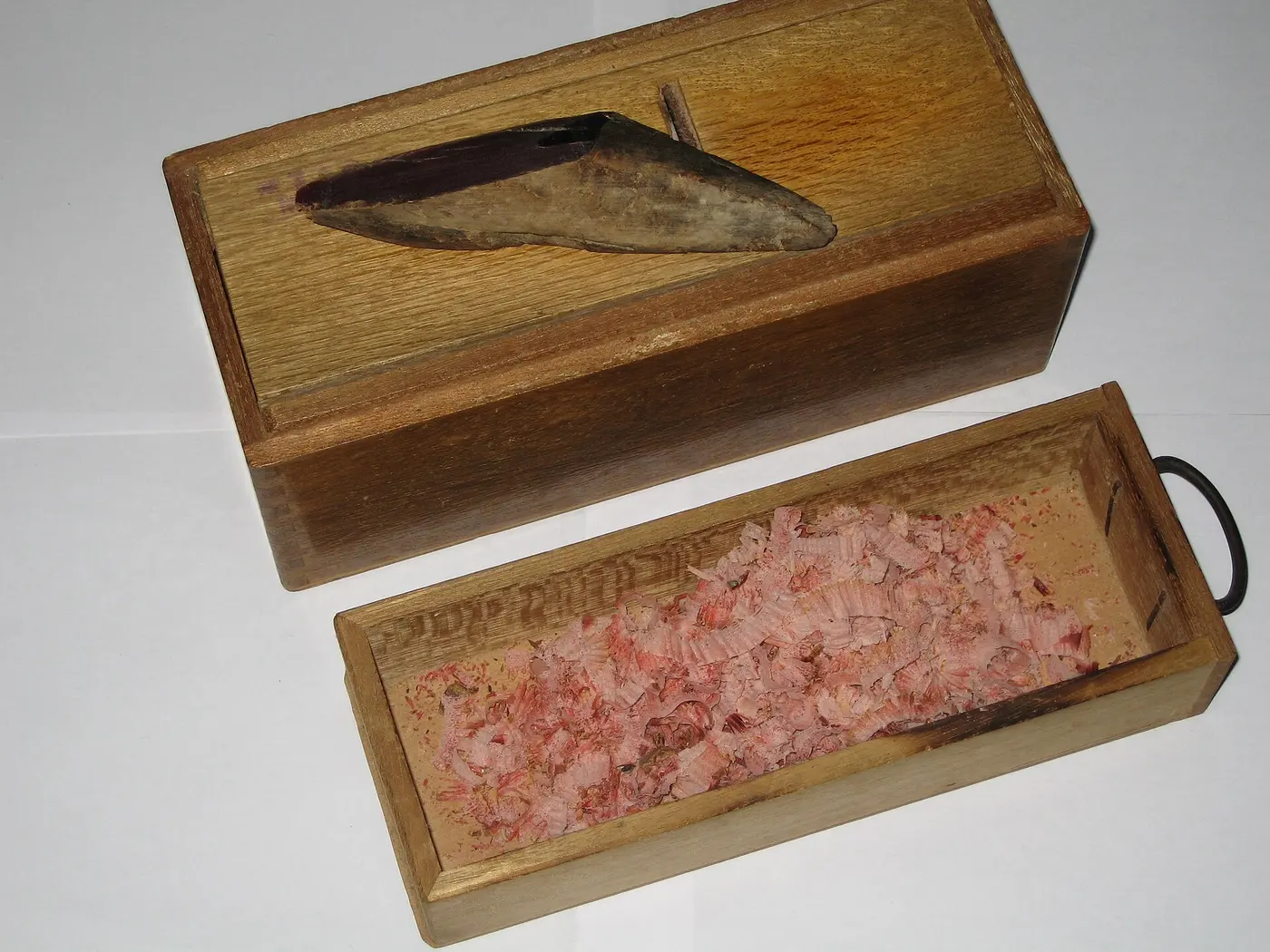

A good one rings
Hardness is also a sign of quality. The Heibonsha World Encyclopedia advises choosing well-dried pieces that make a hard sound when knocked together. Whitish ones are too fatty, it adds, and yellowish-brown ones contain fat that has oxidized.
The modern method is said to have begun in 1674 in Kishu, today’s Wakayama Prefecture, and to have reached Makurazaki in Kagoshima Prefecture in 1707. Kagoshima is now Japan’s largest producer of katsuobushi.