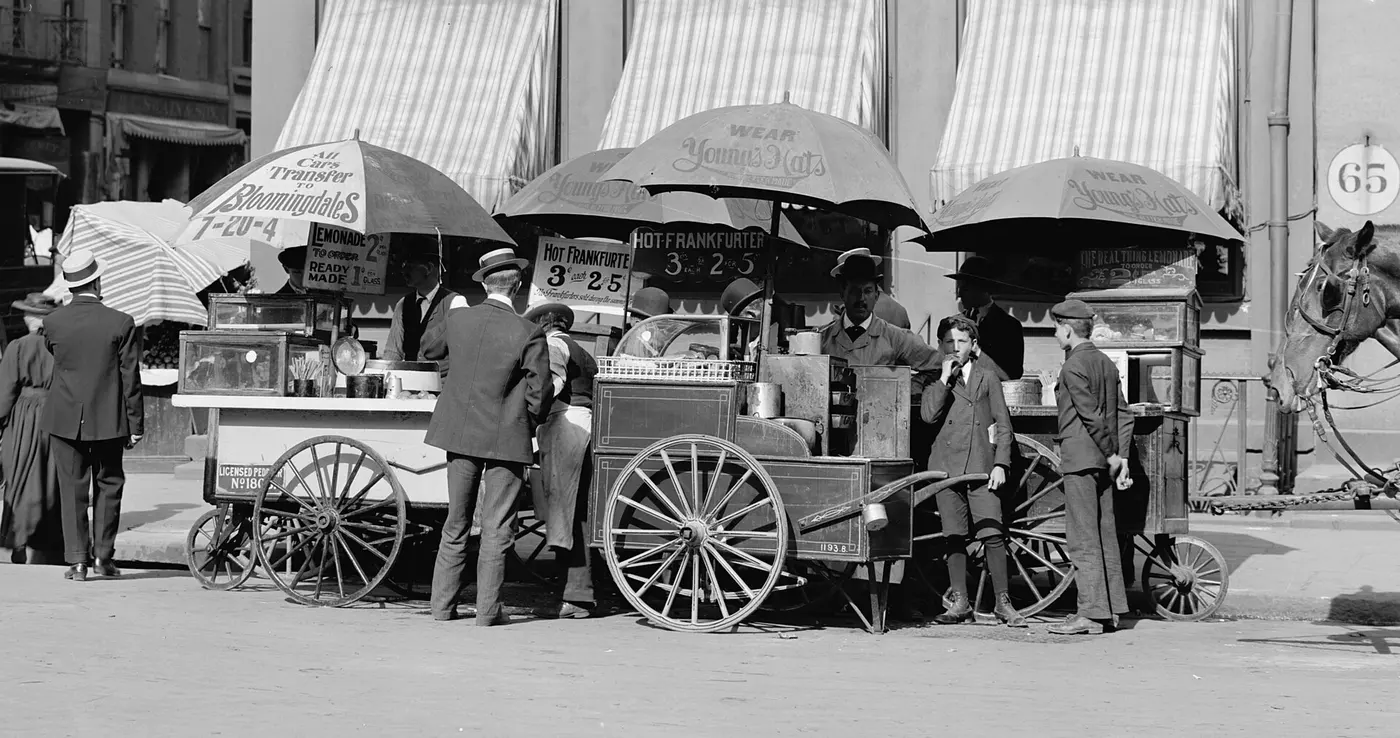
Why is a hot dog called a hot dog?
The name grew out of a 19th-century joke that sausages contained dog meat. The story that a cartoonist coined it is a myth.
1884
A split bun, a hot sausage, a stripe of mustard. The hot dog is a fixture of American ballparks and street corners.
Taken literally, though, it is an odd name for something to eat. A popular story credits a newspaper cartoonist with coining it. Researchers who have traced the history of the word, however, say that story is pure invention.
The cartoonist at the ballpark
The legend goes like this. On a chilly April day in 1901, at the Polo Grounds baseball park in New York, the concessionaire Harry M. Stevens found that nobody wanted ice cream, so he sold hot sausages in rolls instead. His vendors cried, “Get your red hot dachshund sausages!” Up in the stands, the cartoonist Tad Dorgan drew a dachshund lying in a bun, but since he could not spell “dachshund,” he wrote “hot dog.”
Dachshunds are long-bodied dogs from Germany, and as the names frankfurter and wiener suggest, the sausages came from the German-speaking world too. It all fits beautifully. But no one has ever seen the cartoon. According to the word researcher Barry Popik, the legend was originally set in 1906, and the date was moved back to 1901 only after earlier uses of “hot dog” turned up.
The missing cartoon
The legend was taken apart by Gerald Cohen, an etymologist at the University of Missouri–Rolla, together with the independent researchers Popik and David Shulman. In 2004 they published a 300-page study, Origin of the Term “Hot Dog”.
Cohen found that Dorgan did not arrive in New York until 1903, so he could not have been at the Polo Grounds in 1901. Cohen even offered a cash reward to anyone who could produce the famous cartoon. Nobody did. The lexicographer Leonard Zwilling found that Dorgan’s earliest known use of “hot dog” came in December 1906, and not at a ballpark but at a six-day bicycle race in Madison Square Garden.
Stevens himself told a newspaper in 1926 that it was his son Frank who had pushed to sell hot dogs, to the crowds at the bicycle races. The story naming Dorgan as the coiner appeared in print only shortly before his death in 1929. Even the National Hot Dog and Sausage Council, the industry group, acknowledges on its website that the cartoon has never been found.
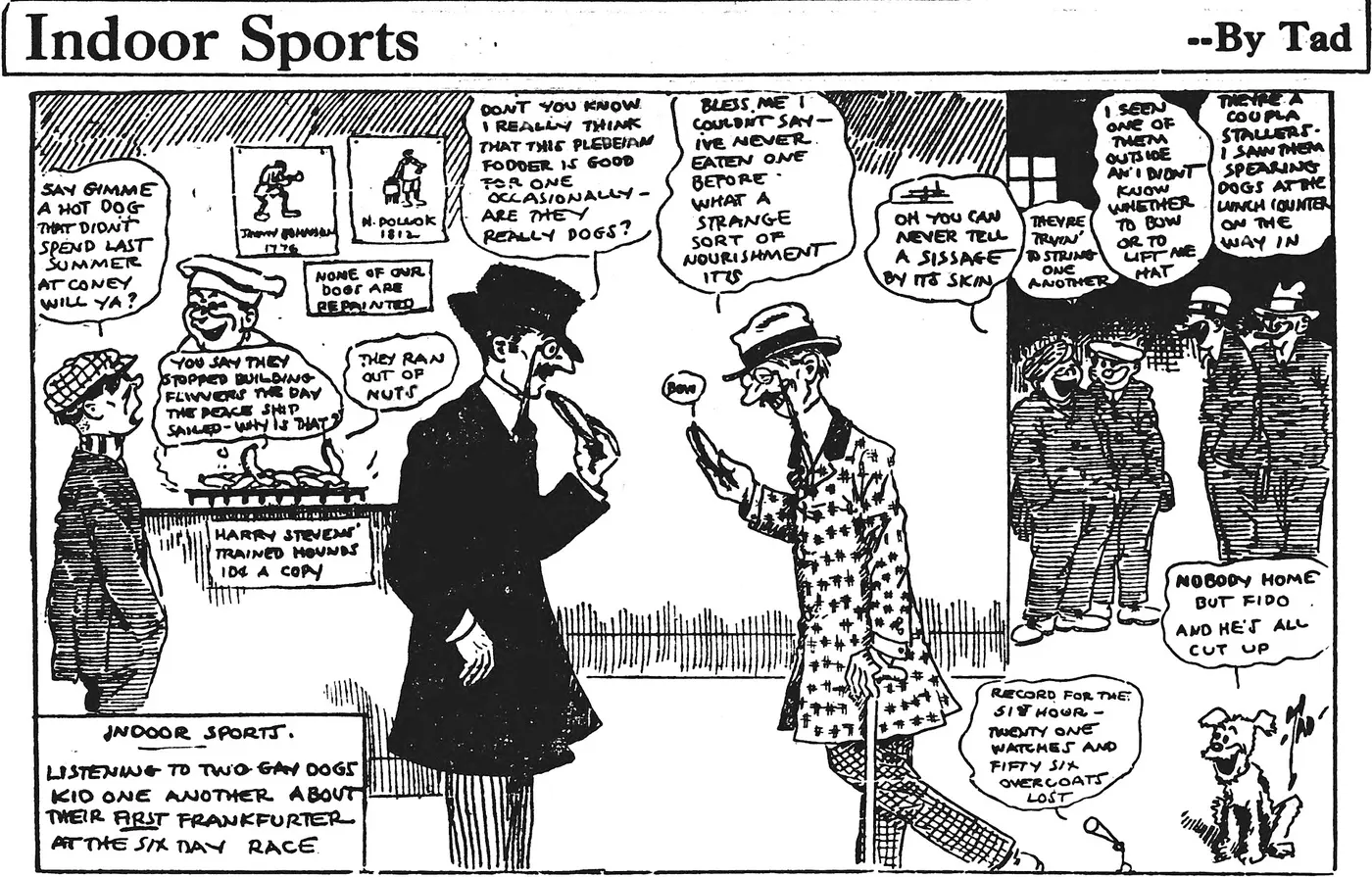

Where the dog came from
So why “dog”? The answer lies in a much older and nastier joke. In 19th-century America, many people suspected that sausage makers used dog meat. Among the old newspaper clippings Popik has collected is an 1838 item reporting that sausages in New York had “fallen in price one half” since “the dog killers have commenced operations.” Cohen has said that the suspicion had a basis in fact.
Over time, “dog” became slang for a sausage. In 1884 an Indiana newspaper ran a letter from Minneapolis warning that “even the innocent ‘wienerworst’ man will be barred from dispensing hot dog on the street corner.” In 1892 a New Jersey paper described a boy demanding, “Hey, Mister, give me a hot dog quick,” whereupon the sausage “was quickly inserted in a gash in a roll.”
College students spread the word fastest. In the fall of 1894, lunch wagons selling sausages to hungry students late at night appeared near Yale University, and the students called them “dog wagons.” According to an 1899 newspaper report, the pioneer of the trade, known as Billy the Dog Man, painted “Yale Kennel Club” on his wagons and decorated them with pictures of dogs, mostly hounds and dachshunds. In October 1895 the student magazine the Yale Record described people who “contentedly munched hot dogs during the whole service.” Humor magazines at Harvard, Cornell and other colleges soon took up the term. In 1897 a Kansas City newspaper, answering a reader’s question, explained that a hot dog was “a sliced bun and wienerwurst” and that the name went back to “the current facetiousness of university towns.”