Did Nero really fiddle while Rome burned?
There is no solid evidence. Tacitus says Nero was out of town, hurried back to organize relief, and calls the story of his singing a rumor, and the fiddle had not even been invented.
4of 14
To “fiddle while Rome burns” is to waste time on trifles while a crisis rages. The phrase goes back to the picture of the Roman emperor Nero strumming away as his capital burned around him.
For a ruler whose name has become shorthand for tyranny, it seems entirely in character. But read the ancient historians side by side, and the scene starts to look a good deal shakier.
Rome in flames, July AD 64
The fullest account of the Great Fire of Rome comes from the historian Tacitus, writing in the early second century in his Annals. The fire broke out on July 19, AD 64, in shops full of flammable goods along the side of the Circus Maximus facing the Palatine and Caelian hills.
Driven by the wind, it raced the length of the Circus and spread through a city of narrow, twisting lanes. On the sixth day it was finally stopped at the foot of the Esquiline Hill by demolishing buildings over a wide area, only for it to flare up again. Of Rome’s 14 districts, Tacitus says, just four escaped. Three were razed to the ground, and in the other seven only a few scorched ruins of houses remained.
Tacitus opens his account by admitting that no one knew whether the disaster was an accident or the emperor’s doing, since both versions had their supporters.
Nero according to Tacitus
So where was Nero? According to Tacitus, he was at Antium (modern Anzio), a seaside town about 50 km (30 miles) south of Rome, and did not return until the flames were nearing his own palace.
Once back, he threw open the Campus Martius, public buildings and even his own gardens to the homeless, and had temporary shelters put up. He had food brought in from Ostia and other nearby towns, and cut the price of grain.
None of it won the people over, because a rumor had spread that at the very moment Rome was burning, Nero had mounted his private stage and sung of the fall of Troy, likening the present disaster to the calamities of the past. Tacitus presents this clearly as a rumor.
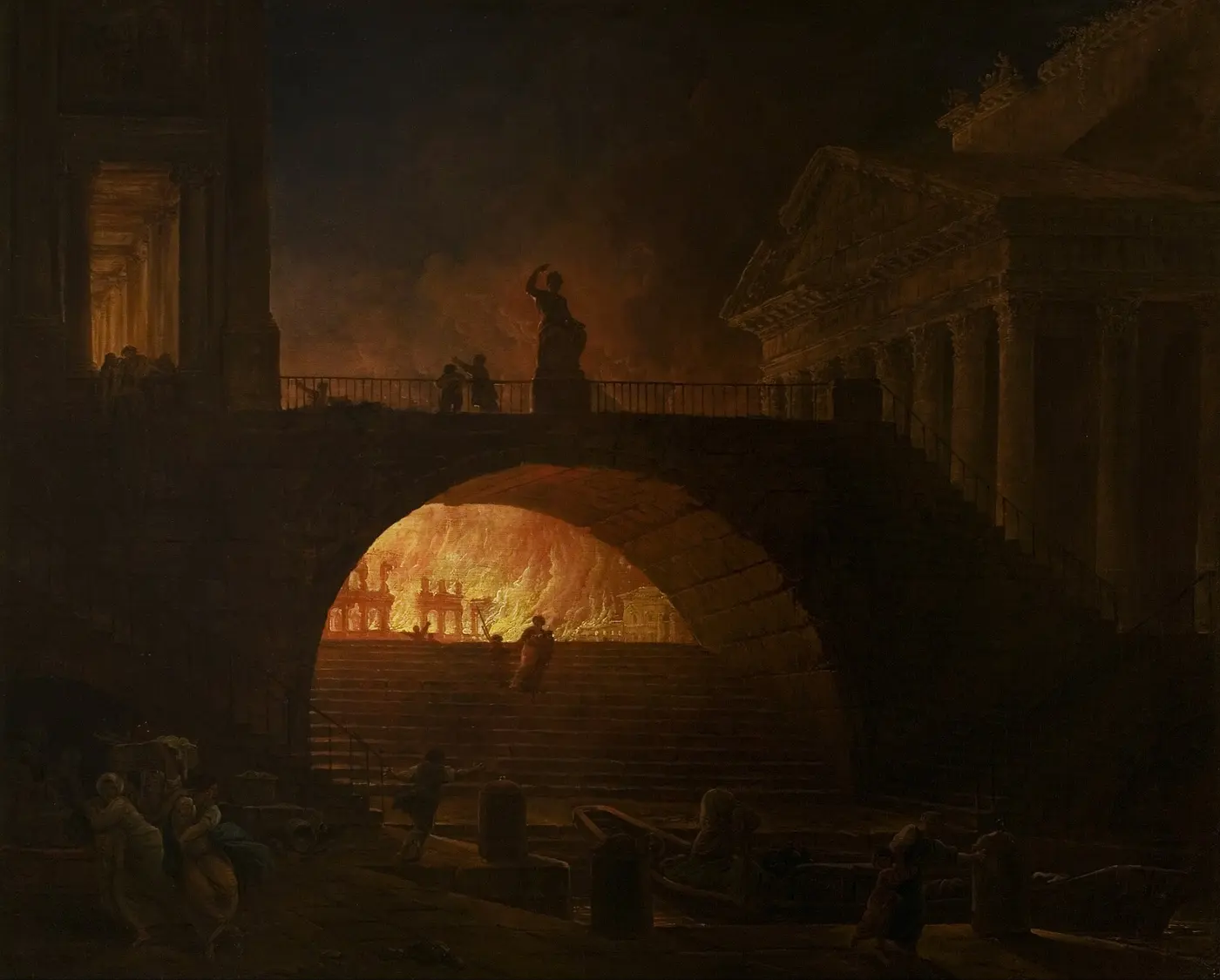

Nero rebuilt the city with wider streets, lower buildings and fire-resistant stone. But he also built himself a sprawling new palace with parkland on the ruins, and suspicion lingered that he had wanted the fire so he could found a new city bearing his name. To stamp out the rumors, Tacitus writes, Nero blamed the Christians and had them cruelly put to death.
The story grows
Writing at about the same time, the biographer Suetonius went much further in his Lives of the Caesars. Nero himself started the fire, he claims, and watched it from the tower of Maecenas, “exulting in the beauty of the flames,” while singing the whole of “The Sack of Ilium” in his stage costume.
In the early third century, the historian Cassius Dio wrote that Nero climbed onto the palace roof, dressed in the garb of a lyre player, and sang “The Capture of Troy.” In a 1947 article in The Classical Journal tracing how the story developed, the scholar Mary Francis Gyles noted that no source clearly hints at a musical instrument until Dio, a century and a half after the fire, and even he stresses the singing.
Nero’s love of music, though, is well documented. Suetonius says that as soon as he became emperor, he summoned Terpnus, the greatest lyre player of the day, and began practicing. His voice was weak and husky, but he went on to perform on stage and enter contests. He kept statues of himself as a lyre player in his bedchambers and even had a coin struck with the same image. His instrument was the kithara, a large, heavy lyre.
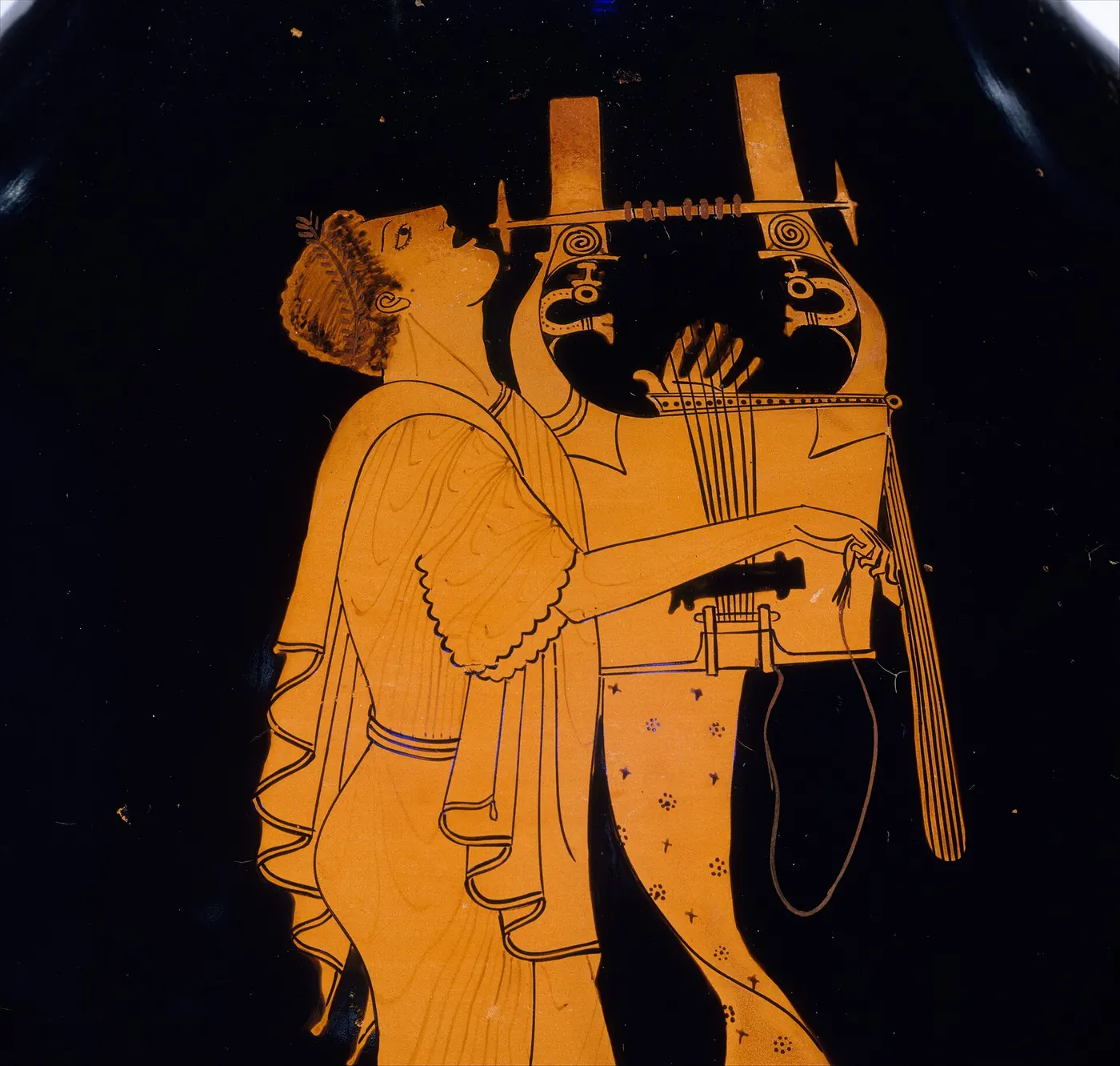

How the lyre became a fiddle
A fiddle is a stringed instrument played with a bow, and today the word usually means a violin. According to Gyles, the bow came into use in Europe only in the ninth or tenth century, and the violin arrived centuries after that. There were no fiddles in Nero’s Rome.
As Gyles traced it, the writer who first plainly put an instrument in Nero’s hands as he watched a city burn was Shakespeare, in the late 16th century. In Henry VI, Part 1, the English commander Talbot vows, “like thee, Nero, / Play on the lute, beholding the towns burn.” An anonymous play of 1624, The Tragedy of Nero, calls the emperor a “fiddler,” and in 1649 the poet George Daniel wrote, “Let Nero fiddle out Rome’s obsequies.” Since “fiddle” had also come to mean wasting time on trivial things, the phrase stuck.